

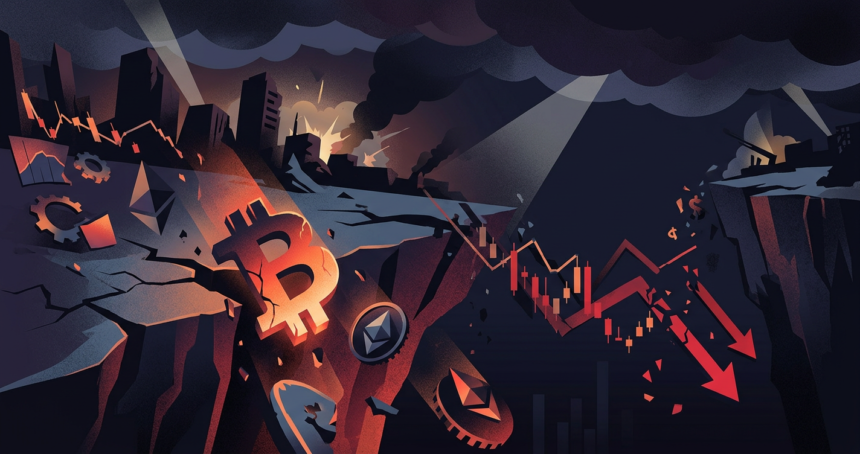
The thin veneer of a market recovery evaporated Friday morning as escalating conflict in the Middle East sent investors scurrying for the exits. Bitcoin, which had been flirting with a return to the $70,000 mark just 24 hours ago, tumbled sharply as the reality of a “risk-off” environment took hold. It wasn’t just digital assets feeling the heat; the S&P 500 and Nasdaq opened deep in the red as the specter of regional war outweighed the cooling inflation data that had briefly buoyed sentiment earlier in the week.
For weeks, the crypto market has been caught in a tug-of-war between institutional adoption and macroeconomic instability. That rope just snapped. Bitcoin dropped 4.2% in early trading, sliding to $65,800, while Ethereum saw even steeper losses, falling nearly 6% to trade around $3,350. The sell-off mirrors a broader retreat from speculative assets as traders move capital into traditional safe havens like gold and the U.S. dollar.
The vanishing ‘digital gold’ narrative
In theory, Bitcoin was designed for moments like this—a decentralized hedge against geopolitical chaos. But the price action tells a different story. When the missiles start flying and supply chains are threatened, the “digital gold” narrative often gives way to the “high-beta tech stock” reality. Most large-scale traders still view Bitcoin as a liquidity play; when risk rises, they sell first and ask questions later.
This latest dip follows a period where Bitcoin dropped below $70,000 amid rising oil prices and a hawkish stance from the Federal Reserve. The flare-up in the Middle East has now added a layer of structural glass to the floor. While gold surged to its highest level since late 2025, Bitcoin retreated. The correlation between crypto and the Nasdaq remains stubbornly high, proving that institutional wallets still treat Satoshi’s creation as a risk asset above all else.
Oil prices and the Fed’s next move
The primary driver behind the stock market rout is the sudden spike in crude oil. Brent crude jumped past $92 a barrel this morning, sparking fears that the “last mile” of the inflation fight will be much harder than predicted. For crypto investors, this is the worst-case scenario. Higher energy costs mean stickier inflation, which in turn means the Fed is likely to keep interest rates “higher for longer.”
We saw this play out on Wednesday when gold, silver, and Bitcoin dropped after the Fed held rates steady and signaled caution. The market was hoping for a pivot; what it got was a reminder that the central bank isn’t ready to declare victory. Now, with war threatening to choke global energy supplies, the odds of a rate cut in the first half of 2026 have effectively vanished.
The pain is particularly acute for the mining sector. As energy costs rise and the price of BTC falls, mining margins are being squeezed from both sides. We are already seeing a shift in the industry as crypto stocks underperform while miners pivot to AI services to keep the lights on. This transition is no longer a strategic choice for many—it’s a survival mechanism.
Liquidity crunches and options expiry
Adding fuel to the fire is the massive $2.1 billion options expiry scheduled for later today. Historically, these events create localized volatility, but the timing couldn’t be worse. With Bitcoin and Ethereum options expiring in the middle of a geopolitical crisis, the “max pain” point of $70,000 now feels like a distant memory.
Traders who were positioned for a breakout are now scrambling to cover their margins. The liquidation of long positions over the last 12 hours has topped $280 million, according to exchange data. In a thin-liquidity environment, these liquidations cascade, creating the sharp “v-bottoms” or “cliff-drops” we’ve seen throughout the morning session.
But it’s not all doom and gloom for companies with conviction. While the paper-handed public scales back, some firms are doubling down. Singapore-based Ryde recently moved corporate reserves into Bitcoin, joining a growing list of companies that view these pullbacks as an entry point rather than a signal to exit. Whether that pays off in a wartime economy remains to be seen.
Looking ahead: Can the $62,000 support hold?
The technical picture has soured significantly. Bitcoin is now trading below its 50-day moving average, a level that has historically acted as a springboard for further gains. If the $65,000 support level fails to hold through the weekend, analysts are eyeing $62,000 as the next major psychological floor.
The broader market is now in a “wait and see” mode. If the conflict remains contained, we could see a relief rally as the initial shock wears off. But if tensions escalate further, the flight to quality will likely continue, leaving crypto—and tech stocks—in the lurch. For now, the “risk-on” party that defined the start of 2026 has been unceremoniously crashed by reality.
Market Impact FAQ
Why is Bitcoin dropping if it’s supposed to be a hedge against war?
While the high-level theory says Bitcoin is a safe haven, the reality is that most institutional money treats it like a liquidity proxy. When there is a “risk-off” event—like a war or a Fed surprise—investors dump their most volatile assets first to raise cash or cover losses elsewhere. Bitcoin is still at the top of that list.
Is the stock market crash directly linked to Bitcoin’s fall?
Yes, but mostly through the lens of interest rates and inflation. War drives up oil prices, which drives up inflation. If inflation stays high, the Federal Reserve won’t cut interest rates. High interest rates are bad for both stocks and crypto because they make “safe” investments like bonds more attractive than “risky” ones like Bitcoin.
Should I expect more volatility this weekend?
Almost certainly. Crypto markets never close, which means they often act as the “canary in the coal mine” for geopolitical shifts while the NY Stock Exchange is shut. With technical supports breaking and a large options expiry today, the next 48 to 72 hours will likely be quite choppy.