

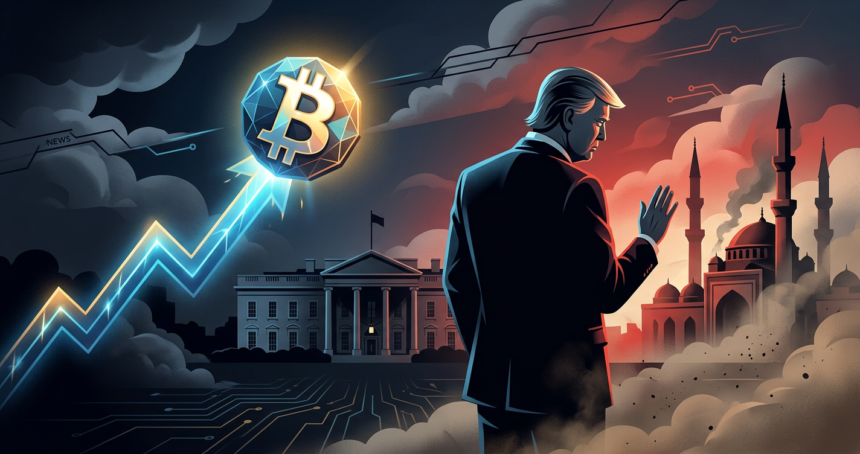
Bitcoin surged late Tuesday as geopolitical tensions in the Middle East took an unexpected turn, providing a momentary reprieve for risk assets. The digital currency, which has increasingly acted as a sensitive barometer for global instability, caught a sharp bid following reports that the Trump administration opted to delay a retaliatory strike against Iranian targets.
The decision to hold fire, at least for the current window, sparked a relief rally across both traditional and digital markets. For crypto traders, the move underscores a growing trend in 2026: Bitcoin is no longer just a “digital gold” hedge against inflation; it is becoming a primary vehicle for speculating on the immediate de-escalation of international conflict. When the headlines broke that the planned military response was being pushed back to allow for further diplomatic backroom channel communication, Bitcoin prices spiked within minutes, wiping out short positions that had built up over a tense weekend.
Markets Breathe as Retaliation Hits a Pause
The White House’s tactical pause appears to be driven by a mix of diplomatic pressure from regional allies and a desire to stabilize energy prices. While the situation remains fluid, the immediate threat of a wider kinetic conflict in the Persian Gulf has receded slightly. Investors who had spent the last 48 hours de-risking and moving into cash suddenly found themselves chasing the move back into “risk-on” assets.
But the reaction in the crypto space was notably more aggressive than in the S&P 500 or Nasdaq. This volatility is a double-edged sword. On one hand, it proves Bitcoin’s liquidity and its role as a 24/7 global sentiment gauge. On the other, it highlights how susceptible the market remains to single-event headlines. While Bitcoin slides as inflation data cools institutional fervor at various points this year, today’s move was purely about the geopolitics of the moment.
Institutional Positioning Amid the Volatility
The current rally isn’t just retail frenzy. Desk data suggests that institutional players are increasingly using Bitcoin to hedge against the total breakdown of traditional fiat corridors in conflict zones. However, the mood in New York and London remains cautious. Wall Street shifts its outlook frequently these days, and many analysts are warning that a “strike delay” is not a “strike cancellation.”
Heavyweight fund managers seem to be pivoting their strategy. Rather than holding Bitcoin as a static store of value, they are treating it as a high-velocity trade. “The market is effectively trading the news cycle in real-time,” noted one senior trader at a London-based digital asset firm. “When the drones stay on the ground, the bulls come out to play. But everyone has their finger on the sell button if the rhetoric from the Pentagon shifts tomorrow.”
The Divergence from Other Assets
Interestingly, Bitcoin’s jump today occurred even as Ethereum and other large-cap altcoins saw more modest gains. While Ethereum enters a rare accumulation phase, Bitcoin continues to command the lion’s share of the “safety” trade within the crypto ecosystem. This suggests that in times of war or rumors of war, the market still views the original cryptocurrency as the only truly battle-tested asset in the space.
And while the focus remains on the Middle East, the broader regulatory environment is still casting a shadow. The recent SEC sweep against sixteen tokens has made investors wary of smaller projects, further consolidating capital into Bitcoin during periods of high stress. For many, a “delayed strike” is the only green light they needed to re-enter positions they liquidated on Friday.
What Happens if Diplomacy Fails?
The outlook for the rest of the week depends entirely on the rhetoric coming out of Washington and Tehran. A delay buys time, but it doesn’t resolve the underlying friction points. If the administration decides that the diplomatic window has closed, the current Bitcoin gains could evaporate just as quickly as they appeared.
Furthermore, traders are keeping an eye on how these geopolitical shifts interact with domestic policy. Under the current administration, the “America First” energy policy often clashes with the volatility of the oil markets, and Bitcoin frequently finds itself caught in the middle. For now, the bulls are in control, but it is a fragile dominance built on the absence of bad news rather than the presence of a lasting peace.
Geopolitical Crypto FAQ
Why does Bitcoin react to Middle East news?
Bitcoin operates on a 24/7 global market, making it the first asset to react when news breaks outside of standard stock exchange hours. It is often seen as a “liquidity of last resort” and a hedge against the instability of traditional banking systems during times of war.
Is the current price jump sustainable?
Most analysts view this as a news-driven rally. While it shows the market’s underlying strength, these gains are often “event-driven” and can be reversed if the geopolitical situation worsens or if the strike delay is cut short.
Does this affect other cryptocurrencies like Ethereum?
Generally, Bitcoin leads the market during geopolitical crises. While Ethereum and others often follow, Bitcoin usually sees the most significant “safe haven” inflows because of its higher liquidity and established reputation among institutional desks.