

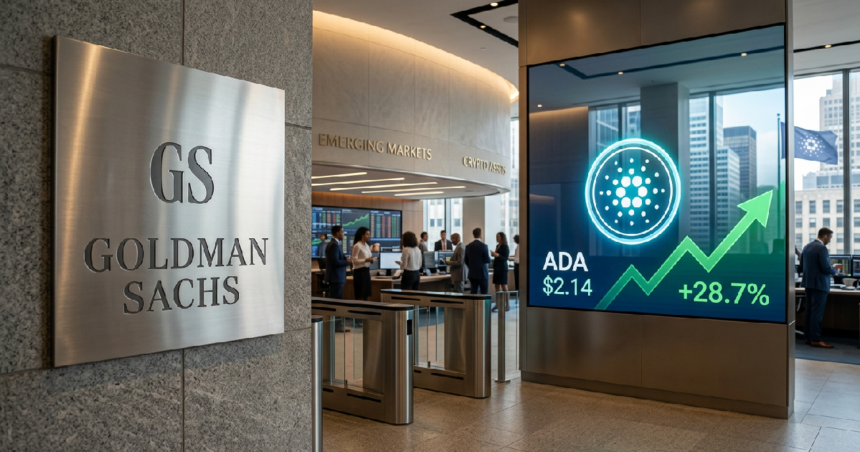
Goldman Sachs analysts have signaled that the prolonged slump in digital asset valuations may have finally reached its floor. In a research note circulated to clients this week, the investment bank pointed to stabilizing liquidity conditions and a shift in institutional sentiment as evidence that the worst of the recent market purge is behind us.
The timing of the report coincides with a notable divergence in the altcoin market. While flagship assets like Bitcoin and Ether have traded within tight ranges, Cardano has emerged as a frontrunner in the recovery. Its native token, ADA, has outpaced several of its large-cap peers over the last 48 hours, buoyed by a sudden uptick in decentralized finance (DeFi) activity on its network.
Goldman Sachs identifies a shift in market structure
The bank’s research desk isn’t just looking at price charts. They’re observing a fundamental change in how capital is moving through the crypto ecosystem. According to the note, the aggressive selling seen earlier this quarter has exhausted itself. The “forced liquidations” that characterized the start of the year appear to have subsided, leaving the market in what analysts call a “bottoming phase.”
This doesn’t mean we’re heading for immediate record highs. But it does suggest that the floor has been established. Goldman’s analysts noted that institutional interest is no longer purely speculative. Instead, they are seeing a more calculated entry from wealth managers who are looking at the 2026 outlook through a lens of long-term utility rather than short-term gains.
This sentiment is echoed across Wall Street, though the optimism remains guarded. Several major firms have recently shifted their outlook on crypto-linked stocks, moving away from high-beta plays toward companies with more sustainable infrastructure models.
Cardano finds its stride amid the rebound
While the broader market waits for a catalyst, Cardano has found its own. The network has seen a surge in total value locked (TVL) as new governance modules and scaling solutions finally go live. For a project that has often been criticized for its slow pace of development, the current traction feels like a validation of its “measure twice, cut once” philosophy.
On-chain data suggests that this isn’t just retail hype. Large-scale holders, or “whales,” have been accumulating ADA at these lower levels, providing the support needed for its recent breakout. The move highlights a broader trend: as the utility window for digital assets narrows, investors are gravitating toward networks that can prove they have an active, functioning ecosystem.
The rise in ADA also comes at a time when other layer-1 competitors are struggling with technical hurdles or regulatory scrutiny. For the moment, Cardano’s focus on academic rigor and peer-reviewed updates is paying off in the form of investor confidence.
What the “bottom” looks like for the rest of 2026
If Goldman Sachs is right about the bottom being in, the question shifts to what the recovery looks like. It is unlikely to be a “V-shaped” bounce. Instead, we are likely looking at a “grind higher,” where projects are judged more on their technical merits and revenue generation than on social media buzz.
The upcoming months will be a test of resilience. We’ve seen Bitcoin’s narrow range signal impending volatility, and that volatility often dictates the direction for the rest of the market. If Cardano can maintain its momentum while Bitcoin stabilizes, it could decouple from the general market trend—a feat few altcoins have managed for long.
But the road remains bumpy. Regulatory hurdles in the US and Europe haven’t disappeared, and the macroeconomic backdrop remains a wildcard. For now, the Goldman Sachs call provides a much-needed psychological boost for a market that has spent months in the doldrums.
Frequently Asked Questions
Is now the right time to buy Cardano?
While ADA has shown strong performance recently, the crypto market remains inherently volatile. Analysts suggest looking at Cardano’s long-term development milestones and TVL growth rather than trying to time the daily fluctuations. Always consider your risk tolerance before entering a position.
Why is Goldman Sachs’ opinion so important?
Major investment banks like Goldman Sachs act as bellwethers for institutional sentiment. When they signal a market bottom, it often gives larger hedge funds and institutional investors the “green light” to begin allocating capital again, which can lead to increased liquidity and price stability.
Could the market still drop further?
Yes. A “bottom” is a projection based on current data, not a guarantee. If a major geopolitical event occurs or if there is a sudden shift in global interest rates, the crypto market could retest its lows. Goldman’s analysis is based on the exhaustion of current selling pressure, but new pressures can always emerge.