

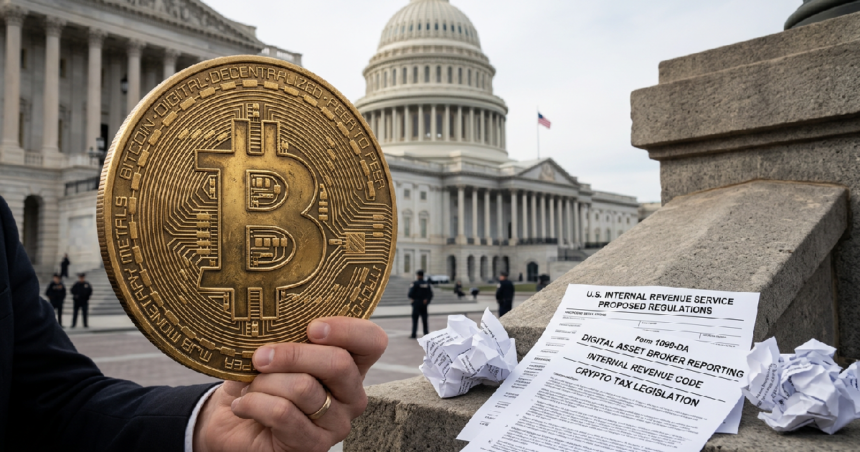
A new bipartisan legislative push to overhaul how digital assets are taxed in the United States has met with immediate and fierce pushback from the cryptocurrency community. While lawmakers frame the proposal as a necessary step toward closing the “tax gap,” critics argue the bill’s requirements for reporting and capital gains calculations are functionally impossible for decentralized protocols to satisfy.
The tension centers on several provisions that would broaden the definition of a “broker” and introduce more stringent reporting requirements for every on-chain transaction. For Bitcoiners, who often prioritize the self-sovereignty of peer-to-peer transfers, these rules represented a fundamental misunderstanding of how the technology works at a basal level.
The Technical Friction of Compliance
The core of the dispute lies in the administrative burden the bill places on individual users and small-scale miners. Under the current draft, certain decentralized finance (DeFi) participants could be classified as brokers, requiring them to collect personal identification information from users they never actually interact with directly.
Industry advocates have spent the morning pointing out that a smart contract cannot perform “Know Your Customer” (KYC) checks on the fly. This puts developers and validators in a legal vacuum where they are mandated to collect data they cannot access. For many in the Bitcoin space, this feels less like a tax initiative and more like a back-door attempt to stifle privacy-preserving technologies.
But the government’s motivation remains unchanged: revenue. Treasury estimates have long suggested that billions of dollars in taxable gains go unreported in the crypto sector. Lawmakers behind the bill argue that by standardizing reporting, they are actually legitimizing the industry and making it easier for large-scale institutional players to operate within clear boundaries.
Impact on Small Holdings and Daily Use
Beyond the technical hurdles for developers, the bill would potentially end the dream of Bitcoin as a ubiquitous medium of exchange. By failing to include a “de minimis” exemption—which would allow small purchases like a cup of coffee to go untaxed—every single coffee purchase or lightning network payment would trigger a taxable event.
This lack of a threshold is a major sticking point. Without it, the record-keeping requirements for an average user would become a logistical nightmare. And while some institutional-focused analysts suggest this is a necessary growing pain, the grassroots response has been one of betrayal. They argue that the US is riskily pushing innovation offshore to jurisdictions with clearer, more lenient tax frameworks.
This legislative friction comes at a delicate time. As noted in recent analysis, the crypto market window is closing as the focus shifts toward utility. Some argue that overly aggressive tax codes will ensure that “utility” happens everywhere except on American soil.
The Institutional Divide
Interestingly, the reaction isn’t entirely uniform. Large centralized exchanges and institutional custodians have been quieter in their criticism. For firms like Morgan Stanley, which has expanded Bitcoin access for its clients, standardized tax reporting is often viewed as a hurdle they are already equipped to jump.
The real casualties, according to the Electronic Frontier Foundation and various Bitcoin advocacy groups, are the individual “HODLers” and the developers building the next layer of the network. There is a sense that the bill treats Bitcoin like a traditional stock or bond, ignoring its unique properties as a programmable bearer asset.
And as the White House continues to monitor external pressures—everything from geopolitical conflict impact to domestic inflation—the appetite for strict financial surveillance appears to be at an all-time high.
What Happens Next?
The bill is currently in the committee stage, where industry lobbyists are expected to fight for significant amendments. Specifically, the push for a “de minimis” exemption and a more narrow definition of “broker” will be the primary battlegrounds. If those changes aren’t made, the community has hinted at a lengthy court battle, potentially challenging the constitutionality of forcing developers to collect user data they don’t own.
For now, the message from the Bitcoin community is clear: you can tax the gains, but you shouldn’t break the technology to do it.
Common Questions Regarding the Crypto Tax Bill
Will this bill tax my long-term holdings?
The bill doesn’t change the underlying capital gains tax rates, but it does change how those gains are reported to the IRS. It aims to make it harder to hide transactions and easier for the government to track your cost basis across different wallets and exchanges.
Does this affect people who only use Bitcoin for payments?
Yes, and that is a major point of contention. Without a minimum threshold for tax-free transactions, spending even a few dollars worth of Bitcoin would require you to calculate the difference between the price you bought it at and the price at the time of the purchase, which is a massive headache for most users.
What is a ‘De Minimis’ exemption and why does it matter?
It’s a rule that would allow small transactions (usually under $200 or $600) to be exempt from capital gains taxes. Without it, Bitcoin is far less practical for daily retail use because every transaction creates a complicated tax filing requirement.