

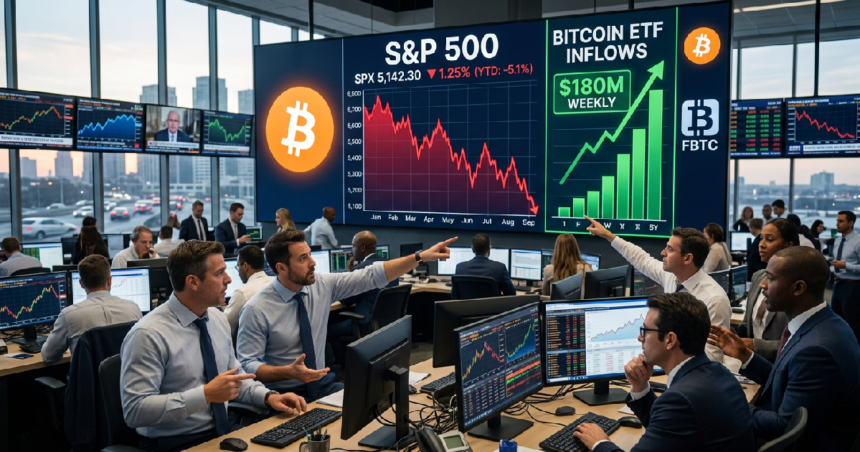
The widening divergence between traditional equities and digital assets reached a new milestone this week as Bitcoin ETFs pulled in $180 million in fresh capital, even as the S&P 500 continues a punishing downtrend. With the benchmark stock index now down 5.1% year to date, the decoupling of Bitcoin from the broader market suggests a fundamental shift in how institutional investors are hedging against macroeconomic instability.
Institutional Appetite Remains Resilient Amid Market Turmoil
While the S&P 500 limps through a difficult 2026, the demand for spot Bitcoin ETFs has not followed the downward trajectory of traditional risk assets. Those $180 million in weekly inflows represent a distinct vote of confidence from the wealth management sector. It isn’t just retail “HODLers” buying the dip anymore; it’s a systematic reallocation of capital into what many are beginning to view as a digital safety valve.
The sell-off in the S&P 500 has been driven by a combination of persistent inflation concerns and a cooling labor market, which has traditionally dragged Bitcoin down alongside it. But the current trend breaks that pattern. Investors appear to be rotating out of tech-heavy equity portfolios—which are suffering the most under the 5.1% year-to-date drop—and into the perceived scarcity of Bitcoin. This behavior is reminiscent of the “flight to quality” usually reserved for gold, though with the high-octane volatility that remains Bitcoin’s hallmark.
The ETF Effect and Wealth Management Shifts
The mechanics of these inflows are changing the market’s plumbing. We’ve recently seen Morgan Stanley expand Bitcoin access for wealth clients, a move that opened the floodgates for a demographic that previously sat on the sidelines. When a major wirehouse provides a green light, it creates a steady stream of passive buying pressure that can offset the liquidations seen in the broader equities market.
So, why is the S&P 500 struggling while the Bitcoin ETF ticker keeps ticking up? Part of the answer lies in expectations of a policy pivot. If the economy continues to stutter, the Federal Reserve might be forced to ease up on interest rates. While that’s usually good for stocks, the 5.1% YTD drop shows that equity investors are currently more worried about a recession than they are excited about lower rates. Bitcoin, conversely, thrives on the prospect of a debased dollar.
A Squeeze on the Horizon
Technically, the market is coiled tight. While the inflows are healthy, the price action has remained within a consolidated range for much of the quarter. This often precedes a breakout. Some traders are looking at the current Bitcoin technical pattern and predicting a volatility spike. If the S&P 500 fails to find a floor soon, we may see even more aggressive rotation into digital assets as the “uncorrelated asset” narrative finally gains real-world evidence.
But it’s not all clear skies. There is a flip side to this institutionalization. As Bitcoin becomes a fixture in 401(k)s and institutional balance sheets, it becomes more sensitive to global liquidity shocks. If the S&P 500’s 5.1% slump turns into a full-scale rout, the need for cash might force even the most bullish ETF holders to liquidate their winners to cover margin calls elsewhere.
What to Watch for in the Second Quarter
The remainder of the spring will be a litmus test for the “digital gold” thesis. If Bitcoin can hold its ground while the S&P 500 remains in the red, the decoupling will be seen as a permanent shift in the financial landscape. However, if the ETF inflows dry up—or if we see a sudden reversal—the narrative of Bitcoin as a safe haven will face its harshest critique yet.
For now, the numbers speak for themselves: $180 million a week is no rounding error. It is a sustained commitment of capital in an environment where almost every other asset class is screaming for the exits.
Frequently Asked Questions
Why is Bitcoin rising while the S&P 500 falls?
Investors are increasingly using Bitcoin as a hedge against traditional market volatility. While the S&P 500 is suffering from specific economic headwinds like slowing corporate earnings, Bitcoin is benefiting from its narrative as a decentralized alternative to the traditional financial system.
Is the $180M in ETF inflows coming from retail or professional investors?
Data indicates that a significant portion of this capital is coming from institutional wealth managers and registered investment advisors (RIAs). This marks a shift from the retail-heavy buying patterns of previous years, suggesting more “sticky” capital is entering the market.
Could a stock market crash pull Bitcoin down too?
It’s possible. In extreme “black swan” events, investors often sell everything to raise cash. While Bitcoin is showing independence right now, a major liquidity crisis in the S&P 500 could still trigger a temporary sell-off in the crypto markets as investors seek to cover losses in their stock portfolios.