

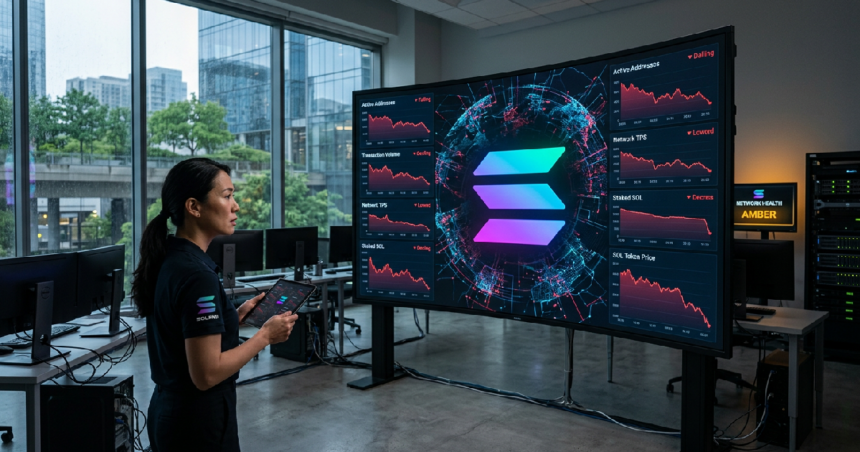
The high-speed narrative that has propelled Solana throughout early 2026 is hitting a patch of turbulence. While price action remains the primary focus for retail traders, a quiet accumulation of on-chain data suggests the network is grappling with significant growing pains that could dictate its trajectory for the remainder of the quarter.
For months, Solana has been the darling of the decentralized finance (DeFi) world, largely due to its low fees and rapid execution. But the very popularity that fueled its rise is now testing the structural integrity of the ecosystem. Recent reports from on-chain monitoring tools indicate that network congestion and a decline in specific engagement metrics are starting to weigh on investor sentiment, even as the broader market remains cautiously optimistic.
Congestion Issues Cloud Network Performance
Solana’s architecture was designed to handle tens of thousands of transactions per second, yet real-world stress tests are proving more complicated. The surge in automated trading bots and high-frequency meme coin launches has led to a noticeable spike in failed transactions. For the average user, this translates to a frustrating experience where “finality” is anything but certain.
Developers are working on patches to the networking stack, but the friction is visible. When transactions fail at a high rate, it doesn’t just annoy users; it creates a “ghost” volume that inflates activity levels without contributing to actual economic value. This discrepancy is what has analysts looking twice at the current SOL price floor. If the volume isn’t translating into successful, value-additive transfers, the premium at which SOL trades might be harder to justify.
Divergence Between Value and Activity
There is a growing gap between the Total Value Locked (TVL) on the network and the number of unique active addresses. While the dollar value of assets held in Solana-based protocols has remained relatively stable, the rate of new wallet creation has slowed compared to the frantic pace seen in late 2025. This suggests that the current price stability may be driven more by existing “whales” or institutional holders rather than a fresh wave of retail adoption.
Part of this shift is attributed to the narrowing window for crypto utility. As the market matures in 2026, investors are moving away from speculative “speed” narratives and toward platforms that can demonstrate consistent uptime and reliable dApp performance. Solana’s recurring battle with network stability puts it at a disadvantage compared to some Layer 2 solutions on Ethereum that have recently optimized their data availability costs.
Institutional Interests and Liquid Staking
It isn’t all grim for the “Ethereum killer.” One area where Solana continues to show strength is in the liquid staking sector. Derivatives like jitoSOL and mSOL have seen steady inflows, providing a layer of “sticky” capital that makes a sudden price collapse less likely. Large-scale holders are clearly comfortable locking up their assets to earn yield, indicating long-term confidence in the token’s value, if not the network’s current performance.
However, the technical charts are showing a pattern that some traders call a “distribution phase.” This occurs when large holders slowly offload their positions to retail buyers while the price moves sideways. Without a significant technical breakthrough to resolve the congestion issues, SOL may find it difficult to break through its current resistance levels.
The Road Ahead for Solana
The coming months will be a defining period for the Solana Foundation and the developers at Anza. The upcoming implementation of “priority fees” was supposed to solve the congestion problem, but so far, it has only led to a bidding war that prices out the very retail users Solana was built for. But the project has a history of engineering its way out of corners. If the 1.18 layer update delivers the efficiency gains promised, the current on-chain challenges will be viewed as a mere footnote in its growth story.
For now, the market is in a wait-and-see mode. The price of SOL remains sensitive to any news regarding network outages or successful mainnet upgrades. Investors should keep a close eye on the transaction success rate—that metric, more than any individual price candle, will likely determine if Solana retains its spot as the premier high-performance blockchain.
Solana Network Frequently Asked Questions
Why are so many Solana transactions failing?
Most transaction failures are caused by network congestion and “bot” activity. These automated programs spam the network with repetitive requests to gain an advantage in decentralized exchanges, which can overwhelm the transaction processing logic during high-traffic periods.
Is SOL still a good investment despite these issues?
Investment value depends on your timeframe. While the network faces technical hurdles, Solana continues to have one of the most active developer communities and highest TVL in the industry. Many see these challenges as natural “scaling pains” for a growing platform.
How do these on-chain metrics affect the price of SOL?
On-chain metrics like transaction success rates and active wallet growth often serve as leading indicators. If activity slows or the network becomes unusable, demand for SOL (which is used to pay for gas fees) naturally decreases, which can eventually exert downward pressure on the market price.