

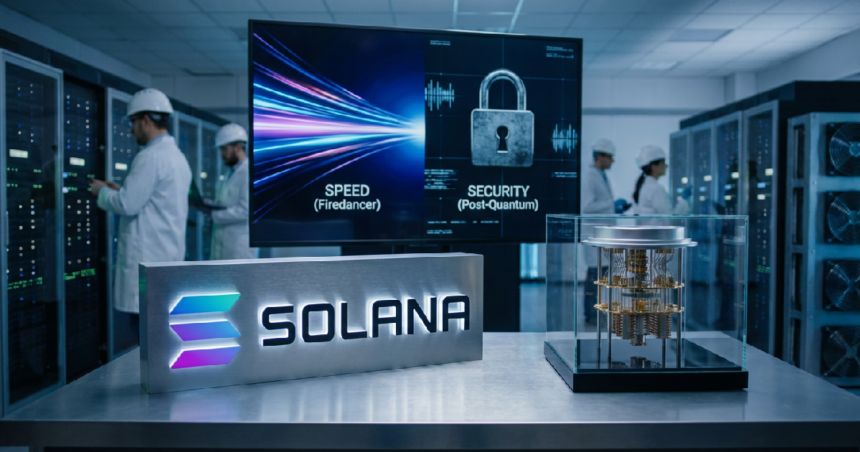
Solana has built its reputation on being the “Nasdaq of blockchains,” a title earned through its blistering transaction speeds and low latency. But a recent shift in the network’s development roadmap suggests that maintaining that crown might become significantly harder as the industry braces for the era of quantum computing.
The core of the issue lies in the cryptographic signatures that protect every wallet on the network. Like most contemporary blockchains, Solana relies on Elliptic Curve Cryptography (ECC). While virtually unhackable by today’s standards, these mathematical safeguards are vulnerable to “Shor’s algorithm,” a theoretical process that a sufficiently powerful quantum computer could use to derive a private key from a public address. For Solana, the transition to quantum-resistant signatures isn’t just a software patch; it’s a fundamental challenge to its scaling philosophy.
The Physics of the Solana Performance Tax
To withstand quantum attacks, developers must implement Post-Quantum Cryptography (PQC). However, PQC algorithms like Dilithium or Falcon come with a hefty technical cost: signature sizes. Currently, a standard Solana transaction is designed to be lean, fitting within a specific packet size to ensure it can travel across the globe at near-light speeds.
Quantum-resistant signatures can be anywhere from 10 to 40 times larger than the current Ed25519 signatures Solana uses. And here’s the rub: larger signatures mean fewer transactions can fit into a single block. If the data load for a single transfer increases tenfold, the network’s advertised throughput of 50,000+ transactions per second (TPS) could face a dramatic, forced reduction.
Engineers within the ecosystem are now grappling with a binary choice. They can maintain the current speed and remain vulnerable to future quantum threats, or they can “future-proof” the network at the cost of the very performance metrics that attracted its massive user base.
Firedancer and the Search for a Middle Ground
Much of the hope for solving this tradeoff rests on Firedancer, the upcoming independent validator client developed by Jump Crypto. While Firedancer is primarily designed to optimize networking and execute transactions more efficiently, it also provides a blank slate for implementing new cryptographic standards.
Sources familiar with the development process indicate that researchers are looking into “hybrid” signatures. This approach would allow users to choose between standard security for small, daily transactions and quantum-hardened security for high-value cold storage. But even this compromise introduces complexity. Managing two different signature types on a network that thrives on uniformity could lead to “jitter”—tiny delays that disrupt the synchronous nature of Solana’s Proof of History.
The stakes are higher for Solana than for networks like Bitcoin or Ethereum. Because Solana processes so much data on-chain and relies on rapid-fire block production, any increase in “bloat” hits its performance harder than its slower competitors. As the industry enters a final test for global utility, the ability to balance high-speed execution with long-term security will likely define the winners of the next decade.
Hardware Acceleration as a Potential Escape Path
If software optimizations aren’t enough to offset the quantum performance tax, the solution might move to the hardware layer. Solana validators already run on high-spec industrial hardware. Future iterations of the network might require specialized FPGA or ASIC chips dedicated solely to processing PQC signatures.
This would keep the TPS high, but it pushes Solana further toward a centralized validation model. If only the most well-funded data centers can afford the hardware needed to process quantum-resistant transactions, the “decentralization” of the network becomes a secondary concern. It is a classic trilemma, updated for the 2030s: you can have speed, you can have quantum security, but doing both while keeping entry barriers low for validators is a tall order.
Looking Toward the Cryptographic Horizon
There is no immediate “Quantum Day” on the calendar, but the window for preparation is narrowing. Markets are already beginning to price in the long-term viability of assets. If Solana can prove it has a viable path to integrating PQC without turning into a sluggish, high-fee network, it would solidify its position as the premier institutional-grade blockchain.
But the transition won’t be seamless. Users should expect a period of protocol-level upheaval where transaction fees might rise to account for the increased data weight. For now, the “speed vs. security” debate remains the most significant technical hurdle in the Solana lab.
Frequently Asked Questions
Is my Solana wallet currently at risk from quantum computers?
No. Current quantum computers are not yet powerful enough to break Ed25519 signatures. Experts estimate we are several years, if not a decade, away from a “cryptographically relevant” quantum computer. However, once they arrive, any funds in non-updated wallets would be vulnerable.
Why is quantum readiness harder for Solana than for Bitcoin?
Bitcoin is slow by design, so adding more data to a transaction doesn’t “break” its core value proposition. Solana, however, relies on extreme efficiency. Larger signatures directly conflict with its goal of sub-second finality and high-volume throughput.
Will I have to move my SOL to a new address?
Likely, yes. When the network eventually transitions to post-quantum standards, users will probably need to “migrate” their assets to new addresses that support the larger, quantum-resistant keys. This will be a coordinated effort across the entire ecosystem, including exchanges and wallet providers.