

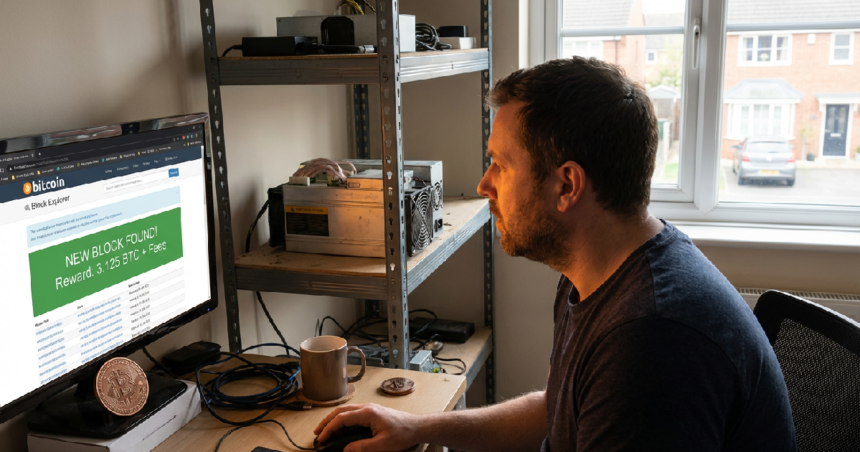
An individual Bitcoin miner has defied staggering mathematical odds to solve a block alone, securing a windfall currently valued at roughly $210,000. The event, which occurred amidst a period of intense competition among industrial-scale mining firms, serves as a rare reminder of the lottery-like mechanics that still underpin the world’s largest cryptocurrency network.
Mining a Bitcoin block is fundamentally a race to find a specific hash, a task typically dominated by massive data centers housing thousands of specialized machines. For a solo operator with limited computing power to “win” a block against the entire network’s hash rate is a statistical anomaly that happens only a handful of times each year. In this instance, the miner was using the Solo CK pool, a service that allows individuals to mine independently rather than sharing rewards with a larger collective.
Defying the hash rate giants
The odds of this specific miner successfully validating the block were estimated at approximately 1-in-28,000 based on their contributed hash rate at the time. To put that in perspective, the Bitcoin network recently hit record difficulty levels, making it harder than ever for any single entity to secure the 3.125 BTC block subsidy plus transaction fees. Most individual miners today opt for “pool mining,” where they combine their power with others to receive small, steady payouts. By choosing to go solo, this miner took the “all or nothing” gamble and won.
The block was processed at a period where the network hash rate remains near all-time highs. It highlights a strange quirk of Bitcoin’s Proof-of-Work system: while the system is designed to favor those with the most resources, the element of luck can never be fully eliminated. Even a single machine, if it happens to find the correct hash before a warehouse in Texas or Iceland, will be recognized by the network as the legitimate winner.
The economics of a solo strike
The total reward for the block amounted to slightly over $210,000, depending on the exact exchange rate at the moment of discovery. This payment consists of the “block subsidy”—which was cut in half during the most recent halving event—and the transaction fees paid by users to have their data included in that specific ten-minute window of the blockchain.
While stories like this spark hope among hobbyists, the reality of solo mining remains precarious. Many participants can run hardware for years without ever seeing a return, effectively burning electricity for zero profit. As institutional interest grows and firms like BlackRock and Fidelity deepen their ties to the ecosystem, the space for the “home miner” continues to shrink. However, as the Bitcoin technical pattern shows, the network’s underlying math remains indifferent to who is running the hardware.
What this means for the network
Beyond the human interest story of a lucky individual, this event reinforces the decentralized nature of Bitcoin. It proves that the “permissionless” aspect of the protocol is still functioning as intended. No central authority can prevent a solo miner from participating, and the protocol does not discriminate based on the size of the operation.
And yet, this is likely to remain an outlier. As mining hardware becomes more expensive and electricity costs fluctuate, the barrier to entry is transitioning from a hobbyist’s basement to a corporate balance sheet. But for today, one anonymous miner is a quarter-of-a-million dollars wealthier because they happened to win a race against the world.
Frequently Asked Questions
How is it possible for one person to beat a massive mining farm?
Bitcoin mining is a probabilistic process, much like a lottery. While a massive farm has millions of “tickets” (hashes) being generated every second, a solo miner still holds a few. While the farm is statistically much more likely to win, any single ticket has a tiny chance of being the winner. This miner simply got the winning numbers before anyone else did.
What is the Solo CK pool?
Unlike traditional mining pools where everyone shares the reward, Solo CK is a service for people who want to mine alone. The pool provides the necessary infrastructure to connect to the Bitcoin network, but if a miner in the pool finds a block, they keep 98% of the reward for themselves rather than splitting it with thousands of others.
Is solo mining a viable way to make money in 2026?
For most people, no. It’s highly speculative. Most miners will spend more on electricity than they will ever earn back in rewards. It is generally considered a form of gambling or a way to support network decentralization rather than a reliable business model for individuals.