

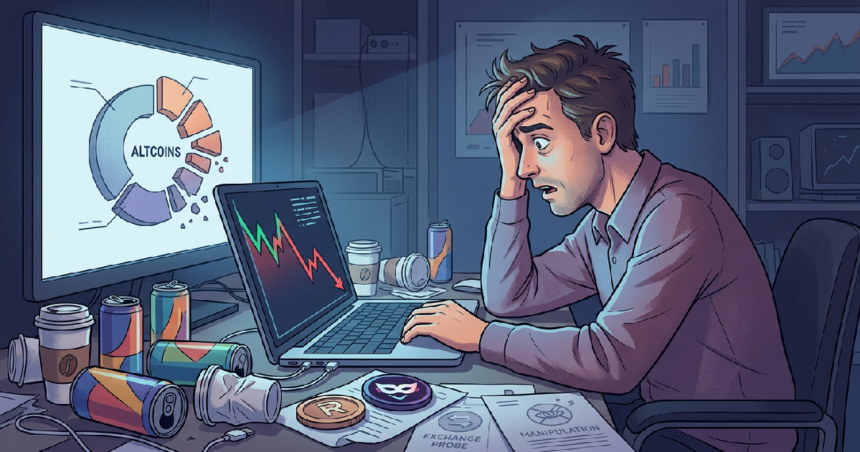
The decentralized finance (DeFi) sector is facing a fresh wave of scrutiny as RaveDAO, a protocol that had been gaining traction within the altcoin market, experienced a sudden and severe price collapse. The token lost the vast majority of its value in a single trading session, leaving retail investors with heavy losses and prompting major cryptocurrency exchanges to launch formal investigations into suspected market manipulation.
The crash appeared to happen with clinical precision, moving from its recent highs to near-zero with a speed that typically suggests a coordinated exit or a fundamental breach of trust. While the broader market has seen mid-cap tokens face selling waves recently, the sheer velocity of the RaveDAO drawdown has raised concerns among analysts who track on-chain anomalies. This was not a standard market correction; it appeared to be a structural failure that has shaken confidence in the project’s long-term viability.
Exchange Watchdogs Probe Potential Market Integrity Breaches
Following the crash, several top-tier centralized exchanges have reportedly frozen accounts associated with large-scale RaveDAO transactions. These platforms are currently scrutinizing order books to determine if “wash trading” or “spoofing” contributed to the price cliff. The goal is to identify whether liquidity was pulled by the developers themselves—a scenario often referred to as a “rug pull”—or if a group of sophisticated market participants manipulated the price to trigger cascading liquidations.
Investigators are focusing on a series of wallets that reportedly moved large quantities of the token to exchanges shortly before the sell-off began. If evidence of insider trading surfaces, it could lead to permanent bans and the sharing of data with financial regulators. This level of scrutiny is becoming more common as the industry moves away from its early lack of oversight toward more rigid monitoring. Even the CFTC has expressed readiness to oversee crypto markets, signaling that the era of consequence-free manipulation is likely coming to an end.
The Rise and Fall of RaveDAO Sentiment
Before the collapse, RaveDAO was marketed as a community-driven DAO (Decentralized Autonomous Organization) focused on yield optimization and collective governance. It attracted a significant following on social media, where community members encouraged others to hold their positions despite early warning signs of thinning liquidity and high volatility.
The aftermath has seen the community fragment. Communication channels once filled with optimism are now dominated by users seeking ways to recover their funds. For many, this event serves as a reminder of the risks inherent in low-cap altcoins, where perceived utility can sometimes mask speculative vulnerabilities. This collapse occurs at a time when the window for pure utility in digital assets is becoming a harsher metric for success, and many projects are struggling to meet their technical promises in a cooling market.
DeFi Risks and the Pattern of Protocol Failures
Technical observers have pointed out that the liquidity pools for RaveDAO were relatively shallow compared to its theoretical valuation. This imbalance made it an easy target for large holders to collapse the price with aggressive market orders. When the price hit certain psychological triggers, automated trading systems likely took over, accelerating the downward spiral and leaving the project in a state of crisis.
Questions are also being raised about the governance structure of the DAO. In many of these cases, the “decentralized” label is used loosely, with a small group of participants potentially retaining enough voting power or token supply to impact the market unilaterally. If the ongoing exchange investigations prove that the sell-off originated from core team wallets, RaveDAO will likely be cited as a cautionary tale for the current market cycle.
What Investors Should Watch for Next
The immediate future for RaveDAO holders appears uncertain. With the token having lost nearly all its value, the path to recovery requires a level of buyer confidence that rarely returns after a manipulation scandal. Many exchanges are expected to delist the asset if investigations confirm foul play, which would essentially strip the token of its remaining exit liquidity.
For the wider altcoin market, the RaveDAO incident is likely to trigger a flight to quality. Investors are increasingly moving capital into more established protocols or waiting for clearer regulatory frameworks that might prevent such blatant price distortion. As exchanges conclude their data audits, the findings will likely serve as a benchmark for how the crypto industry handles internal policing in the face of sudden capital loss.