

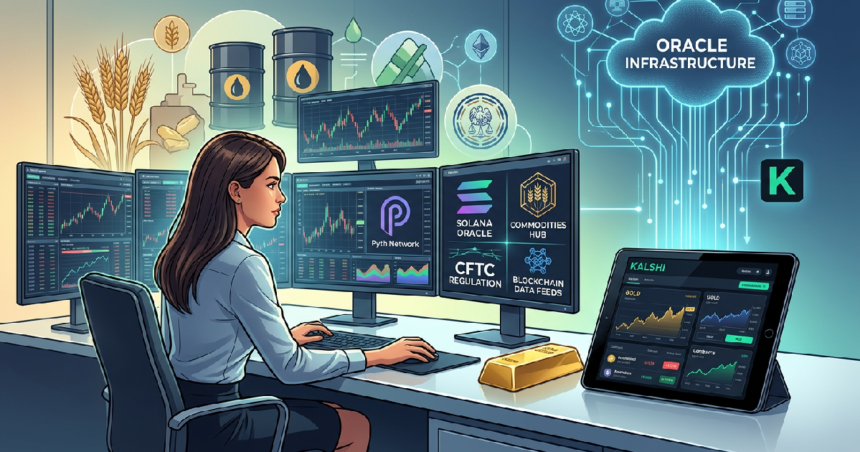
The bridge between decentralized data protocols and traditional financial markets has strengthened as the Pyth Network, a prominent oracle service within the Solana ecosystem, integrates its infrastructure into Kalshi’s newly launched commodities hub. This move establishes Pyth as a primary data provider for a regulated predictions market, focusing on the delivery of low-latency information for various financial instruments.
Kalshi, which operates under the oversight of the Commodity Futures Trading Commission (CFTC), has been expanding its suite of derivatives. By utilizing Pyth’s decentralized price feeds, the platform seeks to improve the precision of its contract settlements. This integration highlights a growing trend where established financial entities look toward blockchain-based infrastructure to potentially enhance the efficiency of market operations.
High-Frequency Data for Commodity Markets
Commodities trading traditionally relies on price discovery occurring across a web of global exchanges and private desks. Pyth Network attempts to streamline this by sourcing data directly from various trading firms and exchanges, then aggregating that information on the Solana blockchain. This technical setup is designed to support rapid updates, which are essential for platforms where users trade on real-world variables like energy costs or agricultural production.
The choice of Solana-based infrastructure is notable given the network’s reputation for high throughput. The ability to process a high volume of price updates per second remains a technical challenge for many legacy systems and more congested blockchain networks. For a platform like Kalshi, maintaining price feeds that closely track the “spot” market is vital for minimizing settlement discrepancies. This type of implementation is a core part of the discussion regarding the narrow window for digital assets to prove their utility in the broader financial world.
The regulatory backdrop for such integrations continues to evolve. While specific policy outcomes remain subject to change, reports indicate that the CFTC is preparing for broader oversight of the digital asset markets. By employing an oracle that provides verifiable, on-chain data, entities like Kalshi may be positioning themselves to meet future transparency and reporting standards expected by federal regulators.
The Evolution of Event-Based Trading
The launch of a commodities-specific hub suggests that prediction markets are moving toward more complex financial applications beyond their traditional focus on politics or sports. Users can now potentially hedge against price fluctuations in metals and grains using simplified contract structures. This shift could provide a new avenue for hedging that has historically been the province of institutional players.
Pyth’s role involves more than just a single price point; it also provides confidence intervals meant to reflect price uncertainty during times of high market stress. This feature is particularly relevant when broader market segments face liquidity shifts and price volatility. Such tools allow a platform to maintain functionality even when underlying markets become less predictable.
Scalability and the Solana Advantage
This partnership underscores why Solana’s technical architecture remains a draw for firms operating in the traditional finance (TradFi) sphere. The network is built to handle the “firehose” requirements of modern trading, where lag can lead to significant financial loss. Pyth, which was originally developed to bring institutional-quality data to decentralized networks, now finds itself serving as a bridge back to regulated financial environments.
But the reliance on specific blockchain networks is not without risks. Critics often point to potential downtime or network-specific vulnerabilities. To mitigate this, Pyth has worked on cross-chain capabilities, though its roots remain firmly in the high-speed Solana environment. This integration appears to be a vote of confidence in the reliability of that stack for settling real-world financial obligations.
Looking Toward Institutional Integration
The performance of the Kalshi commodities hub is expected to be closely watched by other regulated entities. If the use of on-chain data for high-stakes commodity settlement proves successful and reliable, it could clear the path for other asset classes to debut on similar platforms. This might eventually include a range of specialized indices or environmental credits that require transparent and tamper-resistant tracking.
For the Solana ecosystem, the move offers a clear use case that deviates from the speculative activity often associated with decentralized finance. By providing the data backbone for a regulated exchange, these projects are attempting to demonstrate their durability. It indicates a landscape where institutional builders are no longer merely observing blockchain technology but are actively incorporating it into their existing product suites.