

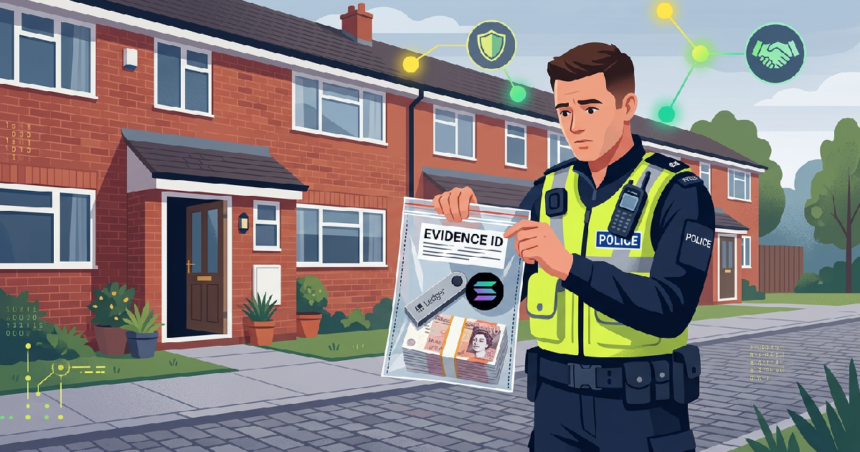
British law enforcement agencies have reportedly launched a series of coordinated operations targeting individuals engaged in off-exchange cryptocurrency-to-cash transactions. These raids mark a notable shift in the government’s approach to unregulated peer-to-peer (P2P) trading, where users bypass registered exchanges to swap digital assets for physical currency. The enforcement actions have immediately reignited a debate regarding financial privacy and the boundaries of personal fiscal freedom in a increasingly digital economy.
Authorities are focusing on what they describe as unlicensed money service businesses. In the UK, anyone facilitating the exchange of crypto for cash as a professional service is required to register with regulators and follow strict Anti-Money Laundering (AML) and Know Your Customer (KYC) protocols. By conducting these trades in private settings or through localized message boards, participants operate outside the traditional banking perimeter. Police claim this environment attracts criminal elements looking to launder funds away from the eyes of investigators.
This trend reflects a narrowing path for those who view digital assets as a tool for decentralized, private transactions. While Bitcoin holds steady as mid-cap tokens face selling wave, the infrastructure supporting its use as an everyday currency is under heavy pressure. This tension is particularly visible in the Solana ecosystem, where high-speed transactions theoretically make cash-outs easier, yet harder to hide from sophisticated chain-analysis tools now utilized by specialized police units.
The Legal Gray Area of Peer-to-Peer Trading
At the heart of the recent law enforcement activity is a fundamental disagreement between the state and the individual regarding what constitutes a business. Many of those targeted in these operations claim they are merely selling personal property to other consenting adults. However, the frequency of these trades often pushes them into a regulatory category that requires a formal license. Authorities argue that without oversight, these cash-for-crypto “pockets” become the primary exit ramp for various illicit proceeds.
The crackdown is not an isolated incident but part of a wider legislative tightening. As the crypto market window closes as utility shifts dictate 2026, regulators are increasingly focused on the points where digital assets interface with the physical world. By targeting the exchange of cash, law enforcement is hitting the “off-ramps” that allow users to maintain some level of anonymity from the central banking system.
Privacy vs Security the Ongoing Standoff
Privacy advocates argue that these raids set a dangerous precedent by criminalizing basic financial interactions. They contend that the right to trade one’s assets for cash is a cornerstone of economic liberty. When the state monitors every transaction through a centralized exchange, the original vision of decentralized finance is effectively neutralized. But law enforcement officials maintain that the anonymity of cash combined with the portability of digital assets creates a difficult challenge for public safety.
Officials often point to the rise in sophisticated scams that rely on underground cash networks to move money into the local economy without detection. For the police, these P2P networks represent a “blind spot” in the national financial security architecture that must be closed to prevent large-scale fraud and money laundering.
Impact on the Solana Ecosystem and Decentralized Finance
The Solana network has become a focal point for many of these discussions due to its focus on retail adoption and real-world payments. As developers within the Solana community work on mobile-first solutions and point-of-sale integrations, the threat of legal action against cash-based facilitators creates a chilling effect on innovation. If users cannot easily move between Solana assets and local fiat without being flagged, the utility of the network for privacy-conscious users diminishes.
Internal shifts in how digital assets are perceived by governments are changing the stakes. Even as some agencies suggest they are ready for broader oversight—similar to how Michael Gillick says CFTC is ready to oversee crypto market in the United States—the emphasis remains on total transparency. For Solana’s decentralized exchange (DEX) users, the physical world is becoming much more restrictive even as the digital world remains permissionless.
Future Implications for Global Crypto Users
The UK’s proactive stance is expected to be watched closely by other G7 nations considering similar measures. As central bank digital currencies (CBDCs) move closer to reality, the tolerance for private, cash-based alternatives is likely to decline. Traders are now forced to choose between the safety of regulated platforms and the escalating legal risks of the gray market.
So, the question remains whether financial freedom is possible when every transaction must be permissioned by a third party. For the people caught in the recent police operations, that question is no longer a theoretical one. It is a matter of legal survival in an era where the definition of money is being rewritten by the state.