

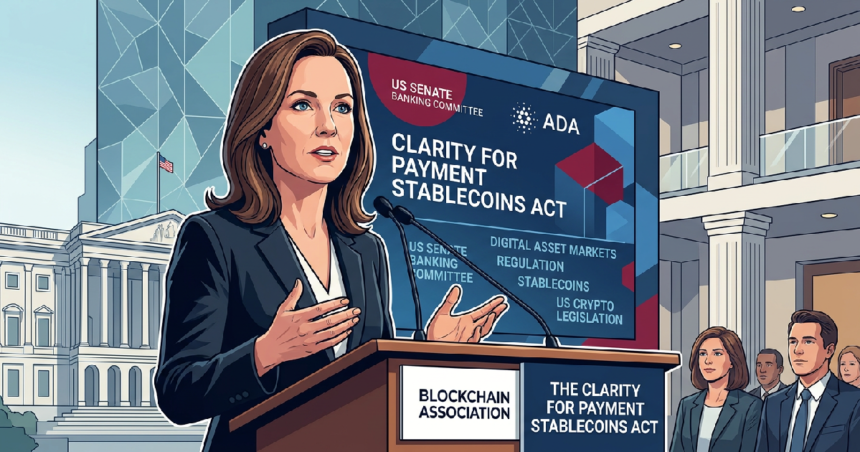
Kristin Smith, the Chief Executive Officer of the Blockchain Association, has issued a renewed call to the United States Senate to advance the Clarity for Payment Stablecoins Act. Smith is reportedly urging the Senate Banking Committee to begin a formal markup of the legislation to address the legal ambiguities that have historically hindered the domestic digital asset sector. The push follows reports of a recent survey indicating that a substantial majority of registered voters believe that federal legislation for the cryptocurrency industry is now overdue. By moving the bill forward, proponents argue the United States can secure its position as a leader in global financial innovation rather than yielding ground to international competitors.
The movement toward a federal framework is not merely a priority for industry advocates; it appears to align with broader public sentiment regarding American competitiveness. Survey data from HarrisX suggests that a clear majority of voters view it as vital for the U.S. to establish global standards for digital finance. Furthermore, many participants expressed a preference for clear statutes established by Congress rather than the current model of regulation through litigation. This sentiment reflects a growing concern that without legislative intervention, the American market will continue to trail behind jurisdictions that have already established clear licensing regimes.
And the pressure is mounting as the House of Representatives has already demonstrated bipartisan support for similar measures. The focus now shifts to the Senate, where the legislative process will determine if the U.S. can transition from a defensive posture to a proactive building phase. While the Morgan Stanley expansion of bitcoin access for wealth clients signals growing institutional acceptance, the lack of a unified federal rulebook remains a primary concern for market participants.
The Challenges of Regulatory Overlap
For years, the digital asset industry has navigated a complex web of oversight from the Securities and Exchange Commission (SEC) and the Commodity Futures Trading Commission (CFTC). While there have been reports of coordination between these agencies, Smith and other industry leaders suggest that these efforts are an insufficient substitute for formal law. Often, assets are treated as securities by one body and commodities by another, creating a “gray area” that has reportedly pushed domestic innovation to offshore hubs.
The current market environment has evolved significantly, moving away from the speculative volatility of its early years. Many observers believe we have entered a phase where utility shifts dictate market trends, favoring projects that provide functional infrastructure over hype. This maturation makes the legal vacuum increasingly problematic for the American economy as traditional financial institutions continue to integrate blockchain technology into their core services.
Stablecoins as Infrastructure
A central pillar of the proposed legislation involves the regulation of stablecoins, which act as a bridge between traditional fiat and digital ledgers. Following the reported introduction of the GENIUS Act, these digital dollars have become a fixture in institutional payment systems. Major global players, such as Visa and PayPal, have integrated various blockchain networks to facilitate faster settlement and transaction speeds. These developments suggest that stablecoins are no longer experimental but are becoming a fundamental component of modern financial plumbing.
As these technologies become more prevalent, the need for investor protections and clear registration requirements becomes more pressing. Without the Clarity Act, innovators are forced to operate under the threat of shifting regulatory expectations. This uncertainty can act as a ceiling on growth, particularly as ADA seeks return to dollar mark levels and other major assets look for a stable foundation to support long-term recovery.
Seeking a Bipartisan Path Forward
For any digital asset framework to remain durable across different political administrations, Smith argues that it must be forged through bipartisan consensus. A partisan bill would likely be subject to reversal, further contributing to the instability that the industry is trying to escape. The markup process in the Senate Banking Committee represents the critical juncture where such a consensus can be built, allowing for public debate on issues ranging from custody and disclosure to market integrity.
If the Senate fails to act, the legal vacuum may continue to reward regions in Europe and Asia that have already implemented comprehensive regulatory frameworks. The stakes go beyond the immediate success of individual firms; they involve the long-term health of the American financial system. Industry leaders warn that the U.S. cannot lead in the digital age while hampered by a century-old regulatory structure that did not anticipate decentralized technology.
The trajectory of the U.S. blockchain industry over the next decade will likely be decided by the actions—or inaction—of the Senate in the coming months. As the pressure on Washington to provide a functional rulebook reaches a peak, the upcoming legislative sessions will serve as a test of whether the Senate is ready to establish a path for growth. For further details on the legislative process, the official website of the United States Senate Committee on Banking, Housing, and Urban Affairs provides updates on hearings and bill statuses.