By True Crypto Focus
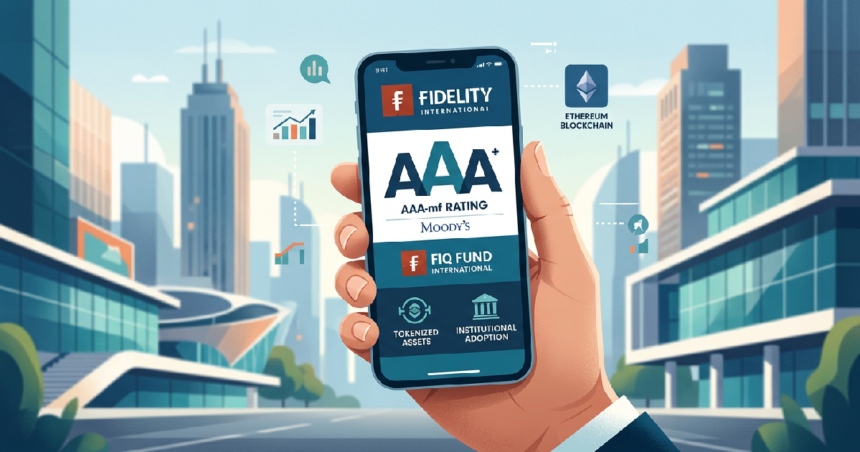
Fidelity International (Fidelity) has achieved a major milestone in the integration of traditional finance and blockchain technology, as the ratings agency Moody’s Investors Service (Moody’s) assigned its highest possible rating to the firm’s first tokenized money market fund. The Fidelity International Institutional Liquidity Fund (FILQ) reportedly received the AAA-mf rating, signaling the highest level of credit quality and stability for institutional investors. This development represents a formal bridge between legacy asset management and decentralized ledger technology, utilizing the Ethereum blockchain to host the fund’s operations.
The move marks a shift in how global investment houses approach the digitization of real-world assets (RWA). By obtaining an institutional-grade rating from an agency of the stature of Moody’s, Fidelity International provides the necessary assurance for corporate treasuries and large-scale financial institutions to interact with on-chain assets. The fund replicates the strategy of existing low-volatility net asset value (LVNAV) products, but utilizes blockchain to aim for continuous settlement and redemption capabilities.
In the current market, the transition toward tokenized models is increasingly viewed as a standard for operational efficiency rather than a fringe experiment. While some sectors of the market have faced headwinds,
XRP momentum restarts in various liquidity corridors as firms prepare for a broader shift toward instantaneous settlement. For Fidelity, the objective is to move beyond the traditional settlement windows that have historically constrained capital movement in the global financial system.
Technical Architecture and Liquidity Management
The FILQ fund is structured to maintain a stable net asset value, which is a fundamental requirement for conservative institutional investors looking to manage cash reserves. Unlike traditional money market funds that are often restricted by banking operating hours and manual processing, the tokenized version is designed to operate on a more continuous basis. This technical shift could allow investors to manage liquidity in real-time, potentially reducing risks associated with market stress and rigid redemption schedules.
The rating from Moody’s reportedly focused on the creditworthiness of the underlying portfolio, which is comprised of high-quality, short-term debt instruments. The agency’s assessment implies that the tokenized delivery mechanism does not introduce prohibitive credit risks that would offset the clear operational benefits. This distinction is critical as the
crypto market window closes around projects that lack clear utility, favoring those that provide tangible value to the financial system.
The Role of Ethereum and Smart Contracts
Fidelity International selected the Ethereum blockchain to host this product, employing smart contracts to automate the distribution of yields and the maintenance of share registries. This automation is expected to reduce the administrative overhead traditionally associated with fund management while providing an immutable ledger of ownership. By using a public blockchain, the firm taps into a global infrastructure reachable by any entity with the necessary regulatory permissions.
The choice of a public blockchain over private, permissioned ledgers highlights an ongoing debate within the financial sector regarding the long-term viability of different ledger types. The use of smart contracts specifically allows for a transparent and verifiable record, which can be essential for compliance-heavy environments. And because these funds are built on standard protocols, they could eventually be integrated into a wider variety of institutional blockchain platforms as the ecosystem matures.
Strategic Implications for the Tokenization Industry
The issuance of a AAA-mf rating is likely to serve as a catalyst for other asset managers who have remained on the sidelines during the early stages of blockchain adoption. Having a standardized credit rating helps bridge the trust gap that has hindered the broader acceptance of digital assets. It transforms the narrative from one of speculative digital currencies to the practical tokenization of established financial instruments.
Analysis of the current financial landscape suggests that the gap between speculative tokens and those with functional utility will likely continue to widen. As discussed in recent reports on the
diverging paths for XRP value and other liquid assets, the ability to settle transactions with minimal latency is becoming a primary driver for institutional adoption in 2026. The success of the FILQ fund provides a blueprint for how traditional assets can be moved on-chain without sacrificing safety or regulatory compliance.
Furthermore, the involvement of major rating agencies is placing pressure on global regulators to provide more comprehensive frameworks for on-chain fund management. Organizations like the
Bank for International Settlements (BIS) have previously noted that integrating tokenized deposits and funds into the global financial architecture has the potential to enhance the efficiency of cross-border payments.
Outlook for Digital Funds and Institutional Adoption
With the top-tier credit rating secured, the next phase for Fidelity International involves scaling the fund and attracting capital from corporate treasuries that may still be acclimating to blockchain-based tools. While the underlying technology is robust, widespread adoption often requires a change in how internal finance departments manage their daily workflows and accounting practices.
But the general direction of the industry appears to be moving toward a unified digital infrastructure. As more asset classes—ranging from government bonds to private equity—are tokenized, the frameworks established by early movers like Fidelity will likely serve as the foundation for the next generation of finance. The firm has positioned itself at the forefront of this transition, proving that blockchain can meet the most rigorous standards of the traditional investment world.
Market participants are now looking to see which major asset manager will be the next to secure a similar validation from the world’s leading rating agencies. For now, the rating of the Fidelity International Institutional Liquidity Fund stands as a significant proof of concept for the institutional viability of tokenized finance. Only a few years ago, the idea of a blockchain-based fund carrying the same rating as the world’s safest sovereign debt seemed remote, yet it is now a reality in the global market.