

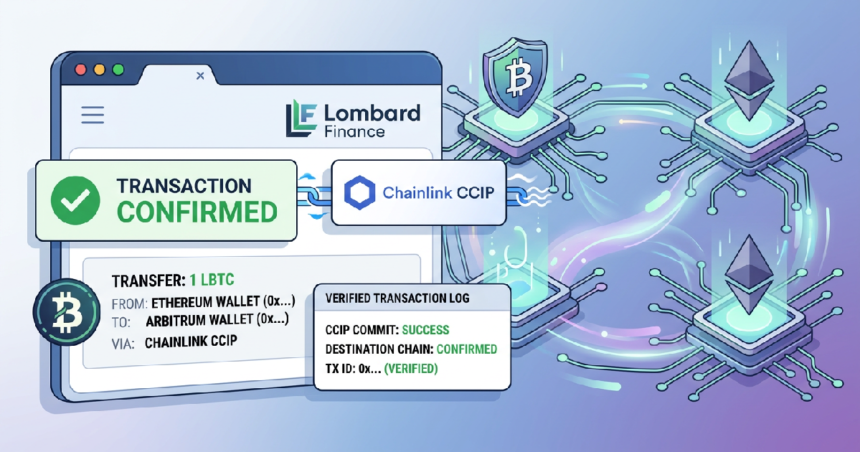
Lombard Finance has announced a pivotal Chainlink CCIP integration, fundamentally enhancing the security and interoperability of its liquid staking token, LBTC.
This strategic move positions Lombard at the forefront of a significant shift within the decentralized finance (DeFi) landscape, where protocols are increasingly migrating substantial asset volumes away from earlier, less robust bridging solutions towards battle-tested, institutional-grade infrastructure.
The Lombard Finance Chainlink CCIP integration is a direct response to the growing demand for heightened security and reliability in cross-chain asset transfers, particularly for high-value assets like Bitcoin-backed tokens within the Ethereum ecosystem.
The decision to adopt the Chainlink Cross-Chain Interoperability Protocol (CCIP) is a strategic imperative designed to address the persistent challenge of liquidity fragmentation for Bitcoin-backed assets on the Ethereum network.
By leveraging CCIP, Lombard aims to ensure that LBTC maintains seamless portability across various Layer 2 scaling solutions and other blockchain environments without compromising on safety or integrity. This unwavering focus on reliability comes at a crucial time, as
link/” target=”_blank” rel=”noopener”>Chainlink (LINK) network com/bitcoin-resilience-ethereum-xrp-bearish-divergence-march-2026/”>diverging market trends between major assets
A New Standard for Security and Transparency
The Lombard Finance Chainlink CCIP integration is not merely an upgrade; it represents a commitment to establishing a new benchmark for security and transparency in cross-chain operations. Chainlink CCIP’s architecture is designed with a multi-layered defense-in-depth approach, far surpassing the security models of many earlier bridging solutions. Key features include:
- Decentralized Oracle Networks: CCIP leverages Chainlink’s industry-leading decentralized oracle networks, ensuring that all cross-chain messages and asset transfers are validated by a robust, independent, and geographically distributed set of nodes, minimizing single points of failure.
- Risk Management Network: This independent network continuously monitors all CCIP transactions for suspicious activity, anomalies, or potential exploits. It acts as an additional, crucial layer of security, capable of pausing or rate-limiting transfers if a threat is detected, thereby protecting user funds.
- Rate Limiting: CCIP implements configurable rate limits on the amount of value that can be transferred over a specific period. This mechanism acts as a circuit breaker, limiting potential damage in the event of an unforeseen exploit.
- Time-Locked Upgrades: Protocol upgrades and changes are subject to time locks, providing transparency and allowing ample time for review by the community and security auditors before implementation.
- Audited Codebase: Chainlink CCIP’s smart contracts undergo rigorous and continuous audits by leading blockchain security firms, ensuring the codebase is robust and free from vulnerabilities.
This comprehensive suite of security features provides an unparalleled level of assurance, which is increasingly becoming a non-negotiable requirement for both sophisticated DeFi users and institutional participants looking to engage with the decentralized economy. The transparency of these mechanisms allows for public scrutiny and verification, fostering greater trust in the underlying infrastructure.
Comparative Security Features of Cross-Chain Bridging Solutions
The table below illustrates how Chainlink CCIP’s multi-layered security approach compares to common features found in other bridging solutions, highlighting the advanced protections offered by Lombard’s chosen integration.
| Security Feature | Chainlink CCIP | Typical Multi-Sig Bridge | Typical Centralized Bridge |
|---|---|---|---|
| Decentralized Oracle Network | ✓ (Robust & Independent) | ✗ | ✗ |
| Independent Risk Management Network | ✓ (Active Monitoring & Mitigation) | ✗ | ✗ |
| Configurable Rate Limiting | ✓ (Circuit Breaker) | ~ (Limited/Manual) | ✓ (Internal Policy) |
| Time-Locked Upgrades | ✓ (Transparency & Review) | ~ (Variable) | ✗ |
| Continuous Audits by Third Parties | ✓ (Publicly Available) | ~ (Often One-Off) | ~ (Often Private) |
| Exposure to Single Point of Failure | ✗ (Highly Minimized) | ~ (Dependent on Signers) | ✓ (High) |
Note: This table provides a general comparison. Specific implementations may vary.
Universal Interoperability Across DeFi and Institutions
Reports of substantial capital outflows from other interoperability providers, such as LayerZero, suggest that the competitive landscape for cross-chain technology is indeed narrowing. Developers appear increasingly hesitant to rely on security models that have not been subjected to years of public scrutiny and real-world stress testing.
The migration highlights a clear preference for the multi-layered defense-in-depth approach characterized by the official Chainlink CCIP specifications, which include not only rate-limiting and decentralized execution but also a robust and independently verifiable oracle infrastructure.
This consolidation of bridging standards is not merely a market trend; it’s a foundational shift towards a more secure and integrated multi-chain future.
But the consolidation of bridging standards around a protocol like Chainlink CCIP also brings significant benefits to the wider Ethereum community and the broader blockchain ecosystem.
A dominant, highly secure protocol helps reduce the proliferation of disparate, often confusing, and potentially risky “wrapped” tokens, which can frequently lose their underlying value if the bridge they rely on is compromised.
As the market continues to mature in the coming months and years, the focus is decisively shifting away from the sheer number of supported chains and towards the verifiable security, reliability, and institutional readiness of the connections between them.
This is crucial for attracting the next wave of institutional capital and enterprise adoption into the DeFi space.
Lombard’s move to Chainlink CCIP signals that the era of aggressive, high-risk experimentation in cross-chain bridging may be drawing to a close.
With market participants, regulators, and institutional investors alike demanding higher standards of security, transparency, and operational integrity, the protocols that prioritize structural robustness and proven reliability are the ones most likely to attract and retain the next wave of capital, fostering sustainable growth and innovation across the entire decentralized economy.
The Lombard Finance Chainlink CCIP integration is a forward-looking step towards this more secure and interconnected future.
Frequently Asked Questions (FAQ) about Lombard Finance and Chainlink CCIP
What is Lombard Finance’s LBTC?
LBTC is Lombard Finance’s liquid staking token for Bitcoin. It allows users to stake their Bitcoin and receive LBTC in return, which can then be used across various DeFi protocols to earn yield, participate in lending, or trade, all while maintaining exposure to Bitcoin’s value. This mechanism enhances capital efficiency for Bitcoin holders within the decentralized ecosystem.
How does the Chainlink CCIP integration improve security for LBTC?
The Chainlink CCIP integration significantly enhances LBTC’s security by providing a robust, multi-layered defense system for cross-chain transfers. This includes leveraging Chainlink’s decentralized oracle networks for reliable data transfer, an independent Risk Management Network to detect and mitigate threats, and features like configurable rate limiting and time-locked upgrades. These measures protect LBTC from common bridge exploits and ensure its integrity across different blockchains.
What are the benefits of cross-chain interoperability for DeFi?
Cross-chain interoperability is crucial for DeFi as it breaks down liquidity silos, allowing assets to move freely and securely between different blockchain networks. This increases capital efficiency, expands market opportunities, reduces fragmentation, and enables users to access a wider range of services and applications regardless of the underlying chain. It fosters a more unified and robust decentralized financial system.
Why are DeFi protocols, like Lombard Finance, shifting to Chainlink CCIP?
DeFi protocols are increasingly shifting to Chainlink CCIP due to its battle-tested security, reliability, and institutional-grade architecture. Following numerous high-profile bridge exploits in the past, protocols prioritize solutions with proven track records, multi-layered security (like CCIP’s Risk Management Network), and transparent operations. Chainlink CCIP offers a comprehensive solution that meets these elevated demands, attracting projects seeking long-term stability and trust.
What is BTCFi and how does LBTC contribute to it?
BTCFi, or Bitcoin Finance, refers to the growing ecosystem of decentralized finance applications and services built around Bitcoin. LBTC contributes to BTCFi by providing a liquid, tokenized representation of staked Bitcoin on the Ethereum network.
This allows Bitcoin holders to participate in Ethereum’s vibrant DeFi ecosystem without selling their BTC, unlocking new yield opportunities and utility for their assets, and securely bridging Bitcoin’s value into other blockchain environments via CCIP.