

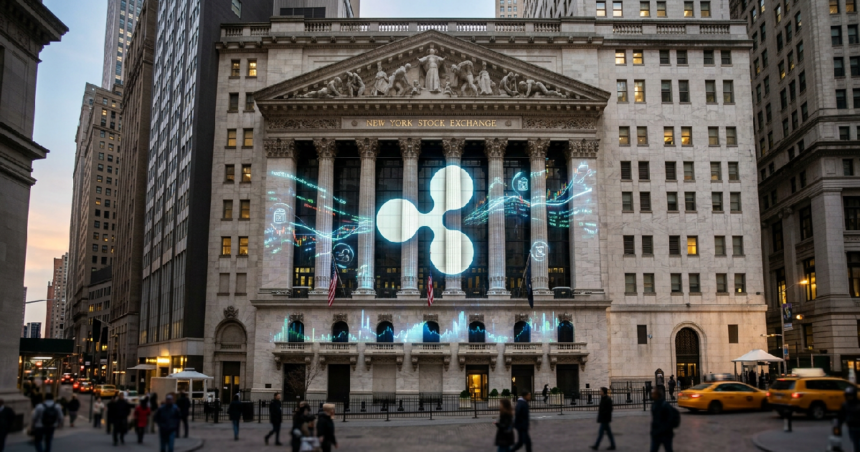
Ripple Labs filed two separate trademark applications with the United States Patent and Trademark Office (USPTO) on May 15, 2026, marking a significant step in its transition toward becoming a full-scale institutional financial infrastructure provider. The first application covers the company’s Triskelion design/logo, while the second covers a corresponding word mark. These filings aim to secure brand protection for an expansive list of services that position the firm as a direct competitor to traditional Wall Street brokerage and clearinghouse operations.
The move follows a period of rapid institutional scaling for the San Francisco-based company. In 2025, the firm acquired Hidden Road for $1.25 billion and rebranded it as Ripple Prime, a global multi-asset prime broker that reportedly clears more than $3 trillion annually. While Ripple’s early reputation was built on cross-border payments, the new applications suggest a future where the company manages treasury operations, cash management, and bank reconciliation for more than 300 institutional clients.
The scope of the May 15 filings indicates that the firm is building a platform capable of handling the entire lifecycle of traditional and digital assets. This transition comes as utility shifts dictate 2026 market trends, forcing blockchain companies to prove their value through real-world financial plumbing rather than speculative trading. The applications include legal coverage for digital asset management, portfolio services, and risk management advisory.
Broad institutional service scope in Ripple trademark filings
The trademark applications filed on May 15, 2026, outline a massive range of financial activities. Beyond payment software, the filings cover brokerage services across equities, derivatives, fixed income, foreign exchange, and commodities. This suggests Ripple Prime intends to offer a comprehensive suite for institutional traders, including futures execution, margin financing, and repurchase transactions, commonly known as \”repos.\”
The applications also mention hedge fund management, securities lending, and financial clearinghouse services. This infrastructure-heavy approach aligns with the company’s previous strategic acquisitions, such as its $250 million purchase of Swiss custody firm Metaco in 2023. By securing these marks, the company is effectively building a legal moat around its enterprise platforms and post-trade settlement services involving both digital assets and commodities.
Furthermore, the filings include downloadable software for treasury operations, fund transfers, and bank reconciliation. This technical foundation is designed to support the firm’s growing institutional ecosystem, which recently integrated with EDX Markets and EDXM International. These integrations allow clients to access EDX spot markets through the Ripple Prime interface, further bridging the gap between blockchain and traditional finance.
Decoupling of corporate growth and XRP price action
While the company’s corporate valuation reached approximately $40 billion following a $500 million funding round in November 2025, the XRP token has not followed the same upward trajectory. On May 26, 2026, XRP was trading at roughly $1.38, a decrease from its previous levels above $2.00. This occurs even as Ripple Prime’s revenue tripled in the 12 months since its inception, highlighting a disconnect between the firm’s commercial success and the token’s market price.
Market data from Santiment showed that crowd sentiment reached a three-week high in “fear” levels on May 26. Traders remain cautious, even as XRP momentum restarts in some sectors due to new liquidity initiatives. Analysts have identified the $0.73 range as a critical accumulation zone for those looking at long-term positions, despite the current short-term volatility and market apprehension.
Evaluating the long-term impact on the financial ecosystem
The strategic push into Wall Street reflects a broader ambition to connect traditional finance with the blockchain ecosystem. The filings on May 15, 2026, cover intermediary services tied to equity swaps and derivatives, signaling that the firm does not view itself solely as a crypto-native entity. Instead, it is positioning itself to handle the “plumbing” of global markets, competing with established custodial banks and clearinghouses.
Legal experts note that trademark filings do not guarantee the immediate release of all listed services. Large corporations often file broad applications to ensure flexibility as they expand. However, the sheer variety—from investment advisory services to commodity brokerage—indicates that the company is preparing for a future where blockchain technology facilitates post-trade settlements across all major asset classes.
As the firm continues to navigate this expansion, the financial industry remains divided on the token’s eventual role in this new infrastructure. Some analysts project diverging paths for the asset’s value, questioning whether the company’s pivot toward service-based revenue will ultimately benefit or overshadow its native token. For now, the focus remains on the USPTO as it processes these new marks, which could define the company’s branding for years to come.