

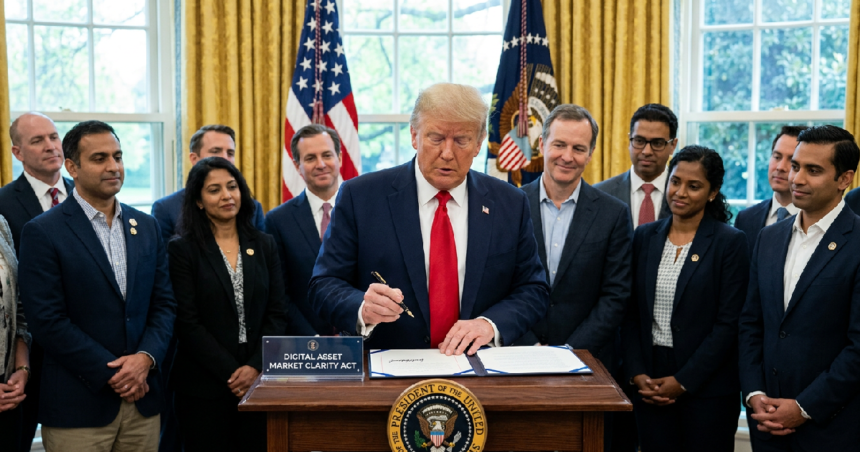
President Donald Trump vowed on May 27, 2026, to establish a “future-proof” U.S. cryptocurrency market structure designed to prevent future administrations or political critics from reversing the country’s current pro-digital asset trajectory. In a statement posted to his Truth Social account, President Trump emphasized his intention to codify a permanent legal framework that would remain resistant to reversal. The push follows a 15-9 bipartisan vote in the Senate Banking Committee on May 14, 2026, which moved the Digital Asset Market CLARITY Act closer to a full Senate vote.
The White House has now publicly targeted July 4, 2026, as the date for signing the CLARITY Act into law, though market analysts warn this timeline is extremely tight. This legislative push aims to move beyond the “regulation by enforcement” era that the administration argues drove innovation offshore. By writing these rules into federal law through Congress, the administration seeks to ensure the current friendly environment survives beyond the tenure of any single president.
Trump’s strategy focuses on “codification” as the only way to lock in regulatory gains that would otherwise depend on temporary political appointments.
White House crypto advisor Patrick Witt is reportedly working with congressional leaders to secure the 60-vote majority needed in the full Senate. The administration’s goal is to repatriate capital that fled to overseas hubs like London, Dubai, and Singapore during previous years of regulatory uncertainty. President Trump claimed in his recent post that “Builders and Entrepreneurs are coming BACK to the United States,” citing a shift in regulatory tone that has already seen firms like HIVE Digital Technologies move their headquarters from Canada to Texas in late 2024.
Establishing the Digital Asset Market CLARITY Act framework
The centerpiece of this effort, the Digital Asset Market CLARITY Act, performs a critical function by legally defining which tokens are securities and which are commodities. Under the proposed rules, the Securities and Exchange Commission (SEC) and the Commodity Futures Trading Commission (CFTC) would have more clearly defined jurisdictions. com/bitcoin-volatility-warning-institutional-pullback-2026/”>Bitcoin correction risk often associated with regulatory ambiguity.
The bill provides guidance on how companies can provide products to American customers and explains the fate of customer funds during corporate bankruptcies.
Beyond jurisdictional lines, the bill includes specific protections for decentralized software developers. These provisions are intended to provide a stable foundation for the broader market as it matures. SEC Chair Paul Atkins has already begun reversing almost every major enforcement priority from the previous era, pivoting the agency toward formal rulemaking and clearer guidelines. This administrative shift is part of a broader effort to provide final proof for digital assets as legitimate components of the financial system.
The roles of Paul Atkins and Michael Selig
Current SEC Chair Paul Atkins has distanced the agency from the posture of former chair Gary Gensler. Since taking the helm, Atkins has worked to undo the “enforcement-first” approach that previously targeted major industry players. This shift is being mirrored at the CFTC under Michael Selig, who is aiming to become the primary regulator of prediction markets and crypto trading. Selig has also worked directly with Atkins to draft clearer rules within the CLARITY Act itself.
The coordination between Atkins and Selig is vital for the “future-proof” goal. By setting these standards now through formal procedures and legislative support, the officials make it harder for a successor to resume aggressive enforcement without new congressional action. However, the President maintains that without the CLARITY Act becoming law, these gains remain vulnerable because a new president could reverse changes simply through new appointments and priorities.
Reversing the legacy of Gary Gensler and the Anti-Crypto Army
President Trump’s rhetoric frequently targets former SEC Chair Gary Gensler, whom he accuses of leading an “Anti-Crypto Army” that nearly destroyed the domestic industry. Between 2021 and early 2025, the SEC under Gensler launched high-profile lawsuits against Coinbase, Binance, Ripple, and Kraken. The current administration frames these actions as a failed attempt to force innovation offshore through frameworks that was not designed for digital assets. The momentum for XRP and other tokens has frequently stalled in the past due to these litigation-heavy cycles.
The Justice Department agency responsible for regulating cryptocurrency crime was disbanded in April, further signaling a departure from the previous administration’s tactics. By reducing the number of agencies with overlapping mandates, the White House hopes to lower the barrier for new startups. The goal is to move from a defensive posture to an offensive one, where the U.S. competes directly with global fintech hubs that already have clearer legal structures in place.
Legislative hurdles and the 60-vote Senate majority
While the House passed the CLARITY Act on July 17, 2025, the path through the Senate remains steep. The 15-9 vote in the Senate Banking Committee showed bipartisan support, though reaching 60 votes in the full chamber requires significant outreach. Figures like Representative Nick Begich and Representative Jared Golden are among those active in the current Washington dialogue surrounding the bill.
Jaret Seiberg, Managing Director at TD Cowen’s Washington Research Group, noted that while the momentum is strong, the July 4 signing target is mathematically difficult given the legislative calendar.
Critics like Senator Elizabeth Warren remain vocal opponents of the current direction, expressing concerns about potential risks to the traditional financial system. Despite this, the administration continues to push for a final vote. Mark Palmer, an analyst at Benchmark, suggests that formalizing these rules is necessary to provide the institutional certainty that large-scale domestic investment requires. The process is being watched closely by organizations like the Independent Community Bankers of America as digital assets integrate further into the banking sector.
Federal Reserve and FDIC integration strategies
The Trump administration is also looking beyond simple market rules to integrate crypto into the core financial system. An executive order signed on May 19, 2026, aimed at integrating fintech companies into the traditional system. This includes assessing whether non-bank crypto companies should have direct access to Federal Reserve master accounts. This follows an earlier executive order from January 23, 2025, which established a framework for fostering digital financial technology growth and repealed SAB 121.
Key figures in this transition include Travis Hill, the Acting Chairman of the FDIC, and Michelle Bowman, who is a leading contender for the Federal Reserve’s Vice Chair for Supervision. Furthermore, Acting SEC Chairman Mark T. Uyeda established the SEC Crypto Task Force in early 2025 to streamline these transitions.
These moves suggest a coordinated effort across the SEC, FDIC, and Federal Reserve to ensure digital assets are managed with long-term stability in mind. The administration wants to avoid another era of shifting priorities that forces builders to seek clarity in foreign jurisdictions.