

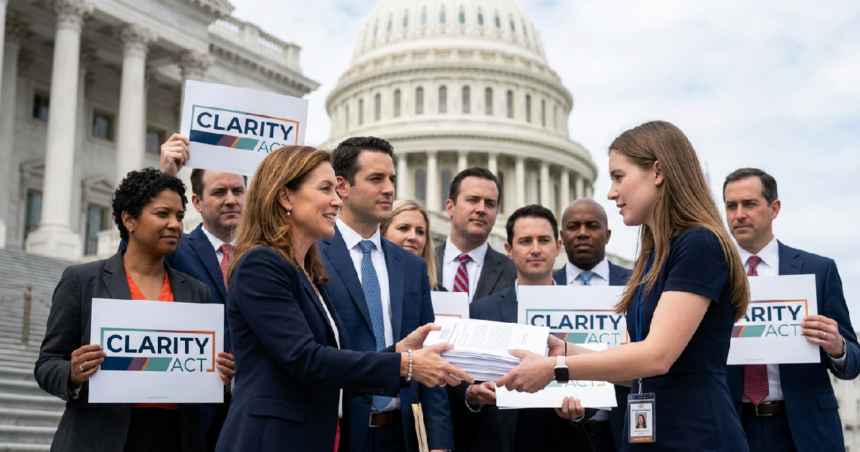
The Digital Chamber and a coalition of over 100 cryptocurrency firms are demanding that the U.S. Senate immediately advance the Digital Asset Market Clarity Act of 2025, or CLARITY Act. Led by CEO Cody Carbone and Founder Perianne Boring, the industry association is pushing Senate leaders to move H.R. 3633 into a formal markup stage following its successful passage in the House and a bipartisan nod from the Senate Banking Committee on May 14, 2026.
The legislative push comes as the industry seeks to end years of regulatory friction between the Securities and Exchange Commission (SEC) and the Commodity Futures Trading Commission (CFTC). The CLARITY Act aims to provide a definitive framework for digital assets, ensuring that American firms can operate under consistent rules. Without this legislation, the Digital Chamber argues that the United States risks losing its competitive edge to international jurisdictions that have already established clear legal boundaries.
Digital Chamber demands Senate action on CLARITY Act hurdles
The urgency of the current campaign stems from a perceived stagnation in the legislative process despite strong initial momentum. On April 20, 2026, CEO Cody Carbone sent a formal letter to Senate Banking Committee Chairman Tim Scott and Ranking Member Elizabeth Warren, highlighting that more than 270 days had passed since the House of Representatives approved the bill. The House vote on July 17, 2025, showed significant cross-aisle support, passing with a 294 to 134 majority.
To break the current deadlock, the Digital Chamber launched a new online campaign hub on May 28, 2026. This platform is designed to mobilize the estimated 70 million Americans who own digital assets, encouraging them to contact their representatives directly. “Congress needs to know that Americans expect them to act,” Carbone stated, emphasizing that constituent voices often carry more weight than corporate lobbying efforts in Washington.
The organization’s strategy focuses on the Senate Banking and Agriculture committees, both of which play pivotal roles in defining market structure. While the Senate Banking Committee recently approved the Act with a 15 to 9 bipartisan vote, the Digital Chamber insists that a full Senate vote is the only way to provide the XRP momentum restarts and general market stability that investors have been seeking during this period of high volatility.
Legislative timeline and the path to a Senate vote
The journey of H.R. 3633 began over a year ago when House Financial Services Committee Chairman French Hill introduced the bill on May 29, 2025. Since then, the proposal has cleared several high-profile hurdles, including a companion version known as the Digital Commodity Intermediaries Act, which passed the Senate Agriculture Committee on January 29, 2026. This dual-track progress suggests a broad consensus that the current “regulation by enforcement” model is no longer sustainable.
Key figures in the Senate have already begun laying the groundwork for the final version of the bill. Senator Tim Scott and Senator Cynthia Lummis released a discussion draft of the Senate Banking Committee’s version in July 2025, shortly after the House victory. This version addresses many of the industry’s concerns regarding the classification of tokens and the specific duties of federal agencies in overseeing secondary markets.
Countering opposition from traditional banking interests
One major point of contention involves the ability of crypto platforms to offer yields and rewards on deposits. Traditional banking advocates have argued against these features, citing potential risks to the broader financial system. However, Chairman Perianne Boring has dismissed these concerns, noting that these are already regulated businesses currently operating within the U.S. without the systemic issues opponents fear.
Boring maintains that the “reality doesn’t match up with the talking points” used by those trying to slow the bill’s progress. The Digital Chamber argues that the lack of a federal framework is actually a greater risk than the activities themselves. Without the CLARITY Act, many firms are left in a legal limbo that discourages Morgan Stanley expands Bitcoin access and other institutional integrations that could actually strengthen market oversight.
Impact of regulatory certainty on American crypto innovation
Government Affairs Director Taylor Barr has been vocal about the cost of continued delays, stating simply that “Clarity cannot wait.” The Digital Chamber’s coalition of over 100 firms believes that the current “cacophony of agencies” creates a fragmented environment where different regulators apply conflicting rules to the same asset class. This confusion often forces domestic startups to move their operations overseas to regions with more predictable legal systems.
The CLARITY Act is seen as the primary vehicle to fix this fragmentation. By defining which assets fall under the SEC’s jurisdiction as securities and which are commodities under the CFTC, the bill would provide the “rules of the road” that Boring and Carbone have long advocated for. As the 2026 legislative session moves forward, the focus remains on whether Senate leadership will prioritize the bill for a final floor vote.
For many in the industry, the stakes extend beyond simple compliance. Analysts suggesting that the analysts project xrp value paths are diverging often point to regulatory outcomes as the single most important variable for long-term valuation. If the Senate fails to pass H.R. 3633 by the end of the current session, the industry may face another year of uncertainty, further stalling the integration of digital assets into the mainstream American economy.