

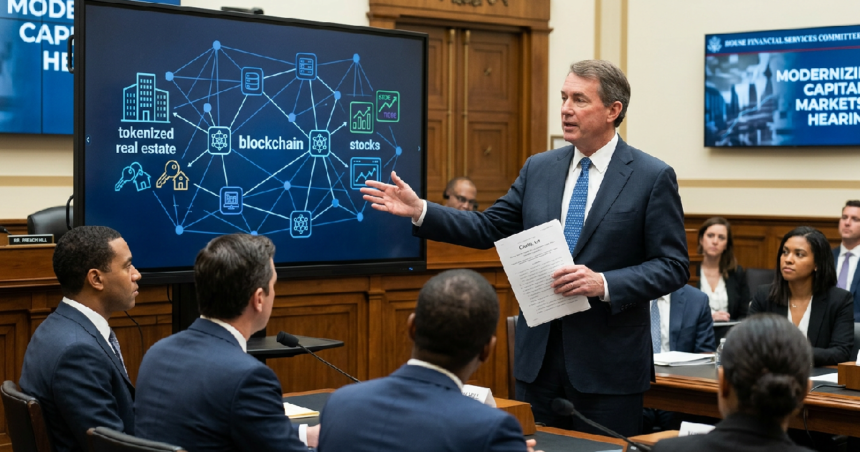
Representative French Hill, Chairman of the House Committee on Financial Services, has identified the tokenization of real-world assets as the next primary focus for his committee. This pivot follows the committee’s work on the stablecoin-focused GENIUS Act and the market structure-focused Clarity Act. In an interview with CoinDesk in early April 2026, Chairman French Hill stated that he expects the Clarity Act to secure bipartisan consensus, paving the way for a deeper exploration into how traditional securities can be represented on blockchain networks.
The House Committee on Financial Services is now assessing whether this technological shift requires new federal legislation or if it can be managed by existing regulators. Chairman Hill noted that moving a common stock onto a blockchain is essentially an “exercise in changing systems” rather than changing the law itself. Because legal and regulatory requirements for a common stock apply regardless of whether it is a physical paper or a digital token, the committee’s current hearings are aimed at raising member awareness and identifying potential regulatory gaps.
This push for modernization comes as lawmakers look to increase efficiency and transparency within American capital markets. The committee’s efforts are being closely watched by the digital asset industry, which has become increasingly politically active ahead of the 2026 election. With Ether enters rare accumulation phase according to some market observers, the legislative clarity provided by Washington could define how these networks are utilized by traditional financial institutions in the coming decade.
Examining the impact of tokenization on capital markets
On Wednesday, March 25, 2026, the House Committee on Financial Services held a full committee hearing titled “Tokenization and the Future of Securities: Modernizing Our Capital Markets.” During the session, lawmakers and industry witnesses discussed how distributed ledger technology could streamline financial processes. Chairman Hill compared the potential shift to the digitization that occurred in the 1970s and 1980s, which eventually reduced equity settlement times from T+5 to the current T+1 standard.
The committee is exploring the possibility of tokenizing deposits within the commercial banking industry, which could potentially enable direct debit payments without traditional intermediaries. While Chairman Hill noted that such a system is not imminent, it remains an area of interest for the committee. The biggest challenge identified during the proceedings was not the technical mechanics of blockchain, but the interoperability of these new systems with existing financial infrastructure and compliance standards.
But the transition is not without its hurdles. Lawmakers are currently navigating the complexities of how different digital assets are classified and treated under existing law. Some recently proposed measures have sparked debate, such as how the New Clarity Act blocks interest payments on certain stablecoin products. These discussions highlight the ongoing tension between fostering innovation and maintaining strict protections for investors in the maturing digital asset market.
Bipartisan support for small business efficiency
The hearing on March 25, 2026, also focused on the benefits of faster settlements for smaller market participants. Representative Roger Williams, who chairs the Small Business Committee and is a small business owner in Texas, argued that tokenization could modernize capital markets by reducing counterparty risk. He noted that more efficient movement of capital translates into better financing and more predictable cash flow for businesses operating on tight margins.
Representative Tim Moore (NC-14) added that tokenization has the potential to fundamentally modernize market operations by allowing traditional assets to be represented on blockchain-based systems. This could lead to lower costs and expanded access for investors. For the technology to flourish domestically, Summer Mersinger, CEO of the Blockchain Association, testified that the government must provide clear rules that allow innovation to grow within the United States.
Regulatory coordination and the role of the SEC
If the committee is successful in finalizing the GENIUS Act rulemaking and passing the Clarity Act, Chairman Hill anticipates a 12-month joint rulemaking process between the Commodity Futures Trading Commission (CFTC) and the Securities and Exchange Commission (SEC). This period would aim to implement a “fit-for-purpose” approach across federal agencies. The committee is also considering the “Modernizing Markets Through Tokenization Act of 2026,” a discussion draft that would require the SEC to evaluate existing rules.
The legacy of former committee leadership also continues to influence the current agenda. Former Chairman Patrick McHenry, who retired from Congress in January 2025, has remained active in the space by joining Ondo Finance as the vice chairman of its advisory board. His transition to the private sector highlights the growing crossover between those who drafted the nation’s financial regulations and the firms now seeking to implement tokenization for treasuries and other assets.
Political landscape and the 2026 election
Political activity within the digital asset ecosystem is expected to play a major role in the 2026 election cycle. Chairman Hill observed that the industry has become increasingly engaged over the past four years, not just on policy points but through the support of pro-innovation candidates on both sides of the aisle. This bipartisan appetite is critical as the committee prepares for its next oversight hearing with federal bank regulators on Thursday.
And as the legislative process moves forward, the focus remains on maintaining U.S. competitiveness. While institutions like Morgan Stanley expands bitcoin access for wealth clients, the House Financial Services Committee is looking toward a broader digitization of all financial instruments. Whether through new legislation or regulatory updates, the goal is a common integrated approach that brings the transparency of blockchain to the core of the financial system.