

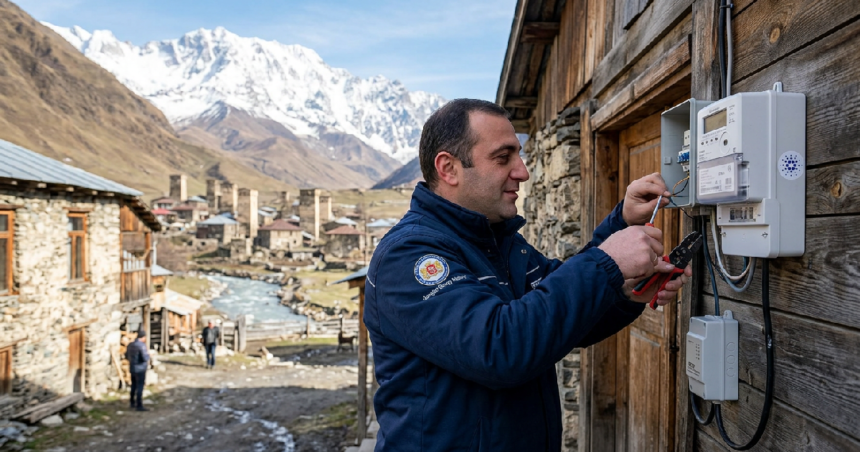
Vice Prime Minister Mamuka Mdinaradze and the Georgian government have launched a coordinated law enforcement crackdown on illegal cryptocurrency mining in the Mestia municipality of the Svaneti region following a catastrophic series of power surges. The initiative, announced officially on June 2, 2026, involves the mass installation of electricity meters and the introduction of new consumption tariffs to stabilize a grid that has been pushed to its breaking point by unauthorized mining rigs.
The situation in the mountainous northwest has reached a crisis level where local tourism and residential life are suffering from frequent outages. Data from 2025 reveals that Mestia’s electricity consumption reached a staggering 133 million kilowatt-hours (kWh). When compared to other municipalities of similar size that consume roughly 10 million kWh annually, the disparity is glaring—Mestia is using more than 13 times the amount of power expected for its population.
And while the region has long been a hub for digital asset activity, the current scale of the problem has forced the hand of the State Minister for the Coordination of Law Enforcement Agencies. Mamuka Mdinaradze confirmed that law enforcement agencies will now directly oversee the metering process to identify the clandestine operations responsible for the drain. This move aims to protect the local economy without penalizing ordinary households.
The financial impact of illicit crypto mining operations
The economic fallout from these unauthorized activities extends far beyond the borders of the Svaneti region. Government estimates suggest that illegal mining results in annual financial losses between 20 million and 25 million Georgian Lari (GEL), which translates to approximately $7 million to $9.4 million USD. This missing revenue creates a hole in the national energy budget that affects every citizen.
In a direct address regarding the strain, Vice Prime Minister Mamuka Mdinaradze noted that the issue creates an additional financial burden for consumers across the country. He estimated that each subscriber in Georgia effectively pays about GEL 1.5 extra per billing cycle to cover the costs of hidden electricity use. As the Cardano price outlook continues to shift with global market fluctuations, the domestic cost of energy remains a more immediate concern for Georgian taxpayers.
National energy consumption and industrial mining data
Georgia’s reputation as a mining haven is backed by heavy data. In 2025 alone, the country’s total cryptocurrency mining electricity consumption hit 752 million kWh. This figure represents 5% of all national electricity consumption, a massive slice for a single industry. Industrial data centers, which are primarily focused on mining, accounted for 556 million kWh between January and September of 2025.
But the problem in Mestia is unique because of historic subsidies. Residents in Upper Svaneti previously enjoyed fully subsidized electricity bills, a policy intended to support remote mountain communities. This “free” power inadvertently created a perfect environment for miners to set up shop without overhead, leading to the current grid instability that threatens the region’s vital tourism sector.
Metering and new tariff structures for Mestia residents
To combat the crisis, the government is moving away from the blanket subsidy model toward a more regulated system. New electricity meters will be installed across every village and settlement in the Mestia municipality. This allows the state to track usage patterns and pinpoint exactly where industrial-level consumption is masquerading as residential use.
Electricity in Svaneti will remain free for every consumer up to the maximum quantity required for their needs, according to Mamuka Mdinaradze. However, a specific limit and corresponding tariff will be imposed on any consumption exceeding that amount. This tiered system is designed to trigger only when mining rigs are drawing immense power, leaving the average homeowner unaffected by the change.
Law enforcement involvement and public cooperation
The government has made it clear that this is not a purely administrative task. Law enforcement agencies have been tasked with identifying illegal mining operations and responding to any attempts to obstruct the metering process. “We call on everyone to respect this process. Any obstruction and violation of the law will be followed by strict legal action,” Mamuka Mdinaradze warned during the June 1 announcement.
Previous attempts to curb the practice in 2021 and 2022 involved house-to-house disconnections and the seizure of equipment. However, those measures only provided temporary relief. The systemic failure of the grid in 2026 suggests that without permanent metering and financial penalties for over-consumption, the miners will simply return. As some investors look toward long-term targets in other asset classes, such as silver price gains during global uncertainty, the Georgian government is looking to secure its own infrastructure.
Future outlook for Georgia’s crypto mining landscape
The crackdown in Mestia may signal the end of Georgia’s “wild west” era of unregulated mining. For years, the country attracted miners with low prices and abundant hydropower from the Caucasus Mountains. But the social cost of frequent blackouts and the financial drain on the state have shifted the political winds toward stricter oversight.
Other parts of the country are also feeling the heat as the CFTC and global regulators move toward more transparent crypto market oversight. The Georgian government’s decision to involve law enforcement in the metering process reflects a growing trend of treatng energy theft as a major criminal offense rather than a simple utility dispute.
So, the local residents of Svaneti now face a transition period. If the metering succeeds in driving out the illegal industrial setups, the quality of electricity supply should improve, benefiting the tourism businesses that form the backbone of the local economy. For the miners, however, the days of free, unmonitored power in the mountains are coming to an abrupt close.