

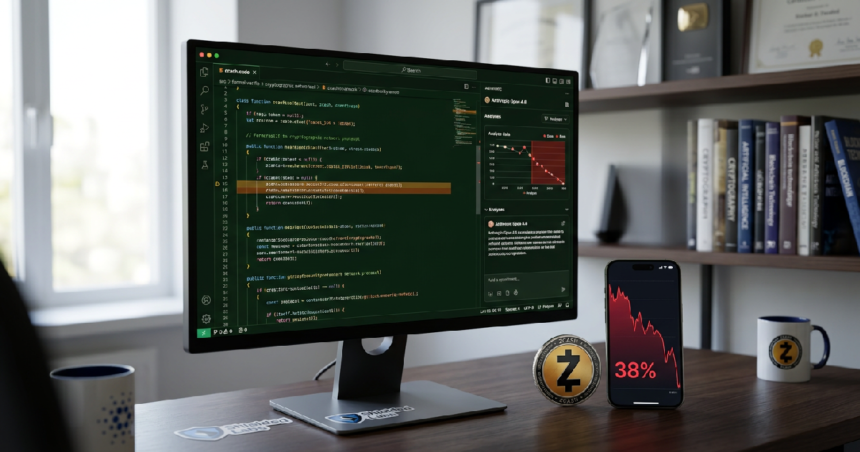
Nonprofit developer Shielded Labs revealed on June 5, 2026, that an advanced artificial intelligence model uncovered a four-year-old security flaw in the Zcash network, a discovery that sent the token price tumbling nearly 38% within 24 hours. Researchers using Anthropic’s newly released Opus 4.
8 AI model identified a logic error that could have allowed an attacker to create an unlimited supply of counterfeit tokens. While Zcash representatives confirmed the vulnerability has been remediated, the event has prompted industry leaders like CEO of SingularityNET Ben Goertzel to warn that similar bugs likely persist within traditional banking infrastructures.
The incident marks a turning point in the intersection of machine learning and cybersecurity, demonstrating that AI can now surface deep-rooted technical debt that humans missed for years. This logic error sat dormant in the Zcash implementation for four years, surviving multiple manual audits and developer reviews.
The revelation triggered a sharp selloff as panic spread through the crypto community. Market sentiment turned grim on social media, with some users suggesting the event proves the fragility of decentralized systems compared to the rapid advancement of AI-driven exploits.
Leading figures in the space argue that this is not merely a crypto-specific crisis but a systemic risk for all financial software. CEO Ben Goertzel told CoinDesk that while the specific Zcash bug was a logic error, other cryptocurrencies and centralized banking systems are almost certainly harboring comparable vulnerabilities.
He suggested that AI tools will likely discover these hidden flaws in the coming weeks and months as more powerful models become available to both researchers and malicious actors.
The rise of AI-driven vulnerability research in finance
The discovery was made possible by Anthropic’s Opus 4.8, a model specifically noted for its improved reasoning capabilities in complex code environments. However, the industry is already looking toward the upcoming Mythos model from Anthropic, which is expected to be even more proficient at identifying and chaining together weaknesses across systems.
This looming technological shift has created a sense of urgency among developers who manage mission-critical financial applications.
For investors, the immediate impact was a reminder of the volatility inherent in early-stage tech. While the Cardano price outlook often focuses on steady network growth, the Zcash incident shows how a single discovery can erase market value in hours. Investors are increasingly looking for networks that prioritize “formal verification” to prevent these implementation errors before they reach the mainnet.
Managing Partner Haseeb Qureshi of the venture capital firm Dragonfly, an early investor in Zcash, maintains a bullish stance despite the price crash. He argued on X that AI finding bugs is a net positive for the industry, as it forces a rigorous hardening of the codebase.
According to Haseeb Qureshi, the path forward involves a complete transition to formal verification, where code is written as mathematical theorems that can be automatically checked for correctness.
Formal verification as the primary defense mechanism
The concept of formal verification is gaining momentum as the only long-term solution to the AI threat. Co-founder of Ethereum Vitalik Buterin has previously described this process as creating mathematical proofs that guarantee a program follows its intended logic. By using AI to assist in these proofs, developers can ensure that implementation bugs by construction become a thing of the past.
Despite its benefits, formal verification is not yet a standard practice. CEO Ben Goertzel noted that while languages like Rust are well-suited for this process, developers often skip it due to the significant extra workload involved. Furthermore, some core Rust libraries use “unsafe” constructs that are difficult to verify mathematically.
Rewriting these systems for safety often results in slower performance, though techniques like “supercompilation” may eventually bridge that gap.
As the crypto market window closes on experimental projects, the demand for ironclad security is shifting from a luxury to a requirement. Projects that fail to adopt these rigorous standards may find themselves increasingly vulnerable to automated scanning tools used by profit-driven hacking groups.
The asymmetric war between hackers and security firms
CEO and co-founder of security firm CertiK Ronghui Gu describes the current environment as an “asymmetric security war.” This imbalance stems from a “token consumption war” where hackers can focus massive amounts of AI computing power on a single target. Since hackers are motivated by the potential for multi-million dollar thefts, they are willing to burn significant resources to find a single exploit.
In contrast, security firms must protect hundreds of clients simultaneously. Allocating the same level of concentrated AI processing power to every single smart contract is prohibitively expensive for defensive teams. To counter this, Ronghui Gu suggests that developers must integrate automated scanners directly into their daily workflows, rather than relying on one-off audits that provide a single point of reference.
The Zcash vulnerability serves as a stark warning for the traditional banking sector, which often relies on legacy systems that may be decades old.
If a four-year-old bug can be found in a modern privacy-focused blockchain, the layers of technical debt in global banking could prove to be an even more attractive target for AI-assisted attackers. Experts warn that centralized institutions embody serious bugs that AI tools will likely uncover in the near future.
Future outlook for financial software security
The consensus among experts like CEO of ZODL Josh Swihart, the former CEO of Electric Coin Company, is that the industry must adopt a “Never Again” mentality. For Zcash, this means prioritizing formal verification on its long-term roadmap. The goal is to move away from reactive patching and toward a system where vulnerabilities are mathematically impossible to implement.
In the short term, markets remain on edge. Traders are watching major assets closely, as Bitcoin volatility often spikes during periods of broader sector uncertainty. As more sophisticated AI models like Mythos enter the public domain, the race between developers and exploiters will only accelerate, redefining what it means for a financial network to be secure in 2026.