

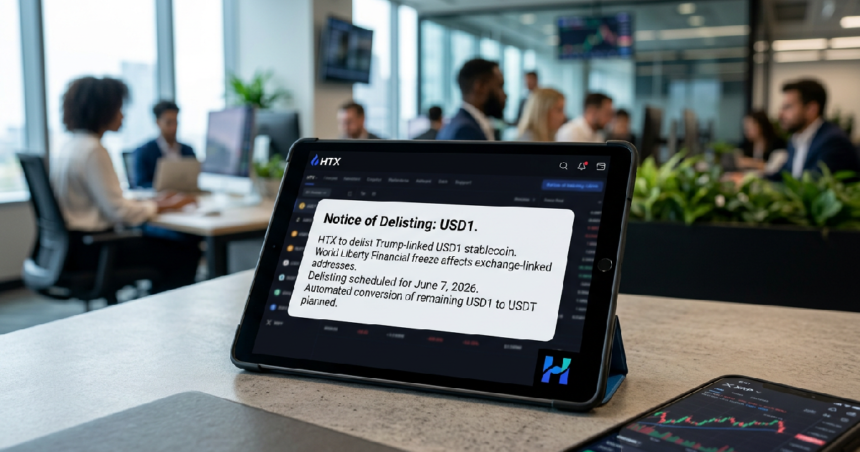
The cryptocurrency exchange HTX announced it will officially delist the Trump-linked USD1 stablecoin on June 7, 2026, following a bitter dispute with World Liberty Financial (WLFI). The decision comes after World Liberty Financial, a crypto venture associated with Donald Trump and his family, froze several on-chain addresses linked to the exchange.
HTX, which is advised by Tron founder Justin Sun, stated the delisting is necessary to protect its user base from what it described as a “unilateral” and “groundless” move by the stablecoin issuer.
The conflict escalated rapidly after World Liberty Financial claimed the asset freeze was a result of necessary sanctions compliance reviews. This follows the United Kingdom’s decision on May 26, 2026, to issue sanctions against Huobi Global S.A., a Panama-registered entity tied to the exchange’s broader operations.
While the exchange has publicly denied these allegations, the friction has led to a total breakdown in the relationship between the two crypto heavyweights.
HTX moved to suspend trading for several major pairs involving the stablecoin, including WLFI/USDT, USD1/USDT, BTC/USD1, and ETH/USD1, on June 5, 2026, at 13:00 UTC. The exchange has also halted all deposits and withdrawals for the token.
For users still holding the asset, HTX confirmed that it will convert eligible USD1 balances into the market-leading stablecoin Tether (USDT) at a 1:1 ratio after the formal delisting process is complete.
World Liberty Financial frozen addresses trigger retaliatory delisting
The core of the dispute lies in the protocol-level control exercised by World Liberty Financial over its USD1 stablecoin. According to HTX officials, the decision by the Trump family crypto project to freeze exchange-linked addresses occurred without prior communication or transparent disclosure. They argued that such actions infringe on the property rights of individual traders who use the platform.
This development underscores the inherent risks of centralized stablecoins that can be blacklisted by issuers. While World Liberty Financial maintains that it must comply with global regulatory standards, the exchange views the move as a breach of standard industry practice. The tension reflects a broader struggle within the market as new stablecoin regulations and sanctions lists force issuers to take aggressive compliance actions.
Sanctions and the link to Huobi Global S.A.
The regulatory pressure on HTX intensified in late May when the United Kingdom government designated Huobi Global S.A. under its sanctions regime. Although HTX rebranded from Huobi to distance itself from past legal entanglements, the connection remains a focal point for Western regulators. World Liberty Financial appears to be distancing itself from any entity with potential exposure to these legal risks.
The Trump-affiliated LLC that owns approximately 38% of World Liberty Financial has a significant financial stake in ensuring the project remains compliant with international law. By freezing addresses tied to a sanctioned entity, the project likely hopes to avoid secondary sanctions. However, the move has effectively killed the liquidity for its primary stablecoin on one of the world’s most active exchanges.
HTX converts USD1 holdings to Tether to protect users
To mitigate the fallout for its customers, HTX decided to automate the transition away from the embattled stablecoin. The exchange will take a snapshot of all eligible user balances and facilitate a 1:1 swap into Tether. This move aims to prevent HTX users from being trapped in an illiquid asset that they can no longer trade or withdraw.
The delisting is scheduled to take effect across different time zones throughout June 7, 2026. Specifically, the exchange outlined the following deadlines for the transition:
- June 7, 2026, at 03:00 UTC: Initial delisting procedures begin.
- June 7, 2026, at 11:00 UTC+8: The USD1 stablecoin is officially removed from all HTX services.
- Post-delisting: Conversion of eligible USD1 holdings to USDT will be finalized.
The exchange noted that the specific time for the USDT distribution will be announced separately. This proactive approach mirrors other instances where exchanges have stepped in to provide liquidity during bearish pressure and asset instability. By using USDT, the exchange is leaning on the most established stablecoin to provide a “safe harbor” for its affected users.
Impact on the Trump crypto venture and market liquidity
The removal of USD1 from HTX is a significant blow to the World Liberty Financial project. HTX represents a major gateway for global liquidity, and losing such a platform restricts the stablecoin’s utility. Without a major exchange to facilitate trading against Bitcoin and Ethereum, the USD1 token risks becoming a niche asset used only within its own ecosystem.
This divorce between the Trump-linked project and HTX highlights the fragmentation occurring in the digital asset space. While liquidity surges in other sectors, projects that fail to manage regulatory friction find themselves isolated. The move also puts unwanted pressure on the WLFI governance token, which was part of the original trading suspension on June 5.
Future outlook for centralized stablecoin compliance
The HTX and World Liberty Financial fallout serves as a warning for other stablecoin issuers. As governments in the United Kingdom and United States tighten their grip on crypto firms, issuers are increasingly forced to choose between exchange partnerships and strict compliance. This “freeze first, explain later” methodology is likely to become more common as projects seek to avoid the fate of sanctioned entities.
For traders, the lesson is clear: even dollar-pegged assets are not immune to platform-wide de-platforming. HTX has made it clear that any project that unilaterally freezes its addresses will face immediate delisting. This stance may protect the exchange’s autonomy, but it leaves users caught in the middle of high-stakes corporate and political disputes.