

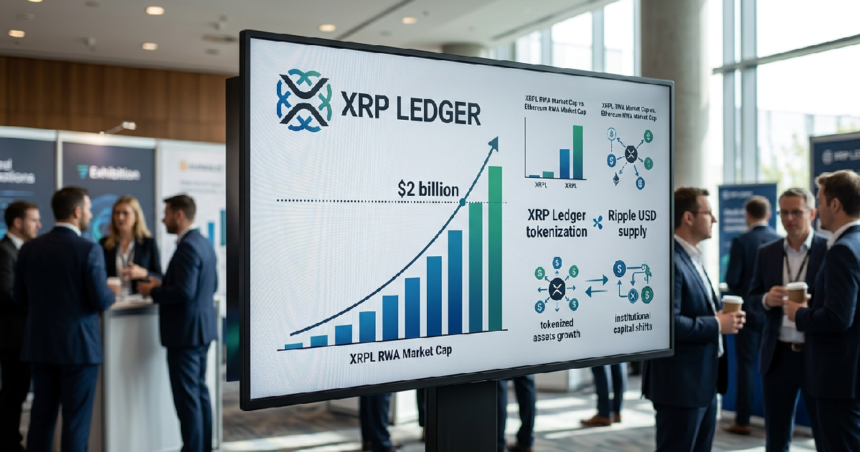
The XRP Ledger (XRPL) saw its real-world asset (RWA) market capitalization grow by more than 124% during the first quarter of the year, with total tokenized assets reaching approximately $2.25 billion in Q1 2026. This growth comes as institutional interest in on-chain financial products accelerates, with the XRPL reaching $400 million in tokenized RWA value within just 15 months of operation. In contrast, it took Ethereum 36 months to achieve a similar $400 million milestone, highlighting a quickening pace of adoption for the Ripple-linked network.
While Ethereum maintains its position as the largest tokenization ecosystem with an RWA Active Market Cap of $14.251 billion as of June 8, 2026, the XRPL is recording faster relative growth. According to a report by Evernorth, XRPL’s tokenized value increased by 78% this year, rising from $227 million to $404 million. During the same period, Ethereum’s tokenized value grew by 36%, moving from $13.8 billion to $18.66 billion.
On June 5, 2026, Ripple CTO Emeritus David Schwartz stated that XRP utility is expanding to support issued assets, tokenized real-world assets, and financial products such as securities, funds, repos, and loans. This technical shift is supported by the network’s low-cost transaction model, which settles in 3-5 seconds for fractions of a cent.
Unconfirmed reports of capital shifting between networks
Market participants are closely watching suspected movements of liquidity between the two major blockchains. Crypto analyst Ledger Man claimed on June 7, 2026, that the XRP Ledger recorded approximately $1.5 billion in new RWA inflows over the last 30 days. During that same 30-day window, Ethereum reportedly experienced roughly $1.2 billion in RWA outflows.
While these specific figures remain unconfirmed, they have contributed to a narrative that XRP momentum restarts as institutions seek alternative infrastructure for tokenized securities. The XRPL has reportedly absorbed over $3.6 billion in tokenized RWA value within five months, marking a 63% increase in just the last 30 days, according to data from RWA.xyz. Analysts at Citi currently project that the total RWA tokenization market could reach $5 trillion by the end of 2026.
Concentration of treasury-scale tokenization activity
The surge in XRPL’s asset value appears to be driven by large, concentrated movements rather than a steady retail climb. Research indicates that 96% of all new tokenization activity on the XRP Ledger over the past year occurred in just 20 days. This pattern suggests treasury-scale commitments from institutional players rather than gradual market entry.
Tokenized U.S. Treasuries have become a focal point of this activity, with their value on the XRPL increasing eightfold to $418 million. Despite this rapid growth, XRP face selling pressure in some trading segments, even as its underlying ledger utility for institutional funds and repos expands. The network has processed over $1 trillion to date, maintaining over 12 years of uptime.
Stablecoin liquidity and the role of RLUSD
A key component of this growing ecosystem is the Ripple USD (RLUSD) stablecoin. The RLUSD supply grew 45% in Q1 2026 and currently stands at approximately $762 million. This total includes a 22% increase in supply recorded in recent weeks, as reported on June 8, 2026. This influx of stablecoin liquidity provides the necessary rails for complex financial products to function on-chain.
To enhance its reach, RLUSD has expanded to multiple networks through Wormhole integration. This move allows the stablecoin to serve as a liquidity bridge for tokenized assets across different blockchain environments. Over the past month, the total XRPL stablecoin capitalization jumped 77% to $888.5 million, while transfer volumes surged 123% to reach $4.71 billion.
Ethereum continues to lead institutional adoption
Despite the aggressive growth rates seen on the XRP Ledger, Ethereum remains the primary hub for tokenized finance. Approximately 65% of all publicly available on-chain RWA value is held on the Ethereum network. Major institutional projects, such as BlackRock’s BUIDL money market fund, have seen rapid success on the platform, with BUIDL accumulating over $300 million in assets under management within weeks of its March 2024 launch.
Other major players continue to utilize Ethereum’s established infrastructure. Franklin Templeton’s OnChain US Government Money Market Fund (FOBXX) reached $360 million in assets by April 2024. Furthermore, JPMorgan’s Onyx platform is processing daily repo transactions exceeding $1 billion. Joseph Chalom, co-CEO of Sharplink Gaming, suggested that Ether enters rare accumulation phase as the market prepares for a potential 10x increase in total value locked (TVL) through 2026.
The stablecoin market is expected to grow from $308 billion to $500 billion by the end of 2026, and Ethereum currently hosts more than half of all stablecoin activity. While the reported capital shifts indicate a changing competitive landscape, most observers view these movements as short-term adjustments rather than a fundamental pivot away from Ethereum’s deep liquidity and massive developer base.