

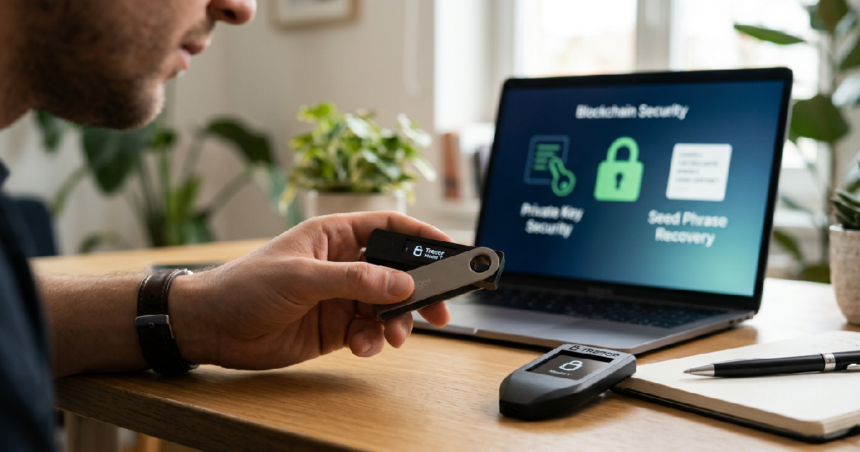
Investors looking for the top wallets to safely buy and store altcoins must navigate a market that now includes over 14,000 different digital assets. Choosing between hardware wallets, designed for maximum security, and software wallets, built for transactional convenience, has become the standard approach for managing these alternative currencies.
Because altcoins often offer faster transactions and support for decentralized applications (dApps) compared to Bitcoin, the underlying storage infrastructure must be robust enough to handle high-frequency interactions across multiple blockchain networks.
The fundamental role of a cryptocurrency wallet is frequently misunderstood; these tools do not actually store the digital coins themselves. Instead, the assets remain on the blockchain, while the wallet manages the public and private cryptographic keys necessary to access and move them.
Losing control of these keys effectively means losing the assets, making the security features and user experience of a chosen wallet the primary defense against permanent financial loss. As the market momentum builds around utility for various tokens, the distinction between cold and hot storage remains a critical strategic decision for every participant.
Current market conditions suggest that while institutional interest is growing, individual security remains a personal responsibility. Unlike traditional banking, where unauthorized transfers might be reversed, blockchain transactions are generally final.
This reality places a premium on wallets that offer clear key generation processes and reliable recovery mechanisms, such as a seed phrase, to ensure that users can reclaim their funds if their primary access device is lost or damaged.
Mechanical breakdown of altcoin wallet security
Every interaction with an altcoin starts with the generation of a unique cryptographic key pair. The private key acts as a secret alphanumeric password that must never be shared, as it provides the digital signature required to authorize any transfer of funds.
Conversely, the public key is used to generate the wallet address, a hashed version that functions similarly to a bank account number for receiving assets from other users.
When a user sends a transaction, the wallet software uses the private key to sign the request without ever exposing the key itself to the network. The blockchain ledger then verifies this signature to confirm ownership before updating the balance.
This mechanical process ensures that even in an environment with thousands of different tokens, the proof of ownership remains anchored in mathematical certainty rather than third-party trust.
Seed phrases and recovery protocols
Most non-custodial wallets produce a seed phrase during the initial setup, typically consisting of 12 distinct words. This phrase serves as a human-readable master key that can reconstruct the entire wallet on new software or hardware. Because this phrase bypasses all other security layers, experts recommend storing physical copies in secure, offline locations to prevent digital theft or accidental deletion.
The reliance on these recovery phrases highlights the “non-custodial” nature of most high-security wallets. By holding the keys and the recovery phrase, the user retains total control over their assets. However, this also means there is no “forgot password” service available if the seed phrase is lost, creating a high-stakes environment where disciplined storage habits are mandatory for long-term holders.
Choosing between hardware and software wallets
Hardware wallets represent the “cold storage” tier of security, keeping the private keys in a physical device that is disconnected from the internet. This isolation protects the keys from remote hackers and malware that might infect a computer or smartphone. They are the preferred choice for significant holdings, especially as altcoins show strength relative to major assets and portfolios grow in value.
Software wallets, often called “hot wallets,” exist as applications or browser extensions. They provide the agility needed for frequent trading or interacting with smart contracts but carry a higher risk profile due to their persistent online connection.
Many investors find a balance by using software wallets for daily utility while keeping the bulk of their assets secured in a hardware device that only connects during infrequent, large-scale transfers.
Broad support and user experience
A top-tier wallet must provide broad support for a wide variety of altcoins to be effective. Since the 14,000+ available tokens operate on diverse blockchain protocols, a wallet that only supports a single network limits an investor’s ability to diversify. Compatibility with various standards ensures that users can manage their entire portfolio through a single, secure interface without juggling multiple fragmented apps.
User experience also serves as a security feature. A well-designed interface reduces the likelihood of “fat-finger” errors, such as sending funds to an incompatible address or selecting the wrong network. Clear transaction previews and intuitive navigation help ensure that the user understands exactly what they are signing before they use their private key to broadcast a transaction to the blockchain.
Managing risks in the contemporary crypto market
While a secure wallet protects the keys, it cannot protect the user from every market risk. The underlying value of an altcoin can still be affected by external factors, such as shifting capital flows or changes in the regulatory environment. For example, some market observers have noted that com/altcoins-fade-capital-shift-real-world-assets-2026-analysis/”>altcoins fade when institutional capital shifts toward other asset classes, a trend that persists regardless of how securely the tokens are stored.
Interoperability also introduces specific challenges. Many altcoins rely on cross-chain bridges or complex decentralized finance protocols to function, and these external layers can sometimes experience technical failures. While the wallet itself remains a secure vault for the keys, the integrity of the blockchain network and the protocols built upon it are separate variables that investors must monitor to truly protect their wealth.
Developing a tiered storage strategy
The most effective way to use these tools is through a tiered strategy that separates long-term savings from active capital. By hardware-securing the majority of a portfolio and only moving small amounts to software wallets for immediate needs, users can significantly reduce their exposure to online threats.
This approach treats the hardware wallet as a vault and the software wallet as a digital “pocket” for daily use.
Regular security audits of one’s own habits are also necessary. This includes verifying that seed phrases are still readable, checking for software updates from wallet providers, and staying informed about common phishing tactics. As the technology evolves to make digital asset management more accessible, the core principles of private key confidentiality will continue to be the most important factor in the safe storage of altcoins.