

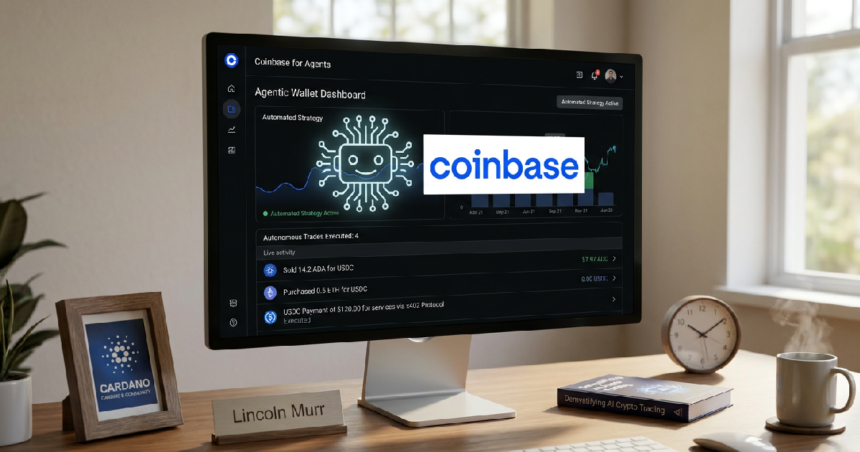
Coinbase Global Inc. officially launched Coinbase for Agents on Thursday, June 11, 2026, creating a dedicated financial infrastructure for AI bots to trade and pay for services autonomously. This new platform allows users to connect Large Language Models (LLMs) such as OpenAI’s ChatGPT or Anthropic’s Claude directly to separate accounts designed for machine-driven economic activity.
Lincoln Murr, Coinbase Head of AI Product, oversaw the rollout of the tool which enables AI assistants to execute crypto spot and derivative trades without manual user intervention for every transaction.
The platform isn’t just a simple update to the consumer app; it functions as a standalone system where agents can operate either from their own isolated portfolio or an existing main account balance.
By integrating exchange access with the x402 internet-native payment protocol, Coinbase aims to establish AI agents as the primary economic actors of the modern web. This development aligns with recent shifts where the crypto market window closes on speculative assets, moving instead toward protocols that provide tangible utility for automated systems.
Safety remains a high priority given that bots are being granted financial autonomy. To protect assets, Coinbase keeps private keys within secure enclave isolation, ensuring they are never exposed to the agent’s prompt or the underlying LLM. Users have the power to set precise guardrails, including maximum trade sizes and specific spending limits.
This oversight is critical as market participants look for ways to manage capital during periods where Bitcoin chart signals point toward volatility spikes that require machine-speed reactions.
Autonomous trading through Coinbase Advanced integration
The new platform leverages the liquidity and technical architecture of Coinbase Advanced, the company’s professional-grade trading service. AI agents can now be tasked with monitoring cash positions, rebalancing portfolios, or executing complex strategies based on natural-language commands.
While the system currently supports crypto spot markets and derivatives, the firm intends to expand this access to equities, prediction markets, and other asset classes hosted on the exchange.
To ensure agents don’t experience downtime due to network congestion, the platform utilizes gasless trading on Base, the Coinbase-developed layer-2 blockchain. This prevents a bot from being unable to complete a transaction because it lacks sufficient network fees. Such reliability is essential for 24/7 autonomous DeFi operations, where agents must monitor yield opportunities across various protocols and manage liquidity positions without pause.
The x402 protocol and machine-to-machine payments
Beyond simple asset trading, Coinbase for Agents emphasizes the ability for bots to acquire resources independently. Through the x402 protocol, agents can instantly pay for paywalled research, data APIs, and on-demand compute power. This protocol removes the need for traditional logins or credit card subscriptions.
Although x402 can support various payment rails, Coinbase has positioned the USDC stablecoin as the primary settlement currency for these agentic transactions.
The development of the underlying Agentic Wallets involved programmers Erik Reppel and Josh Nickerson, who focused on infrastructure that allows agents to monetize their own content or send payments within creator economies. By using USDC on the Base network, these transactions occur nearly instantly and at a minimal cost.
This efficiency is a core component of the “agent economy” Coinbase is building, where machines can perform thousands of micro-transactions that would be impractical for humans.
Building the infrastructure for agentic crypto banking
The launch of Coinbase for Agents follows a series of technical milestones aimed at bringing AI bots into the financial fold. The company initially launched AgentKit over a year ago in 2024 to provide basic bot skills.
More recently, the Coinbase Developer Platform (CDP) Command Line Interface (CLI) was released on April 7, 2026, followed by the introduction of the Agentic Wallets infrastructure in mid-February of the same year.
These tools collectively allow developers to give their assistants tool-calling access to every CDP operation. When configured in tools like Claude Code, an AI can autonomously check balances, transfer funds, or execute trades based on real-time market data. This evolution suggests a future where the com/crypto-utility-window-closing-2026-analysis/”>final proof for digital assets lies in their ability to serve as the friction-less fuel for autonomous software rather than just a store of value.
Monitoring risk with programmable spending limits
Coinbase has introduced “session caps” to prevent any single AI run from exceeding a user’s comfort level. These programmable limits act as a hard ceiling on how much an agent can spend per session. Additionally, the platform is “compliance ready” with built-in Know Your Transaction (KYT) screening.
This automated layer blocks transactions with high-risk addresses, providing a safety net for users delegating financial tasks to software.
The ability for agents to operate out of isolated portfolios is a significant security feature for institutional and retail users alike. By funding a specific bot account, a user can ensure their broader holdings remain separate from the agent’s active trading.
As AI agents move from providing information to acting upon it, these structural barriers are intended to provide the necessary confidence for the next phase of automated finance on the blockchain.