

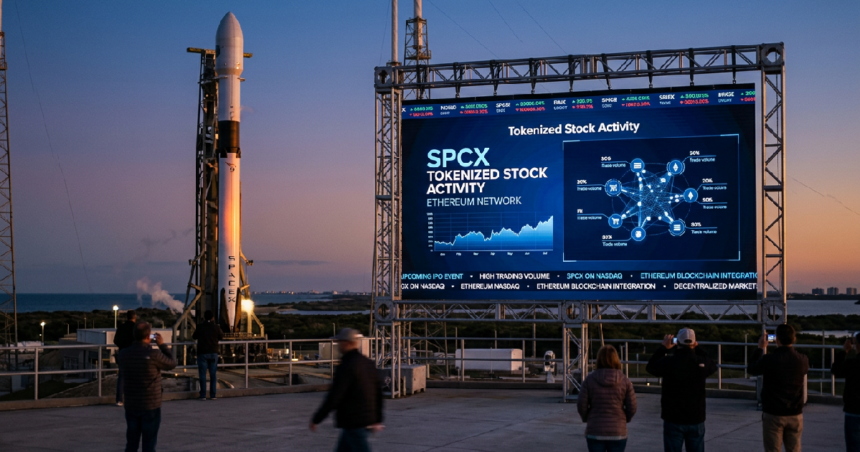
SpaceX surged as much as 20% on Friday, June 12, 2026, following its record-breaking debut on the Nasdaq. The aerospace giant, trading under the ticker SPCX, priced its initial public offering (IPO) at $135 per share but opened at $150 and climbed as high as $173.22 during early trading. This massive listing raised approximately $75 billion, making it the largest IPO on record and pushing the company’s valuation above the $2 trillion mark.
The launch triggered immediate demand for tokenized SpaceX shares and synthetic products across multiple blockchain platforms. Total 24-hour trading volume for tokenized SpaceX (SPCX) reached $86.75 billion, a 229.77% increase from the previous day. While the traditional financial world focused on the Nasdaq listing, global crypto markets effectively became a parallel venue for those seeking exposure to the aerospace firm’s performance.
Despite the heavy capital requirements of the $75 billion IPO, the broader digital asset market remained resilient. Ether enters rare accumulation phase as the global cryptocurrency market capitalization actually rose 1.7% to $2.26 trillion during the session. Bitcoin gained roughly 2%, and Solana advanced 3.5%, defying warnings that the SpaceX listing would drain liquidity from the crypto ecosystem.
Tokenized stocks surge alongside Nasdaq debut
The debut served as a massive catalyst for the real-world asset (RWA) sector, which has seen tokenized stocks jump 422% since the start of 2025. Platforms such as Backpack Securities and Sunrise launched SPCX, a Solana-based token backed by underlying SpaceX shares. These products provided a route for global investors, particularly those in Asia who were largely excluded from the traditional IPO book, to trade the stock with 24/7 liquidity.
On decentralized exchanges, synthetic exposure saw even more intense activity. Hyperliquid’s synthetic SPCX perpetual contract became one of the most discussed products, with implied valuations trading above the IPO price before the market officially opened. This surge in volume allowed Hyperliquid to temporarily overtake XRP in futures open interest, as its total open interest across all markets hit $8.77 billion.
Binance Wallet also reported significant engagement, attracting roughly $557 million in subscription funds for its SpaceX-linked campaign. This offering provided tokens at an indicative price of 135 USDC before fees. Elsewhere, the Velvet token rallied more than 1,400% over the week leading up to the debut as it promoted synthetic SPCX markets.
Prediction markets outpace on-chain gambling
The SpaceX IPO highlighted a growing shift in how crypto traders use prediction platforms to gauge institutional events. On Polymarket, a contract tracking the company’s closing valuation showed that traders assigned 78% odds to SpaceX finishing its debut with a market cap between $2 trillion and $2.5 trillion.
This trend comes as prediction markets surpassed on-chain gambling for the first time in the first quarter of 2026. These platforms generated $36.6 billion in volume during that period, compared to $14 billion for traditional on-chain gambling. This growth suggests that crypto market window closes on simple betting in favor of more complex, event-driven financial instruments.
Regulatory hurdles and valuation debates
While the markets celebrated the successful listing, political and analytical pushback remained visible. Senator Elizabeth Warren urged the Securities and Exchange Commission (SEC) to delay the offering, citing what she described as “unprecedented threats to investor protection and market integrity.” Warren specifically questioned the company’s valuation and governance structure, though demand for the IPO remained high with orders exceeding $350 billion.
Traditional analysts also expressed skepticism about the company’s current price levels. Morningstar experts estimated a fair value of approximately $63 per share, which is less than half of the $135 IPO price. They pointed to significant future capital expenditure requirements as a potential risk, even as bullish forecasts from other firms suggest the stock could move toward $190.
Future impact on the Ethereum and RWA sectors
The success of the SpaceX listing has set a roadmap for other major technology firms considering public debuts. Market participants are already watching for potential offerings from companies like OpenAI and Anthropic, which could further fuel the demand for tokenized equities. Currently, the total market cap for tokenized equities has reached an estimated $5.5 billion.
As more assets move on-chain, the reliance on stablecoin liquidity becomes increasingly important. During the SpaceX debut, USDT maintained its $186.8 billion market capitalization, while USDC held steady near $74.8 billion. Bitcoin chart signals point toward continued interest in these high-liquidity environments as the barriers between traditional stock exchanges and decentralized finance continue to dissolve.
Options on SpaceX shares are expected to begin trading next week. This will likely introduce a new layer of complexity to the tokenized derivatives market, as traders look to hedge their synthetic positions against official Nasdaq price movements. If the current momentum in the RWA sector holds, tokenized stocks may transition from a niche speculative play to a core component of digital asset portfolios.