

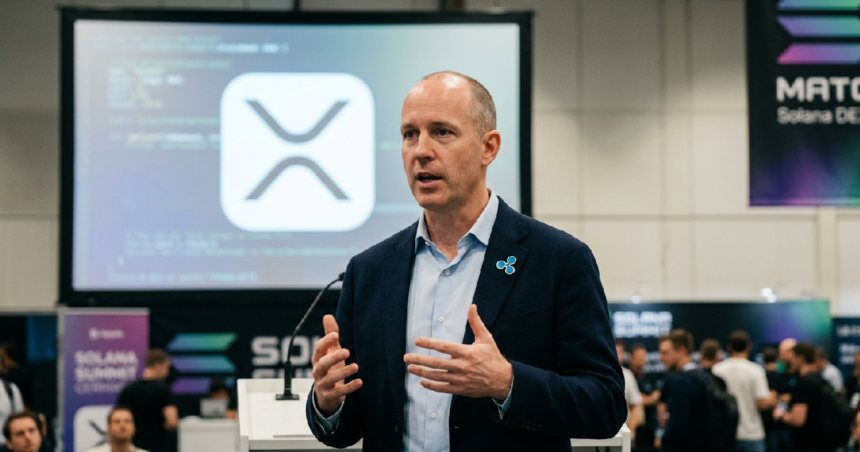
Former Ripple Labs Director of Developer Relations Matt Hamilton has claimed that the XRP Ledger (XRPL) addressed critical market structure issues long before modern competitors. Speaking on June 15, 2026, Hamilton suggested that new decentralized exchange (DEX) projects on Solana are effectively “reinventing the wheel.” He explicitly noted that “this problem was solved 15 years ago on the $XRP Ledger.”
Hamilton’s remarks followed the presentation of Mato, a new Solana DEX project, at the Solana Summit Germany. Mato founder Thomas Gehrmann pitched the protocol as a solution to front-running and order sequencing games. However, Hamilton argued that these challenges were overcome during the earliest days of the XRP Ledger, which began development in 2011 and launched in 2012.
The former Ripple developer described the XRPL as “the very first DEX in existence,” highlighting its built-in central limit order book (CLOB). Unlike many modern blockchains that rely on smart contracts to facilitate swaps, the XRPL integrated exchange tools directly into its core protocol. This design has allowed the network to maintain transaction costs of roughly $0.0002 while processing 1,500 transactions per second.
Hamilton critiques the novelty of Solana DEX projects
While Mato aims to make trading fairer through a continuous clearing auction, Hamilton expressed frustration with the industry’s repetitive development cycles. “I fear this is why we never move on as an industry,” he stated, referring to the tendency of new blockchains to re-solve established problems. He acknowledged it is positive that Solana might now have these solutions but questioned the necessity of the delay.
The debate comes at a time of high activity for the Solana ecosystem, which saw its Total Value Locked (TVL) hit $3.8 billion in 2024. Leading platforms like Jupiter and Raydium continue to dominate volume, even as XRP momentum restarts in various liquidity pools. Despite Solana’s 2020 mainnet launch, Hamilton maintains that the XRPL’s 2012 debut established the blueprint for decentralized trading.
Market structure and the fight against front running
Thomas Gehrmann’s Mato protocol attempts to solve the “searcher” problem, where sophisticated bots manipulate transaction order to profit from retail trades. By processing orders in parallel rather than one at a time, Mato seeks to eliminate the priority given to specific takers. Parallel processing is a central pillar of Solana’s pitch for high-speed, fair decentralized finance.
The XRP Ledger, however, has operated its CLOB without the need for automated market makers (AMMs) for over a decade. While it now supports AMM functionality and proposed “AMM Swappable Curves” for concentrated liquidity, its primary exchange mechanism remains a protocol-level feature. This stability is reflected in its history of closing 70 million ledgers since its inception.
Historical development and the XRP Ledger timeline
The timeline of the XRPL is a point of pride for its early contributors. Development started in 2011, making the “15 years ago” timeline cited by Hamilton a reference to the ledger’s earliest engineering phase. By the time Solana began development in 2017, the XRP Ledger had already been functioning as a decentralized settlement and trading layer for five years.
This historical context often clashes with modern projections for XRP value that focus on institutional adoption. While Solana has captured the retail and meme coin markets, the XRPL is moving toward regulated utility. Ripple Labs is currently preparing to launch an Ethereum Virtual Machine (EVM) sidechain in Q2 2025 to bridge these two worlds.
Scalability and the evolution of decentralized finance
The XRP Ledger remains a highly scalable network with transaction speeds of 3 to 5 seconds. Beyond simple trading, the ledger is expanding into real-world assets (RWAs) and decentralized identity (DID) for permissioned exchanges. These features aim to provide a more robust framework for institutional users who require identity verification and legal compliance.
And yet, Solana’s retail growth remains a benchmark for the industry. Platforms like Orca facilitated over $26 billion in trading volume by mid-2024, demonstrating that user experience and liquidity often outweigh historical precedence. Hamilton’s critique suggests that while Solana is catching up in terms of fairness protocol, the XRPL’s decade-long operational history already provides those safeguards.
A look ahead at DEX competition in 2026
The tension between being “first” and being “most used” continues to define the relationship between the XRPL and Solana. While Matt Hamilton focuses on the technical solutions solved in 2011, the market often rewards the ecosystem with the most active developer community. Solana’s ability to generate $500 million in revenue through platforms like Pump.fun shows a different type of success.
But the XRPL is not standing still, with ongoing proposals for unsecured on-chain lending protocols and stablecoin launches like the MXNB Mexican peso. These developments suggest that both networks are converging on similar goals from different directions. Whether the industry learns from its history or continues to reinvent it, the competition for the ultimate DEX infrastructure remains wide open.