

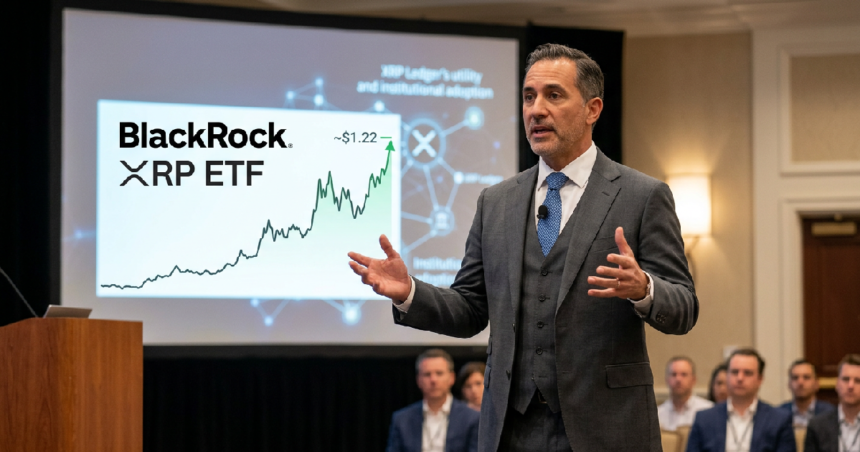
Jake Claver, the CEO of Digital Ascension Group and founder of Digital Wealth Partners, has publicly forecasted the imminent arrival of a BlackRock XRP ETF as the XRP Ledger (XRPL) secures a stronger foothold in the institutional market.
The investment advisor and crypto commentator, who manages a significant following on X under the handle @beyond_broke, contends that the infrastructure for a major institutional fund is now maturing. Claver’s prediction comes as XRP trades near $1.22, reflecting a 3.29% daily gain amidst a broader shift toward utility-driven digital assets.
Claver’s outlook is grounded in his role as a regulated investment advisor with the SEC and his experience as an author on special purpose vehicles. He argues that the increasing integration of XRPL into global financial pipelines makes the asset an unavoidable candidate for BlackRock, the world’s largest asset manager.
This potential shift occurs as various XRP momentum signals restart following recent liquidity surges that have bolstered the token’s market position.
The timing of these claims is particularly relevant as the digital asset market moves away from speculative trading and toward proven infrastructure. Claver suggests that the regulatory landscape is finally clearing enough for giants like BlackRock to move beyond Bitcoin and Ethereum.
He points to the XRPL’s ability to handle high-frequency cross-border payments as the specific value proposition that will eventually force the hands of traditional finance institutions.
Infrastructure readiness and the role of BlackRock
BlackRock has already set a precedent with its successful spot Bitcoin and Ethereum ETFs, leading many to wonder which asset is next in line. Jake Claver believes the XRP Ledger’s growing adoption by financial institutions provides the necessary data points for an ETF filing.
He suggests that BlackRock’s entry into the space would not just be a speculative bet, but a recognition of XRP’s role as a bridge currency for international trade.
The institutional case for XRP is often tied to its speed and low transaction costs compared to legacy systems. As the CEO of Syndicately, Claver has observed how investment management platforms are increasingly looking for efficient ways to move capital. He posits that an ETF would provide the “on-ramp” that conservative institutional investors require to gain exposure without the technical hurdles of direct wallet management.
Market maturity and the XRP Ledger’s growth
The XRP Ledger has seen expanded use cases beyond simple payments, including tokenization of real-world assets (RWA). This diversification is a key pillar of Claver’s argument, as it demonstrates the network’s longevity. Unlike many “ghost chains,” XRPL has maintained consistent developer activity and a high volume of transactions, which are critical metrics for any fund manager conducting due diligence.
For investors, the potential for a BlackRock-backed fund represents a massive injection of liquidity. While analysts project diverging paths for XRP over the next several years, the presence of a spot ETF would likely stabilize the asset’s price floor. Claver argues that the “utility window” for digital assets is currently narrowing, meaning only those with real-world applications will survive the next wave of regulation.
Regulatory hurdles and the SEC-registered perspective
As a founder of an SEC-registered investment advisor, Jake Claver operates within a framework of strict compliance. This adds weight to his “float” of an XRP ETF, as he is familiar with the hurdles involved in bringing crypto products to mainstream markets.
He suggests that while the SEC has historically been hesitant, the legal victories won by Ripple and the broader crypto industry have created a viable path forward.
The ongoing dialogue between the CFTC and SEC regarding market oversight also plays a major role in this timeline. Some experts, like Michael Gillick, claim the CFTC is ready to take on a more prominent role in crypto oversight. Increased clarity from multiple agencies could provide the “green light” BlackRock needs to submit its application without fear of a prolonged legal rejection.
What an XRP ETF means for retail investors
The introduction of a BlackRock XRP ETF would fundamentally change how retail investors interact with the asset. Currently, many are deterred by the complexities of exchanges and private keys. An ETF allows anyone with a standard brokerage account to buy into the XRP ecosystem, effectively bridging the gap between decentralized finance and traditional stock markets.
Claver’s advocacy for this financial product reflects a broader trend among crypto leaders who are pushing for institutional legitimacy. By lowering the barriers to entry, an ETF could spark a new cycle of demand that isn’t dependent on viral social media trends. Instead, the value would be driven by pension funds and wealth managers looking for diversified exposure to fintech infrastructure.
The future of XRPL as an institutional hub
The conversation around a BlackRock XRP ETF is inseparable from the technological progress of the XRP Ledger itself. Recent updates have focused on enhancing the network’s scalability and its ability to host complex smart contracts. Jake Claver suggests that these technical milestones are precisely what institutional researchers look for when evaluating the long-term viability of a blockchain.
Looking ahead, the “wealth in numbers” philosophy championed by Claver in his writing points to a future where digital assets are integrated into every layer of the global financial stack. If his prediction holds true, the filing of an XRP ETF could be the most significant milestone for the asset since its inception.
It would validate the XRPL as a foundational piece of the new financial architecture rather than just a digital token for traders.
While BlackRock has not officially confirmed such plans, the consensus among industry insiders like Claver is that the question is “when,” not “if.” As the XRPL continues to gain ground in specialized investment circles, the pressure on major asset managers to provide access to this liquidity will only intensify.
For now, the market remains focused on the growing utility that Claver and others believe will ultimately drive institutional adoption.