

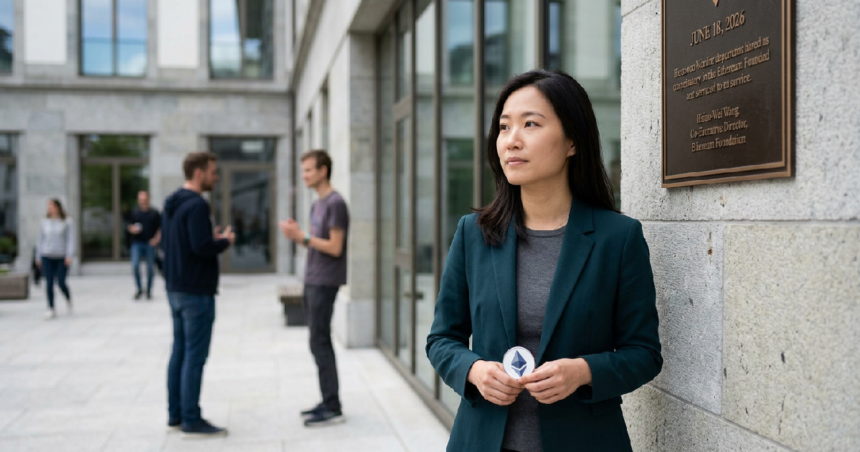
Hsiao-Wei Wang, the Co-Executive Director and board member of the Ethereum Foundation (EF), resigned from her positions effective June 18, 2026. The departure follows a sabbatical period that allowed the long-time technical leader to reassess her future direction. Wang first joined the Switzerland-based non-profit in 2017 and is recognized as a central figure in the network’s most critical infrastructure upgrades over the past decade.
In a statement shared on X, Hsiao-Wei Wang noted that her sabbatical provided the necessary time to reflect on personal priorities. “I have decided to prioritize my personal life and future direction,” she wrote. “Now is the right time to step back and I am still contemplating what my next steps should be.”
She also indicated a desire to dedicate more time to her family and personal life following her leave of absence.
Legacy of technical leadership and community building
The exit comes during a period of steady leadership turnover within the organization. At least eight senior figures have departed the Ethereum Foundation over the past five months.
This list includes former co-executive director Tomasz Stańczak, who left in February 2026, as well as Protocol cluster leaders Josh Stark and Trent Van Epps, who both departed in April after five-year tenures. These shifts are happening while Ether enters rare accumulation phase as markets cool.
Hsiao-Wei Wang leaves behind a deep technical legacy. She was a core researcher involved in the development of the Beacon Chain and the 2022 transition to proof-of-stake, known as “The Merge.” Beyond research, she authored EIP-4844 and contributed to the network’s scalability roadmap, including work on sharding and data availability sampling.
Her promotion to the board in March 2025 marked the first time an ethnic Chinese leader with a technical background held such a role.
Ethereum co-founder Vitalik Buterin praised Wang’s contributions, describing her as a “steadfast contributor” to the ecosystem. He noted that she not only advanced consensus mechanism development but also fostered a vibrant developer community in Taipei, Taiwan.
Buterin remarked that Wang handled the foundation’s “most challenging management responsibilities” during a critical transition period with professionalism and prudence. This technical transition occurs as Ether and XRP face selling pressure from broader market trends.
Transitioning from management to community support
Despite leaving her management and board roles, Wang emphasized that she will continue to support Ethereum as a community member. She reflected that the network’s strength is derived from decentralized infrastructure maintained by global developers and validators rather than any one organization. “Ethereum has always been bigger than any one role, any one organization, or any one moment,” she wrote in her farewell message.
Operations at the foundation have already shifted to accommodate the vacancies. During Wang’s sabbatical, board member Bastian Aue assisted with the leadership transition. Aue has since taken on a larger interim role following the departures of both Wang and Tomasz Stańczak. This management reorganization follows the 2025 shift where long-standing Executive Director Aya Miyaguchi stepped back to become President of the Foundation.
Broader organizational shifts at the Ethereum Foundation
The recent departures have sparked increased community scrutiny regarding the foundation’s governance and strategic focus. With eight senior leaders leaving in just five months, the EF is navigating what some observers describe as a period of upheaval. However, the foundation has historically operated on a “subtraction” model designed to empower the wider ecosystem rather than centralize authority within a single entity.
The loss of specific expertise, such as Wang’s work on sharding research and Asia-Pacific developer engagement, presents a challenge for the interim leadership. The foundation must now ensure that technical roadmaps remain on track while competing with rival blockchains. This internal focus matches a wider industry landscape where utility shifts dictate 2026 priorities for digital assets.
But the foundation’s core mission of funding independent client teams and researchers remains unchanged. While the executive wing sees significant churn, the underlying development of the protocol is decentralized by design. New leaders are expected to emerge from the existing technical clusters to fill the gaps left by the departing veterans.
For now, the focus remains on personal reflection for Wang, who said she is still contemplating her next adventures.