

The cryptocurrency market is constantly evolving, with a new generation of altcoins — any cryptocurrency beyond Bitcoin — pushing the boundaries of what blockchain technology can achieve. This latest wave of altcoin innovation is addressing critical challenges and unlocking novel possibilities within the broader digital asset ecosystem.
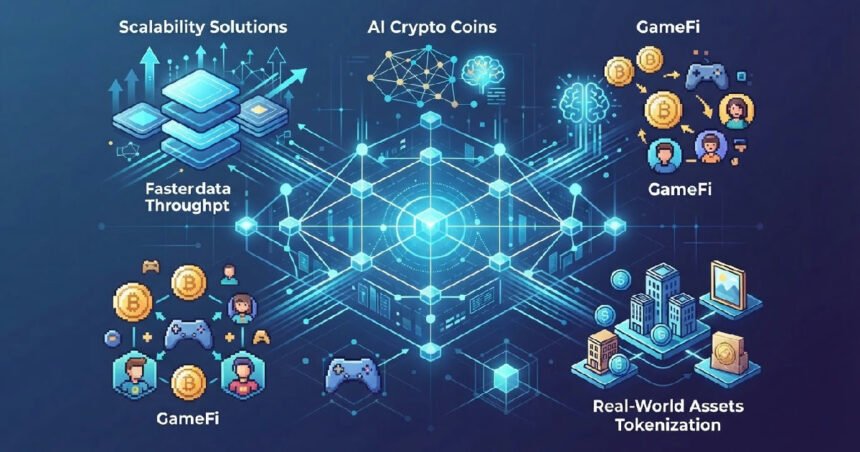
It’s not just about creating new tokens; it’s about developing sophisticated solutions for scalability, integrating artificial intelligence, expanding blockchain gaming, the tokenization of real-world assets, the development of Web3 infrastructure, and advancements in privacy through zero-knowledge proofs. These advancements are redefining the utility and potential of decentralized networks.
What defines altcoins and Web3?
Altcoins encompass a broad spectrum of digital currencies. This includes coins with their own independent blockchains, like Ethereum and Litecoin. It also covers tokens that operate on existing platforms.
These altcoins emerge for diverse reasons, often adjusting Bitcoin’s parameters such as block time or size. Many introduce technical improvements like smart contracts or different consensus mechanisms. Others build around specific themes and communities, fostering unique digital ecosystems.
This push for innovation aligns with the vision of Web3, a concept for a new, decentralized internet. Web3 leverages blockchains, cryptocurrencies, and Non-Fungible Tokens (NFTs) to return ownership and control directly to users, moving away from centralized control.
It’s characterized by decentralization, permissionless access, native cryptocurrency payments, and a trustless environment. Understanding these foundational elements is crucial to grasping the deeper implications of current altcoin development.
Enhancing blockchain performance with scalability solutions
One of the most pressing issues in blockchain technology has been scalability, and altcoins are at the forefront of tackling it. Layer 2 (L2) scaling solutions are a prime example. They’re built on top of existing Layer 1 (L1) blockchains like Ethereum to boost efficiency and capacity.
These L2s alleviate network congestion and high fees by processing transactions off-chain. This increases throughput without compromising the security or decentralization of the underlying L1. Processed transactions are then batched and settled on the L1, inheriting its robust security.
Exploring zero-knowledge and optimistic rollups
Zero-Knowledge Rollups (ZK-rollups) bundle thousands of transactions into a single cryptographic proof, known as a ZK-proof. This proof verifies the validity of transactions without revealing their details, offering both scalability and enhanced privacy. Projects like Polygon Miden, Polygon Hermez, Polygon Zero, and zkSync Era exemplify this advanced approach.
Optimistic Rollups, on the other hand, assume transactions are valid by default. They only run computations if a dispute arises. These systems allow a “challenge period” during which anyone can submit a fraud proof if they detect an invalid transaction. Arbitrum and Optimism are prominent examples utilizing optimistic rollups for Ethereum scaling.
The rise of modular blockchains
Modular blockchains represent another significant architectural shift in scaling. Here, a blockchain’s core functions — execution, settlement, consensus, and data availability — are split across separate, specialized layers or chains. This differs fundamentally from a single, monolithic chain handling everything.
This separation allows each layer to optimize for its specific task, potentially achieving higher throughput and greater flexibility. Ethereum itself is evolving towards a modular design to improve its own capabilities.
Key projects in this space include Celestia, a leading modular blockchain project specifically designed for data availability, ensuring transaction data is accessible and verifiable by all nodes.
Dymension also plays a crucial role as a modular blockchain project excelling in consensus, execution, and settlement through its RollApps framework, often delegating data availability to other specialized blockchains like Celestia.
AI integration in crypto operations
The integration of artificial intelligence is another significant driver of altcoin innovation within the broader blockchain space. AI crypto coins embed AI technologies to enhance platform efficiency, data analytics, and decision-making within blockchain operations. These tokens power AI-driven projects that automate and optimize various industries.
AI algorithms are proving invaluable in optimizing blockchain processes, improving scalability, and enabling advanced applications. They can analyze vast amounts of data in real-time, facilitating smarter decision-making in areas like trading and resource allocation. This enhances the overall intelligence and responsiveness of decentralized systems.
Furthermore, AI can significantly enhance security by monitoring for suspicious patterns. It automates threat detection and can even predict emerging risks before they fully materialize. AI also improves transaction efficiency through automation, predictive analysis, and accelerating transaction speeds across networks.
Some projects allow users to create autonomous “agents” that perform complex tasks. These include data analysis, predictive modeling, and real-time decision-making. Projects like SingularityNET (AGIX) offer tools for network operations, data processing, and predictive analytics.
Fetch.ai (FET) brings AI and machine learning to the blockchain, powering these autonomous agents for tasks such as data analysis and predictive modeling in supply chain management and finance. Render (RNDR) leverages decentralized GPU rendering where artists pay RNDR for cloud compute, also using distributed computing for various AI-related tasks.
Powering decentralized gaming economies
Gaming and GameFi represent a rapidly expanding sector for altcoin innovation. Gaming crypto coins are digital assets specifically designed to power blockchain games and their broader gaming ecosystems. They serve multiple purposes within video-game economies.
These tokens act as in-game currency, providing governance rights to holders, or offering play-to-earn rewards. Players can convert these rewards into traditional fiat currency. This model gives players true ownership of their in-game assets, a fundamental shift from traditional gaming where assets are typically controlled by game developers. This enhances player engagement and value.
Players use these tokens for various activities, including in-game purchases and staking. They also participate in governance decisions for the game’s future development. Network fees often get paid using these digital assets, creating a self-sustaining economic loop within the gaming environment.
This intertwining of economic incentives and gameplay fuels a vibrant new category of digital entertainment. For those looking to invest, understanding how to evaluate cryptocurrency projects in GameFi is becoming increasingly important.
Tokenization and Web3 infrastructure developments
The tokenization of real-world assets is a key category driving altcoin innovation. This area involves representing tangible assets as digital tokens on a blockchain. It’s an evolving space within the broader cryptocurrency market.
The development of Web3 infrastructure is also foundational to these advancements. Web3 is characterized by decentralization, permissionless access, native cryptocurrency payments, and a trustless environment, aiming to return ownership and control to users. This infrastructure is crucial for supporting the next generation of decentralized applications and services.
The future landscape of altcoin innovation
The current landscape of altcoin innovation highlights a significant shift towards more functional and integrated blockchain applications. From enhancing transaction speeds to creating entirely new digital economies, these developments are pushing the boundaries of what decentralized technology can achieve.
As these categories mature, they’re likely to foster greater adoption and mainstream utility for cryptocurrencies beyond just speculative trading. The continuous evolution across scalability, AI, gaming, and real-world asset tokenization suggests a robust future for altcoins. These innovations are paving the way for a more efficient, secure, and user-empowered digital world.