

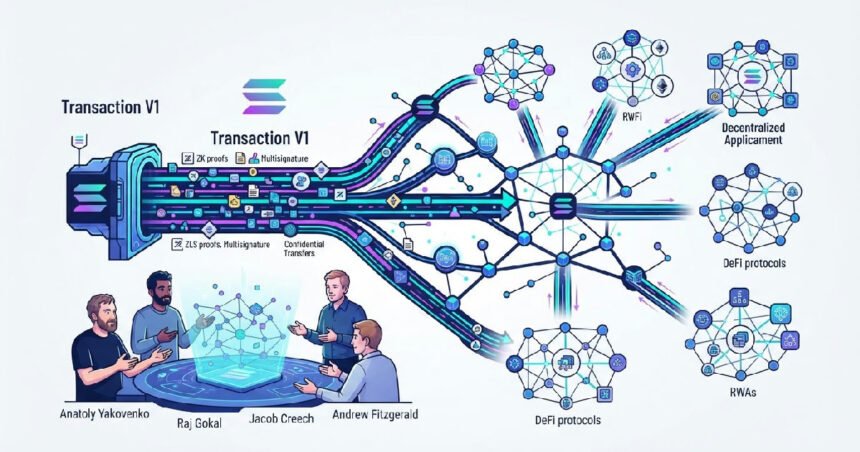
Solana significantly enhanced its core infrastructure today, activating “Transaction V1” on its mainnet to triple the maximum size of a single transaction. This pivotal upgrade, which went live at approximately 01:00 UTC on September 15, 2026, directly addresses the growing demand for more complex on-chain operations and substantially increases Solana transaction capacity.
The move provides developers with substantially greater data capacity within individual transactions. It positions the Solana blockchain to better support advanced applications like zero-knowledge proofs and large multisignature transactions, streamlining development and improving efficiency across the network.
Solana Boosts Transaction Capacity for Complex Operations
Today’s upgrade expands Solana’s maximum transaction size from a previous limit of 1,232 bytes to a robust 4,096 bytes. This represents an impressive 3.3-fold increase, offering ample room for more data-intensive commands within a single, atomic operation.
While this enhancement doesn’t directly boost the network’s overall transactions per second (TPS) throughput—which averages around 3,700 TPS including validator votes—it profoundly impacts the complexity achievable per transaction. Developers can now embed more intricate logic, reducing the need for cumbersome workarounds like splitting operations into multiple transactions or using bundles.
Engineering the Upgrade: From IPv6 to QUIC
The path to this increased capacity involved overcoming historical technical limitations. Originally, Solana’s transaction size was constrained by conservative IPv6 Maximum Transmission Unit (MTU) limitations, which influenced earlier network designs.
However, a strategic transition of Solana’s networking stack to QUIC in 2022 removed these underlying constraints. This change laid the groundwork for the current expansion, allowing the network to handle larger data payloads more efficiently and paving the way for today’s significant upgrade.
The specific technical proposals, SIMD-0296 and SIMD-0385, co-authored by Jacob Creech, Vice President of Technology at the Solana Foundation, and Andrew Fitzgerald, outlined the path forward. They defined the shift, and the new 4,096-byte limit was chosen for practical reasons. It aligns seamlessly with the standard 4 KiB memory page size used by most validator hardware, optimizing memory handling and processing across the decentralized network.
Empowering Developers with Atomic Transactions
This expansion of Solana transaction capacity marks a significant win for the development community. By enabling more data to be processed within a single transaction, the platform drastically simplifies the creation of sophisticated decentralized applications (dApps).
Developers no longer need to fragment complex processes, leading to cleaner code and potentially more stable applications. This improved efficiency could attract more innovative projects to the Solana ecosystem. The Solana Foundation’s proactive development approach has often seen the network adapt to new demands, as it overcame early network challenges.
Facilitating Next-Gen Blockchain Applications
The practical implications of this upgrade are far-reaching. Operations like zero-knowledge proofs (ZK proofs), large multisignature transactions, BLS signatures, and confidential transfers can now be executed atomically and more effectively. This was a key driver for the change.
Solana co-founder Anatoly Yakovenko emphasized this need, stating that the network requires “1 tx moving data atomically through two zk roots.” He also suggested that this capacity could facilitate the existence of based rollups directly on Solana, hinting at future architectural possibilities.
Strategic Rollout and Ecosystem Impact
The activation of the txv1 feature gate on the mainnet, at epoch 1035, followed a methodical rollout. It was first successfully deployed on the testnet at epoch 1025 on September 1, 2026. This phased approach allowed infrastructure providers ample time to prepare and adapt, ensuring a smooth transition.
This phased approach demonstrated the Solana Foundation’s methodical approach to network upgrades. The upgrade arrives at a time when Solana’s ecosystem continues its robust growth, with nearly $5.95 billion in Total Value Locked (TVL) within its DeFi protocols. Additionally, the network currently handles around $1.79 billion in 24-hour decentralized exchange volume.
This growth also reflects in specialized markets. Solana’s tokenized equities market has seen significant activity, indicating broader market confidence.
Broader Implications for Solana’s DeFi Landscape
Beyond raw transaction counts, Solana has carved out a significant niche in tokenizing real-world assets (RWAs). The network currently holds over $4 billion in value tied to RWAs, distributed across more than 350,000 addresses.
The enhanced transaction capacity enables more complex RWA tokenization projects. Developers can now build more intricate financial instruments and derivatives directly on-chain. This could increase efficiency and security for these applications. Real-world asset tokenization on Solana benefits from this expanded capability.
Beyond Raw Throughput: A Focus on Transaction Depth
It’s crucial to distinguish this upgrade from a simple increase in transactions per second. While Solana’s theoretical peak capacity stands at 65,000 transactions per second (TPS), and future projects like Firedancer aim for over 1 million TPS, the Transaction V1 update targets the depth of each individual transaction, not the sheer volume.
With an effective TPS for payments and applications closer to 1,000, the focus here is on empowering more sophisticated operations. The goal is to make each transaction more capable, allowing for richer data and more complex computational processes within the same atomic unit, rather than just processing more simple transactions.
Future-Proofing for an Evolving Blockchain
This strategic enhancement reduces the burden on developers, allowing them to build more robust and versatile decentralized applications. It also mitigates potential points of failure that can arise when complex operations are broken into multiple, sequential transactions.
The Solana Foundation’s proactive approach to infrastructure development, exemplified by this upgrade, underscores its commitment to adapting to the demands of a rapidly evolving blockchain landscape. By prioritizing flexibility and depth, Solana aims to maintain its competitive edge and attract the next wave of innovative projects.