

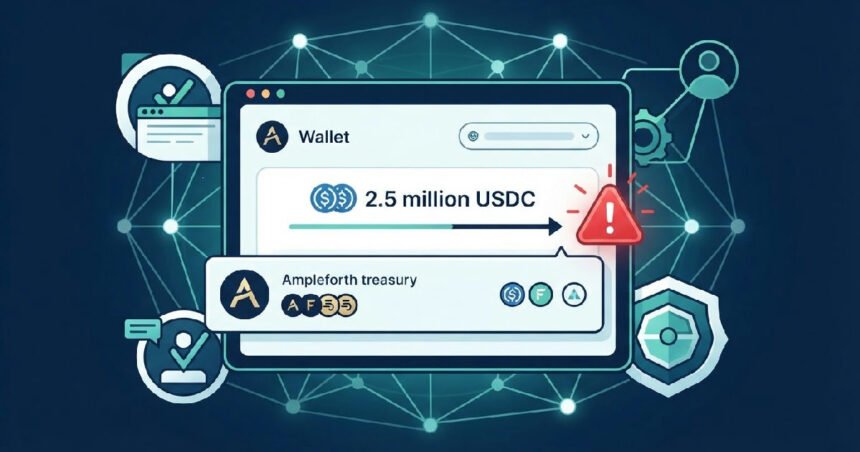
A significant Ampleforth governance gap recently came to light when a single, newly activated wallet attempted to claim nearly the entire USDC balance from the protocol’s treasury. Proposal 54 sought to transfer 2.5 million USDC to its author, representing roughly 98.5% of the treasury’s USD Coin.
While the proposal was ultimately canceled on-chain on September 14, 2026, before any voting began, and no funds were lost, the incident has prompted security firms to label it a potential attack and raised serious questions about the robustness of decentralized finance (DeFi) governance.
Addressing the Ampleforth governance gap
The event highlighted a critical vulnerability within the Ampleforth protocol’s on-chain proposal system, which is governed by FORTH token holders. It revealed how a concentrated delegation of voting power, even briefly, could allow a significant request to enter the binding governance process without prior community discussion or a public vote.
The contentious Proposal 54, as documented on Tally, aimed to direct 2.5 million USDC to a proposing wallet identified as 0x730C…dd82. This sum was considerable, accounting for almost 98.5% of the USDC held in the Ampleforth treasury and 70.2% of its total marked value, according to a treasury dashboard snapshot on September 15, 2026.
The proposal’s author presented the payment as a retrospective grant for “Observatory for SPOT,” an open-source analytics interface for the AMPL and SPOT ecosystem. They presented the tool as complete, independent, and unofficial. However, the mechanism through which the proposal was submitted raised immediate red flags among security observers.
Just minutes before the proposal was created, an address identified as 0x38cA…24D8 delegated a substantial 87,238.5461 FORTH of voting power to the proposing wallet. This swift transfer of influence allowed the new wallet to meet the submission threshold for the on-chain proposal system. The incident underscores ongoing debates within the broader crypto space regarding the security implications of governance standards across different chains.
Unpacking the On-Chain Cancellation Mechanism
The potential crisis was averted through a rapid, on-chain maneuver. On September 14, the delegating address, 0x38cA…24D8, first transferred its 87,238.5461 FORTH voting power away from the proposing wallet. Approximately 14 minutes later, the same address executed a cancel(54) function, effectively nullifying Proposal 54.
This sequence of transactions aligns with Ampleforth’s governor code. The protocol’s smart contracts include a provision that allows a proposal to be canceled if the proposer’s voting power falls below the established threshold before the voting window officially opens. This built-in safeguard, while functional in this instance, highlights a reactive rather than a preventative defense against potentially malicious or unvetted proposals.
While the cancellation successfully prevented any unauthorized transfer of funds, it does not fully resolve the underlying governance design questions. The fact that a proposal could reach this critical stage without broader community review, only to be canceled by the same entity that enabled its submission, suggests a gap in the protocol’s intended governance flow.
The Broader Implications for Decentralized Governance
Ampleforth’s official governance documentation outlines a comprehensive, multi-stage process for proposals. This includes preliminary discussions, formal development, targeted discussions, and optional off-chain signaling, all preceding a final binding on-chain vote. The intention is to foster community consensus and ensure thorough vetting before treasury movements are put to a vote.
However, the events surrounding Proposal 54 deviated sharply from this established process. Records indicate that the proposing wallet submitted its request almost immediately after accumulating the necessary delegated voting power, bypassing any apparent preliminary steps. This raises concerns about how easily the formal governance structure can be circumvented.
Security firms were quick to react. GoPlus Security, for instance, issued a warning about the pending proposal shortly before its cancellation, categorizing it as an “attack.” Defimon Alerts also flagged the unusual activity. Though no actual exploit occurred, and no treasury loss was incurred, the intent behind such an action remains a subject of speculation and concern within the DeFi community.
Ampleforth’s Protocol and the Role of FORTH
Ampleforth, a decentralized finance protocol, distinguishes itself through its elastic-supply cryptocurrency, AMPL. Unlike traditional stablecoins, AMPL aims to maintain a price target (a CPI-adjusted 2019 US dollar) by automatically adjusting its supply through a daily “rebasing” mechanism. This unique approach ensures that a user’s percentage of the total supply remains constant, regardless of price fluctuations.
The FORTH token serves as the governance backbone of the Ampleforth Protocol. Holders of FORTH tokens have the power to vote on crucial decisions, including protocol upgrades, the allocation of treasury funds, and general ecosystem development. They can also delegate their voting rights to other representatives, a feature that played a central role in the recent incident.
The treasury, which Proposal 54 targeted, holds significant assets, including a substantial amount of USDC. USDC itself is a stablecoin pegged 1:1 to the US dollar and backed by reserves.
The stability and liquidity of USDC make it a critical asset for many DeFi protocols, underscoring the severity of a near-loss event involving such a large portion of the treasury’s holdings. This incident effectively tested the resilience of Ampleforth’s protocol and its approach to protocol decentralization under pressure.
Addressing Governance Gaps in DeFi’s Future
The Ampleforth incident serves as a potent reminder of the inherent challenges and vulnerabilities within decentralized autonomous organizations (DAOs). While DAOs aim to distribute power and decision-making, they often grapple with structural complexities that can be exploited by bad actors or simply reveal unforeseen flaws in design. This event underscores the delicate balance between enabling rapid decision-making and ensuring robust security and community oversight.
For Ampleforth and other DeFi protocols, this episode provides valuable lessons. It highlights the need for continuous auditing of governance contracts and perhaps stricter safeguards around proposal submission thresholds.
Enhancing the visibility of proposals and ensuring that preliminary discussion phases are not easily bypassed will be crucial for maintaining trust and security in the evolving DeFi landscape. The lessons from this event could also prompt further investigation into wallet key replacement strategies and other security mechanisms across the blockchain ecosystem.
As the DeFi ecosystem continues its rapid growth, the spotlight remains firmly on governance models. The Ampleforth incident, though ultimately contained, underscores the ongoing necessity for vigilance, continuous improvement, and a proactive approach to identifying and mitigating potential vulnerabilities. It’s a stark reminder that even well-intentioned decentralized systems require constant scrutiny and adaptation to protect user assets and maintain integrity.