

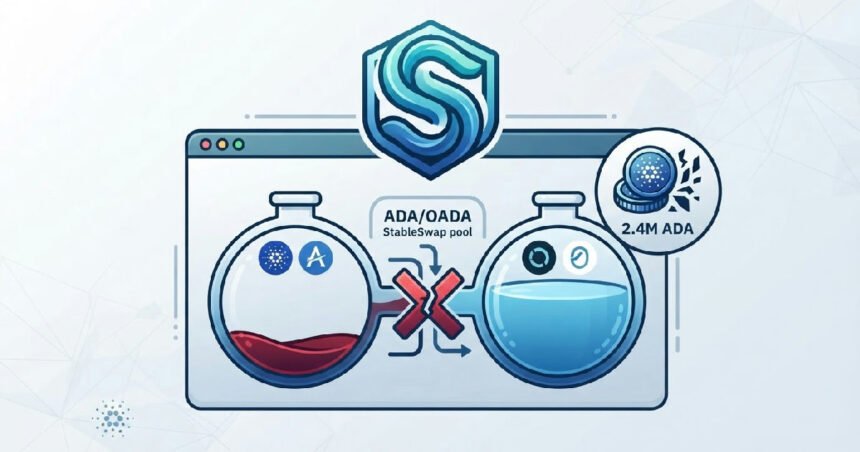
A major Cardano Splash exploit on the Cardano blockchain has drained over 2.4 million ADA from a decentralized finance protocol, leaving token holders trapped even after developers deployed a patch for the vulnerability. The incident, which targeted the Splash protocol’s ADA/OADA StableSwap pool on September 13, has highlighted the critical difference between fixing code and restoring lost capital.
The attacker siphoned a net total of 2,424,778 ADA (Cardano’s native token) and nearly 2 million OADA tokens, according to an incident report from Splash. While a subsequent “Splash fix” has closed the loophole, it does nothing to recover the stolen funds.
How the Cardano Splash exploit unfolded
The pool, which provided the primary exit route for OADA holders, was left with just 10 ADA, rendering the remaining 1.44 million OADA tokens effectively illiquid.
The situation underscores a persistent risk within the decentralized finance space, where code vulnerabilities can lead to irreversible financial losses for users. While the rapid deployment of a patch is a positive step for protocol security, it offers little comfort to investors whose assets have already been drained.
This event serves as a stark reminder of the challenges facing even well-funded efforts in DeFi development and the precarious position of users when things go wrong.
The breach was executed in a brief window between 00:47 and 00:48 UTC on September 13, using just two transactions. According to Splash’s post-mortem report, the attacker leveraged a critical flaw in the pool’s validator logic, which is responsible for calculating the reserves available for trading.
The validator calculated a “tradable” reserve by subtracting accrued protocol fees from its real balances. However, the code was missing crucial safety checks. It failed to require that this tradable reserve remain positive, did not properly bound fee changes, and neglected to enforce the direction of a swap.
This oversight allowed the validator to approve a transaction even after the tradable ADA balance had been driven into a negative value.
Splash confirmed that implementing a simple reserve-domain check or a two-sided fee bound would have prevented the attack. The attacker deposited a small amount of 9,870 ADA before executing the exploit, ultimately draining 2,434,648 ADA and 1,988,222 OADA, for a net loss of over 2.42 million ADA before network fees.
A code patch isn’t a liquidity fix
While the development team successfully patched the vulnerability, the core problem for OADA holders is one of capital, not code. With the ADA/OADA pool almost completely empty, there is no meaningful way for them to swap their OADA back into ADA or any other liquid asset. The pool’s remaining balance of just 10 ADA offers no practical exit liquidity.
The balance sheet damage is severe because Splash’s own report from September 13 noted that OADA had no protocol-level redemption mechanism. This meant the StableSwap pool was the only viable venue for converting the token. Other listed pools for OADA at the time held only trivial amounts of ADA, often in the single or double digits, making them useless for any significant trading.
This scenario illustrates a fundamental principle often overlooked by retail investors. The value of a token is not just its quoted price but its accessible liquidity. For OADA holders, the exploit didn’t just lower the token’s price; it eliminated the market itself, a critical lesson in understanding tokenomics and the infrastructure that underpins them.
Secondary markets create further complications
Restoring liquidity is not as simple as just refilling the pool with new ADA. The attacker’s actions created a secondary problem that complicates any recovery effort. A significant portion of the stolen OADA was moved to another decentralized exchange on Cardano, creating a large, discounted supply waiting on the sidelines.
At 14:53 UTC on the day of the attack, a Minswap V2 pool held over 1.76 million OADA. The Splash team warned that this massive inventory poses a serious arbitrage risk. If new ADA liquidity were to be injected into the original Splash pool, these discounted OADA tokens from the secondary market would almost certainly be used to immediately drain the fresh capital.
This creates a catch-22 for the developers. They cannot restore the primary market without first addressing the supply overhang on the secondary market. Any good-faith effort to recapitalize the pool could be instantly exploited, benefiting the arbitrageurs (and potentially the original attacker) at the expense of the project and its community.
Project response and an uncertain future for holders
In the wake of the exploit, related protocols have taken defensive measures. Optim Finance, another project in the ecosystem, announced on September 13 that its protocol was paused. It confirmed that all remaining liquidity had been removed and that OADA-to-ADA swaps were no longer available through its platform.
In a follow-up statement on September 15, the Optim Fi team said it was indexing the blockchain to compile a full report of all impacted addresses and assets.
The team stated it was “working toward a resolution,” but did not announce any concrete plans for restoring liquidity, operations, or providing a redemption path for OADA holders. This leaves affected users in a state of uncertainty, waiting to see if any form of compensation or recovery will be offered.
The path forward remains unclear. Potential solutions range from the project team using its own treasury to partially or fully compensate users, to a complex relaunch of the token and pool, or the unfortunate outcome where users are forced to accept the total loss of their funds.
How the situation is handled will likely set a precedent for the Cardano DeFi ecosystem, influencing user trust and expectations for how projects respond to security failures.