

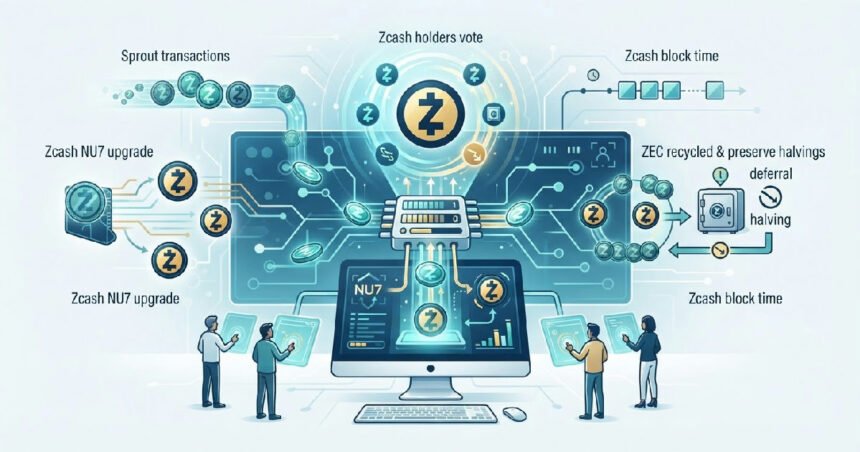
Zcash holders vote to preserve the network’s Bitcoin-style halving schedule and postpone the reintroduction of recycled ZEC into block rewards until February 2031. This outcome emerged from a five-question advisory poll, which settled the scope of NU7, Zcash’s next major network upgrade. The poll results were published on September 16, 2026.
The ZEC-weighted poll saw significant turnout, with approximately 2.4 million ZEC participating across the board. This figure represents about two-thirds of the roughly 3.6 million eligible coins, easily surpassing the 1 million ZEC threshold required for the vote to be considered a representative signal from the community.
Zcash holders vote reaffirms bitcoin-style monetary policy
The most consequential outcome of the poll centered on Zcash’s long-term monetary policy. Coinholders overwhelmingly favored preserving the existing halving mechanism, where block rewards are cut in half at regular intervals. This contrasts sharply with the option that proposed switching to a smoother, continuous issuance curve.
This result signals a strong preference among the economic majority of Zcash holders for a model of predictable scarcity, similar to that of Bitcoin. Halvings are a core feature of many leading cryptocurrencies, designed to control inflation and create a deflationary supply dynamic over time.
By reaffirming this choice, the community has prioritized a proven economic model over experimental alternatives. While crypto market optimism has been growing, foundational economic principles remain a key focus for established projects.
The alternative, a smoother issuance curve, would have gradually reduced block rewards on a more frequent basis instead of through periodic shocks. Proponents of this model often argue it creates a more stable and predictable environment for miners. However, Zcash holders have clearly indicated their confidence in the power and appeal of the halving narrative.
Recycled ZEC delayed until 2031 in conservative move
In another critical monetary decision, voters chose a long-term, conservative path for funds collected by the Network Sustainability Mechanism (NSM). The community elected to wait until February 2031 to begin recycling these funds back into circulation via block rewards. Other options, such as starting sooner, were also presented.
The NSM directs a portion of block rewards to a fund intended to support ongoing development and network health. The question was when to start re-injecting these accumulated ZEC back into the ecosystem. By choosing 2031, the community allows this fund to grow substantially over the next several years, creating a significant treasury for future initiatives without introducing near-term inflationary pressure.
This long-term perspective was endorsed by several key organizations within the Zcash ecosystem. A public statement noted that Shielded Labs, Project Tachyon, ZODL, the Zcash Foundation, and Valar Group had all aligned on the February 2031 date as the most prudent interpretation of the poll’s outcome. This consensus provides a stable, long-range financial outlook for the protocol’s development.
This kind of long-term planning is a crucial part of understanding tokenomics for sustainable growth. By setting a clear, distant date for the reissuance, the Zcash community provides developers and investors with a predictable economic roadmap, removing a major point of uncertainty. The decision also leaves the door open to revisit the timing in the future should network conditions change dramatically.
Faster block times on the horizon
Voters overwhelmingly supported a proposal to dramatically reduce Zcash’s target block spacing from 75 seconds down to just 25 seconds. A significant majority of Zcash coinholders backed this change, which will triple the network’s transaction throughput. Faster blocks mean quicker confirmation times for users, improving the practicality of ZEC for everyday transactions and enhancing the overall user experience.
This change is not without complexity, as it requires careful implementation to avoid potential network instability. However, the strong support from coinholders gives developers a clear directive to pursue this significant performance enhancement as part of the NU7 upgrade.
Retiring legacy sprout transactions
The community also voted to deprecate the network’s oldest transaction type, known as Sprout-era v4 transactions. Voters approved disabling this legacy feature upon the activation of NU7. Removing old code simplifies the protocol, reduces the potential attack surface, and makes the codebase easier for developers to maintain and audit.
This is a standard part of a blockchain’s lifecycle, similar to how software companies phase out older versions of their applications. It ensures the network remains robust, secure, and focused on its most advanced and widely used privacy technologies, like the current Ironwood shielded pool used for the vote itself.
Governance in action: a high-turnout, privacy-preserving poll
The NU7 poll was a powerful demonstration of Zcash’s on-chain governance capabilities. The high participation of roughly 2.4 million ZEC showcased a deeply engaged community of stakeholders invested in the protocol’s future direction. The process itself was a testament to Zcash’s core technology, as it used encrypted ballots to protect voter privacy.
While the coinholder vote showed clear majorities, other community bodies reportedly held different leanings on some monetary questions. This highlights the diverse viewpoints within the ecosystem and reinforces the weight given to the ZEC-weighted economic consensus.
The success of the vote provides a strong mandate for developers to proceed with implementation. The community also supported shipping NU7 without any features that miss the September 30 implementation deadline, indicating a desire for timely execution over an ever-expanding feature list. Thinking about the different groups involved is a key part of how to evaluate altcoin project teams and their community dynamics.
What happens next for the zcash network
It’s important to remember that this poll was advisory. It provides a powerful and unambiguous signal of coinholder intent, but it does not automatically trigger any code changes. The next crucial phase is implementation, where developers will translate these preferences into tested, secure, and deployable code for the NU7 network upgrade.
The work to specify the preserve-halvings feature and other approved changes is now underway. The Zcash Foundation, alongside other teams and independent developers, will collaborate on writing, reviewing, and testing the necessary code. The final step will be to set an activation height for the upgrade on the Zcash mainnet, a date which has not yet been determined.
Ultimately, the NU7 vote has provided a clear and decisive roadmap for Zcash’s medium-term future. By committing to a predictable, scarcity-based monetary policy and a series of key technical upgrades, the community has laid a stable foundation for the network’s continued growth and development. This clarity is invaluable for building long-term confidence among users, developers, and investors alike.