

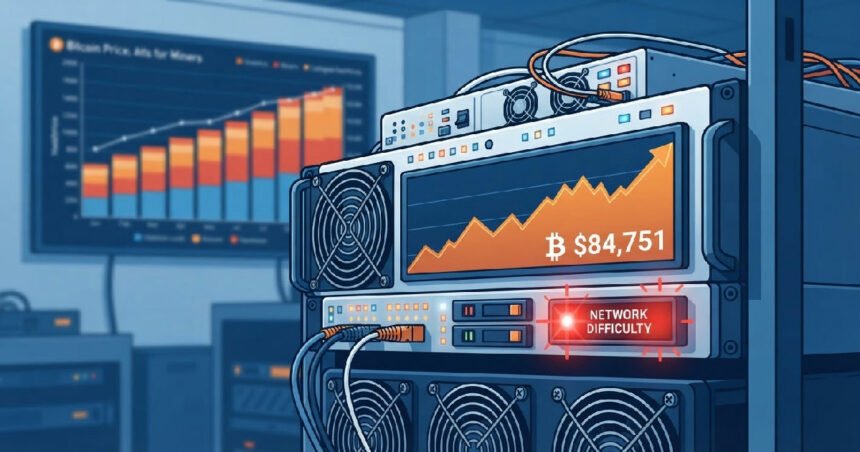
Bitcoin’s recent ascent to $84,751 has offered only a fragile lifeline for Bitcoin mining operations. Despite the impressive price surge, crucial network difficulty signals are already flashing caution, suggesting that lasting relief for miners remains elusive. This complex scenario unfolded on September 21, 2026, as industry analysts evaluated the true impact of market movements.
The cryptocurrency’s rally to $84,751, while a positive headline, hasn’t fully offset the intricate challenges inherent in the mining sector. Miners continue to grapple with escalating operational costs and the Bitcoin network’s programmed difficulty adjustments. These factors collectively determine their profitability in a volatile market.
Bitcoin’s Price Surge Meets Mining Reality
On September 19, the network’s mining difficulty jumped by 4.1634%, pushing it to 132.757 trillion at block 967,680. This significant increase immediately raised the bar for computational effort required to secure new blocks. Miners need a strong Bitcoin price to counter such shifts.
This adjustment was, however, less severe than initial projections. Analysts had once forecast a 4.6976% increase, which would have demanded Bitcoin reach approximately $82,877 just to neutralize revenue-per-hash impacts. The current $84,751 price comfortably cleared that theoretical threshold.
CryptoSlate, a prominent industry publication, highlighted this dynamic in its recent analysis. Editor-in-Chief Liam ‘Akiba’ Wright noted the narrow margin of improvement. The theoretical gross hashprice, a measure of revenue per unit of computing power, climbed to about $40.31 per petahash per second per day.
This figure represents a roughly 2.65% increase above the prior modeled baseline. So, while there’s a modest improvement in gross revenue, it remains tenuous. The increase in competition for block rewards still strains operational margins for many.
Difficulty Adjustments Keep Miners on Edge
An early, albeit noisy, signal suggests a potential reversal in difficulty adjustments. Data gathered at only 14.43% completion of the new epoch projects a 2.48% decline in difficulty around October 3. This estimate stems from slower block times observed across the network.
Blocks have been averaging 625.3 seconds, or about 10 minutes and 25 seconds, which is slightly above Bitcoin’s target of one block every 10 minutes. Bitcoin’s protocol recalibrates difficulty every 2,016 blocks to maintain this average production pace. A consistent slowdown prompts a downward adjustment.
Early Signals Versus Sustained Trends
It’s crucial to note that early epoch readings can be highly volatile and are not definitive indicators of sustained trends. Bitcoin developer Pieter Wuille and various academic research papers have underscored this point. Block discovery is inherently stochastic, meaning short-term samples can fluctuate significantly.
Hashrate Index research also corroborates that constant-block-time forecasts are particularly inaccurate near the beginning of an epoch. Therefore, interpreting this projected decline as a direct result of miners shutting down equipment might be premature. The network hashrate, which peaked at 1.053 ZH/s in the past month, shows no persistent collapse.
Still, if slower blocks persist and the sample grows, this projected decline could become more informative. A lower completed difficulty would ultimately reduce the amount of computational work required, making the network temporarily more accessible for participating Bitcoin network participants.
Anemic Transaction Fees Limit Miner Revenue
One of the most persistent hurdles for Bitcoin mining operations remains the negligible contribution from transaction fees. In a recent 144-block sample, fees amounted to a mere 0.01422626 BTC per block. This figure barely registered, accounting for approximately 0.45% of the total block rewards.
This imbalance means miners overwhelmingly depend on the fixed block subsidy rather than user transaction volume. During periods of high network congestion, transaction fees can surge, offering a welcome boost to miner revenue. However, such instances have become less frequent and less impactful.
A more robust fee market would provide a much-needed secondary income stream, offering greater financial stability. Without this, miners remain highly exposed to fluctuations in Bitcoin’s price and the block reward, which was halved from 6.25 BTC to 3.125 BTC in April 2024.
Beyond Network Data: Operational Realities for Bitcoin Miners
The network’s aggregate data often obscures the diverse realities faced by individual Bitcoin mining businesses. Factors such as fleet efficiency, the cost of power, and financing arrangements vary dramatically among operators. What might be a narrow reprieve for one company could be insufficient for another.
For instance, older mining machines with efficiencies above 30 J/TH became unprofitable almost immediately following the 2024 halving. Even S19 generation machines now operate with razor-thin margins if electricity costs exceed $0.07/kWh. This underscores the critical importance of low-cost power contracts and modern hardware.
Post-Halving Consolidation and Cost Pressures
The 2024 halving dramatically reshaped the mining landscape, driving significant consolidation within the industry. Nearly 30% of smaller mining operations reportedly ceased activities within six months of the event. Larger firms, benefiting from economies of scale and advanced technology, absorbed much of this market share.
Production costs for Bitcoin mining currently exceed $30,000 per Bitcoin, according to August 2026 estimates. The all-in cash costs for the top 10 listed miners hovered around $45,000 per Bitcoin post-halving. These figures highlight the immense capital expenditure and ongoing operational costs required to remain competitive. Regulatory speculation impacts these operational costs as well.
While Bitcoin’s price rally from around $64,000 at the halving to over $100,000 by late 2024 certainly helped, it didn’t erase these underlying cost pressures. The market continues to favor highly efficient, well-capitalized operations that can secure favorable energy rates, often in the $0.03-$0.07/kWh range.
Path to Durable Profitability Remains Unclear
For Bitcoin mining to achieve durable profitability across the sector, several elements need to align beyond just a rising Bitcoin price. A sustained price above current thresholds would certainly help preserve the modest relief generated by recent rallies. But that alone won’t solve the deeper structural issues.
Crucially, a larger and more consistent contribution from transaction fees would diversify miner revenue streams. This would lessen their near-total reliance on the block subsidy and Bitcoin’s fluctuating market value. A significant downward difficulty retarget that holds firm for a substantial portion of an epoch would also indicate a more favorable environment.
Such a scenario would provide stronger evidence of an effective network hashrate softening. However, even then, the underlying causes, whether from shutdowns, curtailment, or equipment migration, would remain opaque from network data alone. Continued investment in energy-efficient hardware and strategic power sourcing will also be vital for long-term viability in the Bitcoin mining industry.