

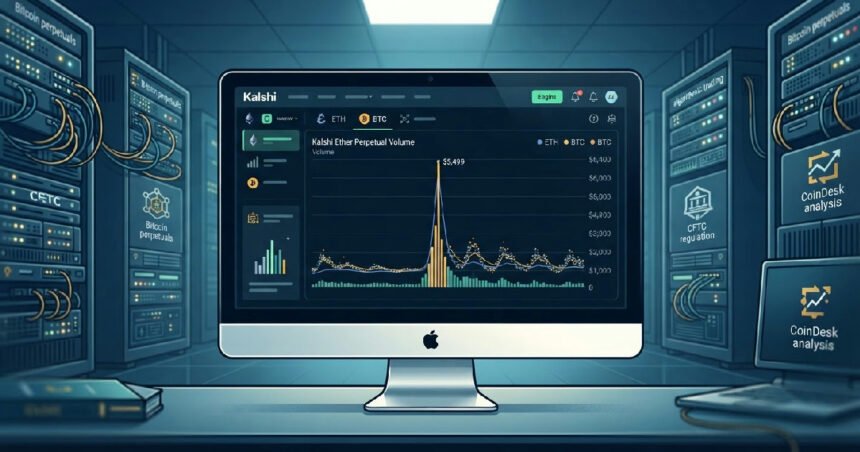
A recent CoinDesk analysis, published on September 22, 2026, has uncovered an unusual and highly repetitive trading pattern dominating the Bitcoin and Ether perpetual volumes on Kalshi, a U.S. derivatives exchange. The findings suggest that a significant portion of the reported trading activity may stem from automated programs executing fixed-dollar amounts, raising questions about the true liquidity and market participation on the platform.
Specifically, trades valued near $5,499 accounted for a staggering 57% of the Kalshi Ether perpetual-futures volume analyzed by CoinDesk between September 17 and September 20, totaling $7.7 million out of $13.5 million. This concentrated activity, alongside similar patterns in Bitcoin trading, highlights how derivatives market activity can sometimes be driven by a limited number of strategies or participants.
Kalshi Ether perpetual volume shapes perception
The CoinDesk investigation, based on public trade records from Kalshi, revealed that more than half the value traded in both Bitcoin and Ether perpetuals originated from a small set of recurring trade sizes. Such concentrated activity can significantly influence how a market’s volume is perceived, potentially overstating its breadth and depth.
Market volume is a crucial metric traders use to gauge a market’s activity and liquidity. High volume typically signals a robust market with ample buyers and sellers, suggesting easy entry and exit without substantial price impact. But when a large segment of this volume comes from consistent, repeating trade sizes, it complicates the assessment of genuine market participation.
Unpacking the Ether Trading Anomaly
The Ether market displayed particularly stark evidence of this repetitive behavior. CoinDesk’s four-day sample period showed trades clustering tightly around the $5,499 mark. This specific value held sway even as the underlying price of Ether fluctuated, forcing the number of contracts in each trade to adjust to maintain the fixed dollar target.
Data extending further back confirmed the pattern’s persistence. From June 19 to September 20, 43 out of 46 one-hour samples examined by CoinDesk showed Ether trades repeatedly gravitating towards specific dollar targets.
These prevailing trade sizes consistently accounted for about 45% of the total value across all samples, and over half the value on 15 different dates. The patterns underscore the significant role that advanced trading strategies play in shaping reported volumes and how Ethereum’s ongoing development continues to influence its market dynamics.
Shifting Dollar Targets in Ether
Interestingly, while the dollar value of individual “clips” remained fixed for periods, the target itself evolved over time. Early samples showed trades clustered around $4,999. By June 28, trades near $9,999 dominated, representing 72% of the sampled value.
Subsequent shifts saw targets of $3,999 emerge on August 10, $4,499 on August 18, and finally the $5,499 target by August 24. This dynamic adjustment of targets points strongly to sophisticated algorithmic control.
Kalshi, regulated by the Commodity Futures Trading Commission (CFTC), launched its Bitcoin perpetual futures in late May. The exchange typically focuses on prediction markets, so this deep dive into its crypto perpetuals sheds new light on the operational mechanics within a regulated digital asset environment.
Bitcoin Mirrors the Repetitive Pattern
Bitcoin’s perpetual market on Kalshi exhibited a similar, though distinct, pattern. CoinDesk’s analysis identified two recurring trade sizes, approximately $2,500 and $5,000, which together comprised 54% of the $8.5 million in sampled data during the same September 17-20 period. What made the Bitcoin activity particularly notable was the consistent relationship between these two trade sizes.
The larger trade consistently remained almost exactly double the smaller one. In 9 of 22 samples, it was precisely double; in the remaining 13, it was just one contract above, a difference attributed to rounding. For instance, when Bitcoin traded around $76,300, the pair consisted of 327 and 655 contracts.
On the day of the analysis, this shifted to 307 and 614 contracts, illustrating how algorithms dynamically adjust contract numbers to maintain a fixed dollar ratio. This behavior offers important insights into market structure, particularly how Bitcoin market signals are processed by automated systems.
Volume-to-Open Interest Ratios Raise Eyebrows
Further scrutinizing the data, Kalshi’s Ether perpetual showed an exceptionally high volume-to-open interest ratio of 61. This means roughly 61 contracts changed hands for every contract remaining open at any given time. For Bitcoin, this ratio stood at 26. These figures stand in stark contrast to the median ratio of about eight across Kalshi’s 20 perpetual markets with open interest.
While high turnover doesn’t inherently imply improper trading, such elevated ratios typically signal intense short-term trading activity relative to sustained positions. This specific detail adds another layer to the discussion about the nature of volume reported on the platform, reinforcing the notion that a small group of high-frequency traders might be dominating the activity.
Kalshi’s Explanation and Algorithmic Underpinnings
Following CoinDesk’s initial inquiries, Kalshi released a blog post clarifying the source of these repetitive trades. The exchange stated that the activity stemmed from a single market maker deploying ‘fixed-size orders’ as part of a dedicated program. This program compensates firms with a flat monthly fee for maintaining consistent bids and offers within specified size and price parameters.
Kalshi’s statement emphasized that hundreds of distinct traders were consistently taking the other side of these orders. The exchange also asserted that it mechanically prevents self-matching and actively monitors for coordinated trading, finding no evidence of collusion or wash trading.
The firm pointed out that the takers of these orders were consistently faster and profitable, while the market maker often traded at a disadvantage as prices moved.
The Role of Advanced Trading Strategies
The observed fixed-dollar trades are characteristic of advanced algorithmic strategies, often referred to as ‘clips’ in trading circles. These programs dynamically adjust the number of contracts to achieve a predetermined dollar value, recalculating as asset prices fluctuate. This approach is well-documented in quantitative finance literature on dynamic position scaling, such as Cartea, Jaimungal, & Ricci’s Algorithmic and High-Frequency Trading.
Bots frequently scale their quotes and contract sizes to hedge against adverse price movements and manage risk exposure. This concept is thoroughly explored in models like the Avellaneda-Stoikov Model.
The periodic adjustments seen in Kalshi’s target values—shifting from $4,999 to $3,999, $4,499, and $5,499—are consistent with market makers adapting their notional-size parameters to changing market conditions or internal risk mandates. This sophisticated use of algorithms underscores the evolving nature of trading practices in derivatives markets.
Critics Raise Concerns
Trading became exceptionally cheap for some firms that settled their own transactions directly with Kalshi shortly before CoinDesk’s four-day sample began. A rebate program filed with the Commodity Futures Trading Commission (CFTC) took effect on September 16, cutting fees for those firms to 0.003% and paying market makers a rebate of the same size. This program started one day before the four-day sample.
However, the rebate program does not fully explain the emergence of the recurring trade sizes, as the $5,499 trades appeared almost a month earlier. While it might affect the economics of trading during the later sample, its timing means it doesn’t account for the initial pattern.
Pseudonymous trader ‘Beni’ flagged these repeating sizes on X over the weekend, publicly accusing Kalshi of inflating its crypto volume.
Kalshi’s crypto head, posting as IcoBeast, disputed parts of Beni’s claims. He noted that a volume-share chart Beni cited covered prediction markets, not perpetual futures. IcoBeast also clarified that Kalshi does not pay rebates on crypto prediction markets and must publicly file incentives for its regulated exchange.