

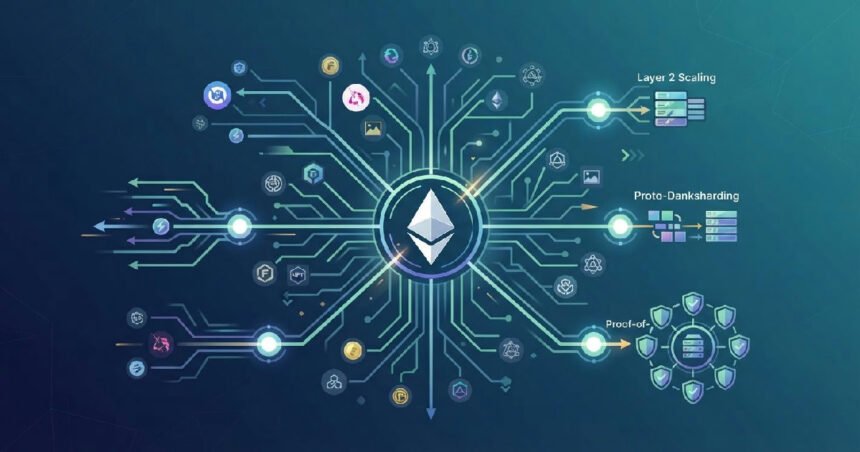
The ongoing Ethereum upgrades are fundamentally transforming the landscape for decentralized applications (dApps) through a series of interconnected improvements. These enhancements empower dApps with greater scalability, heightened security, and notably lower operational costs, paving the way for a more robust and efficient blockchain ecosystem.
While the initial “Merge” transition to a Proof-of-Stake (PoS) consensus mechanism laid critical groundwork, subsequent and planned improvements like sharding, Danksharding, and the widespread adoption of Layer 2 solutions are delivering tangible benefits. This ongoing development creates new possibilities for developers and improves the user experience across various blockchain sectors.
Understanding Ethereum upgrades and their transformative roadmap
The roadmap for Ethereum, often historically dubbed “Ethereum 2.0 transition” or “Eth2,” focuses on building a more resilient and performant network. Its primary objectives include significantly improving scalability, fortifying security measures, and ensuring the long-term sustainability of the platform. This comprehensive approach is vital for supporting the next generation of decentralized applications.
Early upgrades established the foundation, but the practical improvements for dApps are now emerging through more advanced phases. These continuous developments are crucial for Ethereum to maintain its position as a leading smart contract platform amidst a competitive blockchain environment. They help shape Ethereum’s influence across the wider crypto market.
Key Drivers of dApp Enhancement
Several pivotal upgrades and scaling solutions are directly contributing to the enhanced capabilities of decentralized applications on Ethereum. These innovations address long-standing challenges and unlock new frontiers for blockchain technology.
Enhanced Scalability and Throughput
Scalability has historically been a significant bottleneck for mainstream dApp adoption. While the Merge didn’t immediately boost transaction speeds, it set the stage for future improvements. The long-term vision includes sharding, which aims to distribute the network’s load across multiple chains, potentially enabling hundreds of thousands of transactions per second (TPS).
Critically, Layer 2 (L2) scaling solutions like Optimistic and ZK-rollups are already delivering substantial throughput increases. These solutions process transactions off the main Ethereum chain, then efficiently settle batched results back to Layer 1, allowing dApps to handle surging user demand without congestion and contributing to a more robust blockchain ecosystem.
Reduced Transaction Costs (Gas Fees)
High gas fees have traditionally hindered user engagement and made many dApps cost-prohibitive. Though the Merge didn’t directly lower these fees, subsequent upgrades have made a difference. Proto-Danksharding (EIP-4844) is a prime example, significantly cutting transaction costs for Layer 2 rollups.
This upgrade introduces “data blobs” for more efficient data storage, enabling dApps to operate more economically. These significant cost savings are then passed on to users, making decentralized finance (DeFi), non-fungible tokens (NFTs), and gaming applications more accessible than ever before and fostering broader adoption.
Increased Network Security
The transition to Proof-of-Stake (PoS) has profoundly strengthened Ethereum’s security posture. This consensus mechanism makes the network far more resilient against various attack vectors. Validators stake their ETH, creating a powerful economic incentive to act honestly and maintain network integrity.
Malicious behavior by validators is met with penalties, known as “slashing,” which further deters fraud and ensures stronger safeguards. This robust security underpins the trust essential for the growth and stability of all decentralized applications operating on the network.
Market Implications for Decentralized Applications
The practical improvements brought by Ethereum’s upgrades are having a profound impact across the decentralized application ecosystem. Developers can now build more ambitious projects, free from previous constraints regarding transaction volume and cost.
This allows for the creation of increasingly complex and resource-intensive dApps, particularly in sectors such as decentralized finance (DeFi), non-fungible tokens (NFTs), and blockchain gaming. Users benefit from smoother experiences, faster transaction finality, and a more responsive environment, which collectively enhance the overall utility and appeal of decentralized applications.
The Road Ahead for Ethereum and dApps
Ethereum’s development is a continuous process, with future phases promising even further enhancements. The long-term vision includes full Danksharding, which is expected to bring even greater scalability and efficiency to the network. These planned upgrades signal a persistent commitment to optimizing the blockchain for mass adoption.
The ecosystem continues to adapt and evolve, driven by community input and technological advancements. This forward-looking approach ensures that Ethereum remains at the forefront of blockchain innovation, providing a foundational layer for the expanding world of decentralized applications and influencing various decentralized platforms.
Concluding Summary: A Robust Foundation
Ethereum’s strategic upgrade roadmap, from the Merge to advanced scaling solutions, has significantly enhanced the capabilities of decentralized applications. These improvements deliver superior scalability, dramatically reduced transaction costs, and an unshakeable security framework. This collective effort solidifies Ethereum’s position as a leading platform.
Ultimately, these advancements are fostering a more efficient, accessible, and secure environment for dApps across various industries. They are enabling a new era of innovation within the blockchain space, benefiting both developers and end-users with a continually improving decentralized experience.