

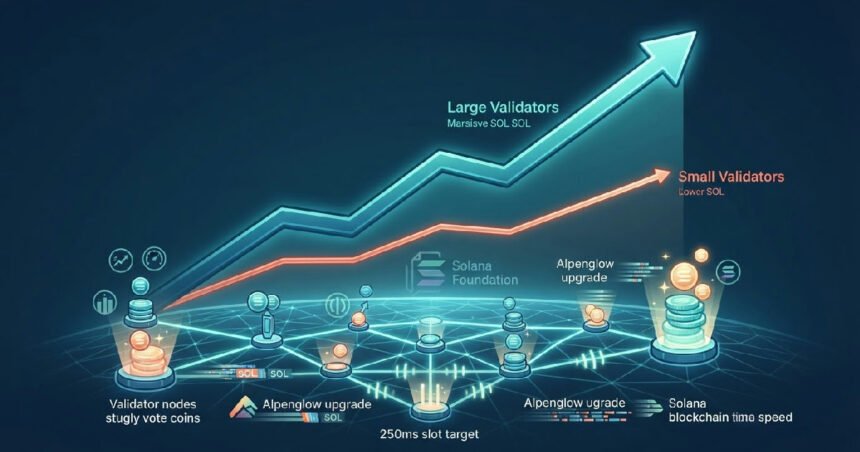
Solana’s recent speed enhancement to a 250-millisecond slot time is creating an economic divide across its network, with smaller validators losing a disproportionately larger share of reward-linked vote credits. A study published by the Solana Foundation on September 28 reveals this disparity, bringing new economic questions to the forefront as the network pursues ever-faster transaction processing.
While network stability remains strong, the data shows a significant gap in performance based on validator size. When measured equally, validators lost 1.6360% of vote credits. But when weighted by the amount of SOL staked, that figure plummets to just 0.0874%, indicating that larger, well-capitalized validators are capturing rewards far more effectively in the faster environment.
Solana Foundation study: uneven economic outcome
On the surface, the transition to faster slot times appears to be a success. The Foundation’s analysis confirmed that key network health metrics, like block skip rates, remained low and stable. This suggests that the core consensus mechanism is holding up well under the increased speed, and the network continues to produce blocks reliably.
This is a crucial benchmark for a blockchain that prioritizes high throughput.
However, beneath this veneer of stability lies a more complex economic story centered on vote credits. These credits are essential for validators, as they are a primary factor in determining the inflationary staking rewards distributed each epoch.
The more successful votes a validator lands on-chain, the more credits they earn, and the larger their share of rewards becomes. The study shows that not all validators are keeping pace equally, which has a direct financial impact on their operations and the delegators who stake with them.
The findings add a critical layer of nuance to the ongoing discussion about how Solana nodes achieve high performance. While the aggregate performance is high, the distribution of the economic benefits of that performance is becoming skewed. For smaller operators, a persistent loss of vote credits translates directly into lower revenue, potentially making their operations unsustainable over the long term and threatening network decentralization.
The stark numbers behind the validator divide
The core of the issue lies in the chasm between the two key metrics presented by the Foundation. The 1.6360% loss of vote credits for an equally-weighted network treats every validator as a single entity. This figure gives a clearer picture of how the average, often smaller, operator is faring.
In contrast, the 0.0874% loss for a stake-weighted network shows the performance of the network’s capital, which is heavily concentrated in the hands of a few large validators.
This disparity highlights that validators with less stake are losing a larger share of their potential vote credits in the 250ms window. This might mean their votes are arriving too late, causing them to miss out on credits. While the precise cause isn’t isolated, the outcome suggests a system where capital and performance could be creating a feedback loop favoring larger operators.
Why stake-weighting can mask underlying issues
Understanding the concept of stake-weighting is crucial to grasping the report’s implications. A stake-weighted average gives more influence to operators with more delegated SOL. It can remain extremely low and look healthy even when a significant number of smaller operators are losing a much greater fraction of credits.
The strong performance of a handful of massive validators can effectively hide the struggles of the broader community in an aggregate statistic.
The Foundation’s report does not identify the specific SOL payout loss for any particular operator, but the mechanism is clear. According to Solana’s own documentation, vote credits are a key input for calculating staking rewards. Fewer credits mean lower rewards, which could discourage delegation to smaller validators and further concentrate stake among the top performers.
This trend, if it continues, runs counter to the ideal of a robust and decentralized network.
Geographic latency and the path forward
The study also unearthed secondary findings related to geography. It noted that vote latency—the time it takes for a vote to land on-chain—increased as slot targets shortened. This increase was most pronounced for validator nodes located in Asia and South America.
While the network-wide average vote latency remained safely below two slots, the regional variation points to potential disadvantages for validators operating further from the network’s core clusters.
The Foundation was careful to add a statistical caveat. For instance, it counted only seven leader handoffs between Asia and Oceania and 35 Europe-to-Oceania leader handoffs during the 250ms test period. This small sample size is insufficient to definitively prove a regional penalty, but the observation of higher latency warrants further investigation.
This issue touches on the broader challenge of ensuring fairness across a global network, a topic that has been central to other recent network proposals, including debates around how Solana fairer trades should be implemented.
Ultimately, the report does not prove that faster slot times are the sole cause of the reward gap. A validator’s stake size, geography and hardware setup may all be correlated. What the data provides is a clear observation of a distributional gap that has emerged alongside the network’s speed upgrades.
This puts the onus on the community to investigate the root causes before pushing speeds even further.
The 200ms question and the Alpenglow upgrade
These findings complicate the next proposed step in Solana’s performance roadmap: a potential reduction of slot times to just 200ms. The debate is no longer just a technical question of whether the network can handle the speed, but an economic and philosophical one about what kind of network Solana wants to be.
Proceeding to 200ms without addressing the reward disparity could exacerbate the centralizing pressures on smaller validators.
Adding another layer of complexity is the planned Alpenglow upgrade, which is expected to fundamentally change how validators communicate. The new design would allow votes to be sent directly between validators, with proof of voting collected within eight slots.
This is a significant departure from the current system where votes are transactions that must compete for space and land on-chain. This upcoming change is part of why the Alpenglow upgrade has generated excitement.
If Alpenglow is successfully implemented, the current mechanisms driving vote latency and credit loss would be altered significantly. This means that today’s performance patterns may not extend to a future network running at 200ms with a different voting architecture. It offers a potential solution to the problems highlighted in the study, but also introduces uncertainty.
The community must now weigh whether to push for more speed now or wait for architectural changes that could make the network faster and fairer simultaneously.
For now, the Solana ecosystem is left to scrutinize the trade-offs. The Foundation’s data confirms a functioning, stable network at 250ms but also reveals uneven economic consequences. The decision on whether to chase the 200ms target will require a careful consideration of not just block times, but the distribution of rewards that keep the network secure and decentralized.