

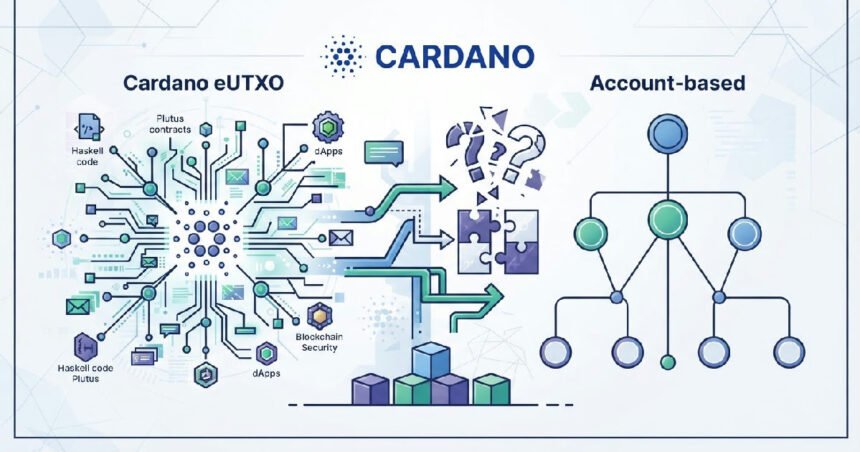
Cardano’s smart contract capabilities are frequently misunderstood, largely due to their distinctive architecture. Many observers often compare it directly to account-based blockchain models, overlooking its foundational differences. This often leads to common misconceptions regarding its flexibility and operational nuances.
At its core, Cardano employs a research-driven approach, leveraging the Extended Unspent Transaction Output (eUTXO) accounting model and its Plutus platform. This design choice prioritizes rigorous security, system predictability, and a unique development paradigm, setting it apart in the crowded blockchain landscape.
Understanding Cardano’s Foundational Smart Contract Model
Cardano positions itself as a third-generation blockchain platform, meticulously designed for security, scalability, and sustainability through peer-reviewed academic research. Its smart contract infrastructure relies heavily on Plutus, a Turing-complete platform rooted in the Haskell programming language. The entire Cardano node is also built on Haskell.
Smart contracts on Cardano aren’t standalone programs in the same vein as some other chains. Instead, they operate as immutable validator scripts. These scripts automatically execute within each Cardano node, dictating whether funds can be moved from a specific script’s address. Once deployed, their tamper-proof nature is a key security advantage.
The eUTXO model is central to this operation, extending Bitcoin’s original UTXO concept. In this enhanced model, transaction outputs can contain arbitrary logic through validator scripts, alongside custom data known as “datum.” This allows for sophisticated smart contract functionality, deeply integrated into the transaction structure.
Datum itself is an arbitrary piece of data stored on-chain within a UTXO. It plays a crucial role in managing the state of decentralized applications (dApps). Meanwhile, a “redeemer” provides additional data to a validator script, enabling it to parameterize its logic for diverse actions and state machines.
How eUTXO Differs from Traditional Account Models
The unique eUTXO model underpins Cardano’s distinct approach to smart contracts. Unlike account-based systems where a single global state is updated, eUTXO transactions consume specific unspent outputs (UTXOs) from previous transactions and generate new ones. This granular approach offers significant benefits for predictability and parallelism.
A key advantage lies in off-chain transaction validation. Before a transaction even hits the blockchain, its validity can be fully checked. This is possible because its success or failure depends solely on the transaction itself and its inputs, rather than on the blockchain’s ever-changing global state. This greatly enhances transaction predictability and user experience.
Cardano’s architecture further enhances flexibility through a layered design. It separates ADA transactions on the Settlement Layer (CSL) from smart contracts and dApps, which reside on the Computation Layer (CCL). This division is engineered to boost scalability and overall network flexibility, allowing specialized optimization for each function.
Plutus and Its Dual-Component Structure
Plutus smart contracts themselves comprise two distinct yet interdependent parts: the on-chain code and the off-chain code. The on-chain component is the validator script, written in Haskell and compiled down to Plutus Core. This immutable logic runs on every network node, approving or rejecting attempts to spend from a contract address.
This validator functions as a pure mathematical function, deterministically deciding whether an eUTXO can be unlocked based on the transaction, the redeemer, and the UTXO being spent. Its purity ensures consistent and predictable outcomes, bolstering trust in contract execution.
The off-chain code, in contrast, is the client application that builds and submits transactions for validator approval. Developers can write this part using various programming languages, handling user interfaces, data fetching, and transaction construction. The Plutus Application Framework (PAF) is specifically designed to facilitate this off-chain development.
When a transaction containing scripts is processed by the network, it undergoes a rigorous two-phase execution process. Phase 1 validates the transaction’s basic structure, verifies input existence, signature validity, and transaction balance. This initial check ensures fundamental integrity.
Phase 2 then executes the scripts embedded within the transaction. Each script receives an allocated execution budget, known as ExUnits, which directly influences the transaction fee. A critical security measure is the consumption of collateral—ADA-only UTXOs—if a script fails Phase 2, a mechanism designed to deter and prevent network flooding by maliciously crafted, failing scripts.
Debunking Common Cardano Smart Contract Misconceptions
One of the most persistent Cardano smart contract misconceptions is the idea that it isn’t truly Turing-complete. This is false. Plutus, Cardano’s native smart contract platform, is indeed Turing-complete. This means it can express any computable function, offering the same theoretical capabilities as any other general-purpose programming language or blockchain platform.
Another frequent misunderstanding suggests that the eUTXO model is overly restrictive for complex dApp development. While it requires a different programming paradigm than account-based systems, eUTXO offers enhanced security and deterministic execution. Developers know exactly what will happen to a transaction before it’s even submitted, reducing unexpected failures and improving reliability.
Some critics also point to Haskell, the language underpinning Plutus, as a barrier to entry, arguing it makes Cardano smart contract development overly niche or difficult. While Haskell is a functional language with a steeper learning curve for some, Input Output Global (IOG) has invested heavily in developer education, notably through its Plutus Pioneer Program. This initiative aims to equip developers with the necessary skills.
Expanding the Development Ecosystem
The perception of a limited development ecosystem is quickly changing. Beyond Haskell, new, more accessible languages are emerging that compile to Plutus Core, broadening developer reach. Aiken offers a modern toolchain for ease and efficiency, providing a compelling alternative to traditional Plutus Tx.
For those familiar with Python, OpShin provides a Python-based language for generic smart contracts on Cardano. Additionally, plu-ts is a TypeScript-embedded language and transaction creation library, catering to web developers. These innovations directly address the purported difficulty of development, making Cardano more accessible to a wider audience.
Furthermore, domain-specific languages like Marlowe simplify financial contract creation. Marlowe allows for both visual and code-based development, significantly lowering the barrier for users without deep programming knowledge. This diverse toolkit ensures that developers can choose the language and environment that best suits their expertise and project needs.
The Role of IOG and Future Decentralization
Input Output Global (IOG), co-founded by Charles Hoskinson, has been the primary architect behind Cardano and its core technologies like Plutus. IOG’s commitment extends beyond initial development; it actively drives the decentralization of core Cardano functions, including the stewardship of Plutus itself. This strategic move aims to diversify control and foster community involvement.
IOG has been delegating these responsibilities to specialist companies, including Midgard Labs, Se7en Labs, Teragone, ICAN Group, and BlockPQR. This ensures that the platform’s development and maintenance are not solely dependent on a single entity. Such decentralization strengthens the network’s resilience and fosters a more collaborative environment for innovation.
The Plutus Pioneer Program, initiated by IOG, exemplifies this commitment to ecosystem growth. It’s an educational initiative focused on training developers to write and deploy Plutus smart contracts. This sustained investment in human capital is crucial for expanding the pool of skilled developers capable of building robust dApps on Cardano.
Beyond the technical advancements and educational programs, Cardano also natively supports user-defined fungible and non-fungible tokens directly at the ledger level. This is a significant distinction from platforms like Ethereum, where tokens like ERC-20s are themselves smart contracts. Cardano’s approach means basic token functionalities—minting, burning, and transferring—do not require an accompanying smart contract, simplifying token management and potentially reducing transaction fees.
Looking Ahead: Secure and Predictable dApp Development
Cardano’s robust, Turing-complete smart contract capabilities, powered by its eUTXO model and Plutus platform, are designed for high assurance and predictable outcomes. While different from other blockchain paradigms, this architecture addresses vulnerabilities by design, offering a secure foundation for decentralized applications. The platform’s research-driven approach and emphasis on security underscore its potential for various decentralized applications.
The ongoing efforts by IOG and the wider community to expand the developer toolkit and decentralize core functions signal a maturing ecosystem. By continually addressing and clarifying common misconceptions, Cardano aims to attract a broader range of developers and projects. This will ultimately contribute to a more diverse and resilient network in the years to come.