

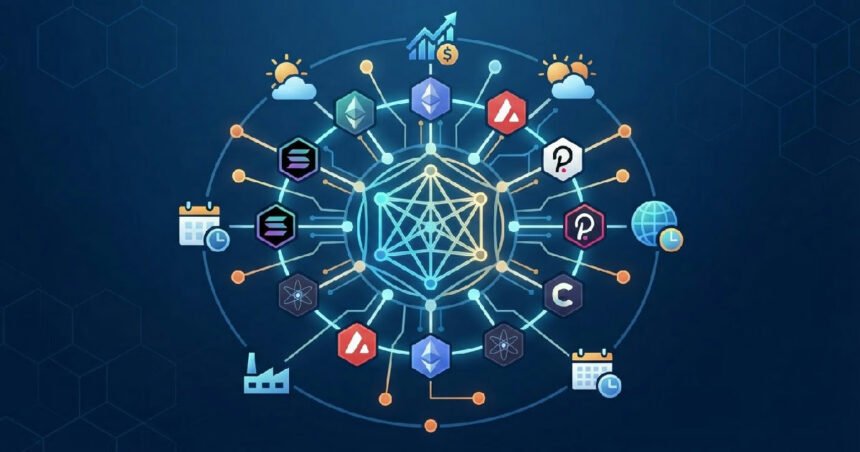
Decentralized oracle solutions are foundational for the advancement of emerging altcoin projects, enabling smart contracts to interact reliably with real-world data.
These crucial middleware layers bridge the inherent isolation of blockchains, unlocking a vast array of functionalities for decentralized applications (dApps) across various sectors.
Bridging the “Oracle Problem” with Decentralized Oracle Solutions
Blockchains, by design, are secure but isolated systems. This isolation creates what experts call the “oracle problem,” preventing smart contracts from natively accessing external, off-chain information.
Brian Curran defines this as “the security, authenticity, and trust conflict between third-party oracles and the trustless execution of smart contracts.” Without a solution, smart contracts couldn’t react to real-world events like asset prices or weather conditions.
A blockchain oracle acts as a third-party service, securely connecting these isolated blockchains to external systems and APIs. It queries, verifies, and authenticates data before relaying it to the blockchain.
For altcoin development, a Decentralized Oracle Network (DON) is particularly vital. A DON consists of independent nodes that collectively retrieve, verify, and deliver external data, eliminating single points of failure inherent in centralized alternatives.
This decentralized approach helps maintain the robust security guarantees that underpin blockchain technology. Such design fosters modular blockchain design for various altcoin applications.
How Decentralized Oracles Deliver Reliable Data
The process by which decentralized oracles ensure data integrity is multi-faceted, involving several critical steps from request to delivery.
First, a smart contract on an altcoin blockchain initiates a request for specific off-chain data. This triggers the oracle network into action.
Next, multiple independent oracle nodes within the network begin sourcing the requested data. They pull information from various external sources, including premium data aggregators, exchanges, or direct APIs, to ensure diversity and prevent manipulation.
The collected data then undergoes aggregation and validation. Nodes communicate off-chain, filtering outliers and employing cryptographic consensus mechanisms to agree on the accurate data point.
Once consensus is reached, and the data is validated and cryptographically signed, a transaction containing the finalized report is submitted on-chain. The requesting smart contract then consumes this verified data to execute its programmed actions.
Furthermore, decentralized oracle networks incorporate crypto-economic incentives. Staking and token rewards encourage honest data reporting, while penalties deter malicious behavior, reinforcing the system’s integrity.
Key Players in the Oracle Landscape
Several prominent decentralized oracle solutions cater to the diverse needs of emerging altcoin projects, each offering unique architectures and focuses.
Chainlink’s Dominance in DeFi
Chainlink stands as a leading decentralized oracle network, powering much of the decentralized finance (DeFi) sector. It connects smart contracts to crucial off-chain data, computation, and other blockchains.
Its architecture employs Decentralized Oracle Networks (DONs) with multiple independent node operators and data sources, ensuring end-to-end decentralization. Chainlink primarily utilizes a “push model,” sending data to the blockchain at regular intervals or based on specific conditions.
The platform has enabled over $27.6 trillion in transaction value, with top protocols like Aave, GMX, and Lido relying on its data standards. It also offers services like Data Streams for low-latency information and CCIP for cross-chain interoperability.
DIA’s Transparent Data Feeds
DIA, or Decentralized Information Asset, provides an open-source, verifiable, and trustless oracle network. It delivers transparent, on-chain data feeds to dApps across more than 60 blockchains.
DIA sources data directly from over 100 primary sources, including exchanges, to enhance accuracy and avoid reliance on opaque third parties. Its modular, rollup-based architecture, featuring its proprietary Lasernet, executes all oracle computations on-chain.
This ensures full auditability from the initial source to the smart contract. The $DIA utility token facilitates network governance, staking for data feed security, and payment for oracle services. DIA supports over 50 integrated blockchain networks and provides more than 100 data feeds on stocks, bonds, and other real-world assets through its xReal offering.
Pyth Network’s Real-time Financial Data
The Pyth Network specializes in delivering real-time, high-quality financial market data directly on-chain, designed specifically for low-latency updates. It aggregates price feeds from over 120 leading financial institutions.
These contributors include major exchanges, market makers, and trading firms. Unlike Chainlink’s push model, Pyth primarily uses a “pull model,” where data is published on-chain only when a smart contract requests it, potentially reducing costs.
This direct sourcing approach aims to address fragmentation in financial data. Pyth offers over 1,900 price feeds across various asset classes, including cryptocurrencies, forex, equities, ETFs, and commodities, with updates occurring every 400 milliseconds.
Tellor’s Community-Driven Approach
Tellor operates as a fully decentralized, community-focused oracle system, enabling the secure placement of arbitrary data on-chain. It prioritizes trustlessness and censorship-resistant security.
The system utilizes a bonded set of “reporters” who answer data queries on-chain. Crypto-economic incentives, through its native token “Tributes” (TRB), reward reporters for submitting data and secure it via staking and dispute mechanisms. Anyone can become a reporter without a verification process, contributing to its decentralized nature.
These robust decentralized applications offer solutions for diverse data needs.
The Future Impact on Altcoin Development
The evolution of decentralized oracle solutions marks a pivotal moment for altcoin projects, dramatically expanding their potential and utility. These technologies move beyond simple token transfers, enabling complex, data-driven smart contract functionalities.
As the crypto ecosystem matures, the demand for verifiable and tamper-proof off-chain data will only intensify. Oracles are instrumental in ensuring that dApps, whether in DeFi, gaming, or supply chain management, can operate with real-world relevance and security.
The continuous innovation in oracle architectures, from Chainlink’s comprehensive DONs to Pyth’s low-latency financial feeds, underscores a commitment to robust infrastructure. This ensures altcoins can truly fulfill their promise of revolutionizing various industries.
Ultimately, the reliability and transparency provided by these decentralized systems are essential for fostering broader adoption and trust within the altcoin space. They also play a role in evolving crypto compliance solutions for the future.