

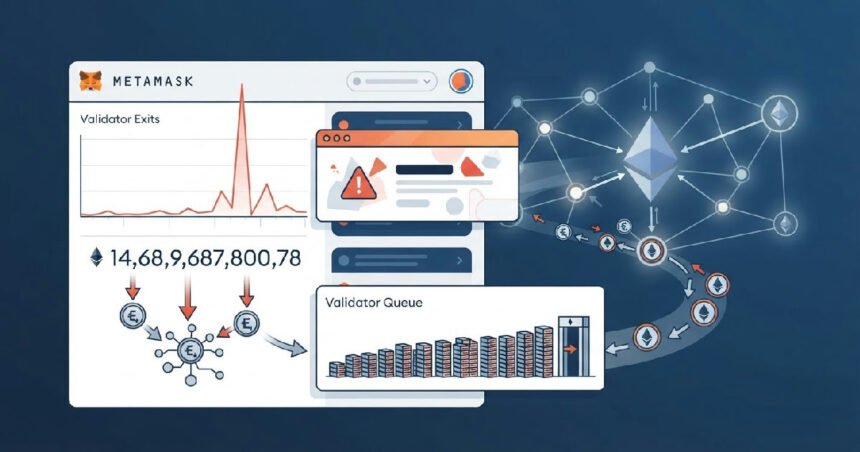
A recent security incident involving MetaMask’s infrastructure has prompted the crypto wallet provider to proactively exit approximately 17,000 Ethereum validators it operates, leading to a significant surge in the network’s validator exit queue. The incident, disclosed on September 30, 2026, saw transaction-fee rewards from several validators reportedly diverted to an address funded via the privacy protocol Tornado Cash, as identified by onchain security researcher Kaden.
This precautionary measure by MetaMask has had an immediate impact on the broader Ethereum staking ecosystem. By October 1, 2026, the total ETH awaiting withdrawal from the validator set soared to 773,447, marking the largest backlog since December 2025 and indicating substantial delays for other stakers.
MetaMask security incident prompts action
MetaMask initiated the validator exits following the detection of a compromise within its operational infrastructure. While the company has not confirmed specific figures, onchain analysis from security researcher Kaden indicated that around 17,000 MetaMask-operated validators, collectively holding approximately 523,000 ETH, were being pulled from service.
Kaden’s detailed investigation revealed that fee rewards from 18 of 19 block-proposing validators had been rerouted to a wallet linked to Tornado Cash. The attacker’s reported haul was relatively small, around 0.36 ETH, but the breach’s full scope and the potential exposure of validator signing keys remain critical concerns.
MetaMask acknowledged the infrastructure compromise but has yet to disclose whether signing keys were exposed, which could lead to “slashing” penalties for compromised validators. The company stated it identified no immediate threat to individual MetaMask wallets, aiming to reassure its vast user base.
Ethereum’s Exit Queue Swells Dramatically
The decision by MetaMask to exit thousands of validators immediately impacted Ethereum’s staking infrastructure, pushing the withdrawal queue to a nine-month peak. Data from October 1, 2026, showed 773,447 ETH in the exit queue, implying an estimated waiting period of 13 days and 10 hours before validators clear the queue.
Beyond this initial wait, an additional 7.6-day “withdrawal sweep delay” is anticipated. This bottleneck is a function of Ethereum’s built-in safeguards, designed to prevent rapid shifts in stake from destabilizing its proof-of-stake consensus mechanism.
The network processes validator exits at a controlled churn rate of 256 ETH per epoch, with each epoch lasting about 6.4 minutes. This deliberate slowness ensures network stability but means large-scale exit events, like the current Ethereum validator exits, must be processed gradually over time.
Understanding Slashing Risks and Non-Custodial Operations
A key aspect of MetaMask’s response is its emphasis on the non-custodial nature of its staking operations. The company asserted that it does not control clients’ withdrawal keys, a crucial distinction.
This means an attacker gaining access solely to validator-level controls cannot directly withdraw the underlying staked ETH. However, the potential exposure of signing keys could still pose a risk of slashing, where validators are penalized for misbehavior on the network.
MetaMask, the primary interface to decentralized applications for millions, maintained that “Our staking operations are non-custodial in nature, and we do not manage withdrawal keys for stake on behalf of our clients.” This helps protect the principal amount of staked ETH even if a validator itself is compromised.
Broader Impact and Staking Ecosystem Implications
The ripple effects of the MetaMask security incident extend beyond immediate withdrawals. Liquid staking provider Lido, which hosts some of the affected MetaMask-operated validators, estimated a full exit, withdrawal, and eventual re-entry process could take up to 45 days.
This prolonged timeline is partly due to the existing 27-day entry queue for new validators, adding another layer of delay for those looking to re-stake. Such incidents highlight the operational complexities and potential downtime associated with managing staking infrastructure, even for major players.
While the market for Ethereum staking remains robust, these security challenges underscore the continuous need for vigilance. Stani Kulechov, founder of Aave, quickly confirmed that Aave markets remained unaffected, demonstrating how protocols aim to compartmentalize risks.
Navigating Future Security Challenges
The incident serves as a stark reminder of the persistent security challenges within the blockchain ecosystem. Ohm Shah of MetaMask noted that “Drainers are a constant cat and mouse game,” emphasizing the ongoing battle against malicious actors.
While MetaMask reported no immediate threat to wallets, the incident underscores the interconnectedness of infrastructure. The relatively small amount of ETH reportedly captured by the attacker—just 0.36 ETH—doesn’t diminish the gravity of the breach itself or its broader implications for trust and operational stability.
ConsenSys, MetaMask’s parent company, has faced prior security scrutiny, including a March-April 2026 incident involving a North Korea-linked IT worker, though no user funds were compromised then. These events reinforce the critical importance of robust security protocols and swift incident response for Web3 platforms.
The coming weeks will reveal the full extent of the incident. Lido expects the final MetaMask-operated validators to complete their exit by October 7, 2026. The industry will closely watch for further details on how MetaMask addresses the vulnerabilities and whether the incident prompts new security standards across the ecosystem.
The security scare also emphasizes the importance of understanding the mechanics of staking. Ethereum’s design includes mechanisms to manage both entry and exit queues, aiming to ensure stability, but these queues can lead to significant delays during periods of high activity, whether positive or negative. The incident may prompt further discussions around queue management and flexibility in the face of unexpected events.
The long wait times for exiting and re-entering validators could also impact the profitability for some staking operators. While the network’s 2.64% average APR for staking remains attractive, extended periods outside the active set mean lost potential rewards. This could influence future operational decisions for entities managing large validator pools.
Ultimately, this MetaMask security incident highlights that even prominent and widely used platforms are not immune to sophisticated attacks. The rapid response and transparency, albeit limited by ongoing investigations, are crucial for maintaining user confidence in decentralized finance infrastructure.