

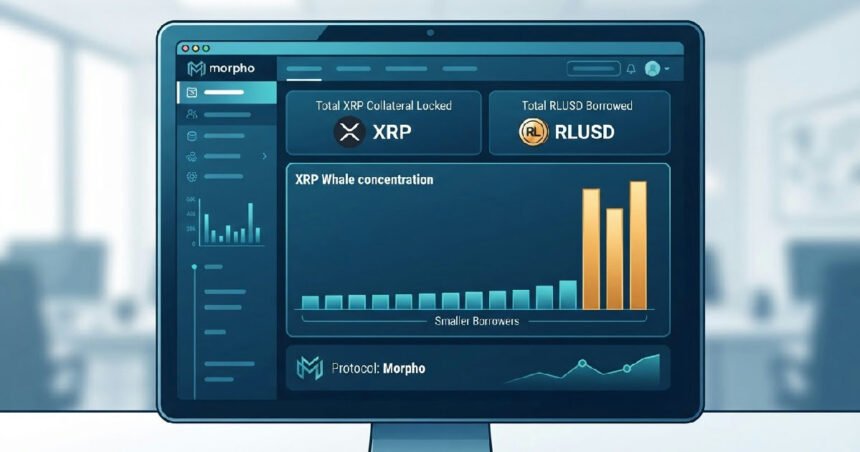
XRP has officially entered the live dollar borrowing market on Ethereum, marking a significant new utility for the digital asset. However, this nascent lending ecosystem, particularly on the Morpho protocol, remains heavily skewed towards a select group of large holders.
As of October 1, 2026, the Morpho market reported approximately 7.18 million Ripple USD (RLUSD) in outstanding loans, collateralized by 10.76 million FXRP – a tokenized representation of XRP.
Whale Activity Dominates Emerging XRP Credit Market
A striking 93% of this debt is concentrated among just three addresses, according to market data. This early dominance by a handful of “whales” raises crucial questions about the genuine breadth of XRP adoption in decentralized finance (DeFi) and how this emerging credit market will evolve. Ripple, meanwhile, continues its push for broader institutional integration of XRP.
The concentration of borrowing activity on Morpho is undeniable. The three largest addresses effectively control the vast majority of the outstanding 7.18 million RLUSD in loans. This level of centralization means that the market’s size and perceived activity can be dramatically altered by the actions of just a few entities, making it less representative of widespread participation.
For instance, a substantial loan repayment from one of these dominant wallets could sharply contract the total borrowing figures overnight. Conversely, another large loan from the same investors would inflate the total without necessarily attracting new users. This dynamic highlights a key challenge for nascent DeFi markets seeking to demonstrate broad utility.
Liquidation Thresholds and Market Vulnerability
The lending mechanism on Morpho allows lenders to liquidate a position if its debt value surpasses 77% of its collateral. While the three largest borrowers currently maintain a healthy buffer against price fluctuations – with the biggest position withstanding a roughly 45% decline in the FXRP-to-RLUSD ratio – smaller participants have less room to manoeuvre.
One such position, holding approximately 121,000 RLUSD in debt against 133,000 FXRP, could hit its liquidation threshold after just a 21% fall in the FXRP-to-RLUSD ratio. The market did record some liquidations in September but without any realized bad debt as of October 1. A more significant market downturn would truly test the resilience of these concentrated positions and the broader market.
Should a major position face liquidation, a considerable amount of FXRP would suddenly need to be absorbed by liquidators. This doesn’t automatically imply an immediate sale of the underlying XRP, as liquidators have options: they could hold the FXRP, sell it, bridge it back to Flare, or redeem it for native XRP. Still, the prospect introduces a layer of market sensitivity.
Beyond Morpho, the broader XRP ecosystem has also seen significant whale movements. On September 26, 2026, XRP whales accumulated over 470 million tokens, valued at approximately $724 million, within a five-day trading period. This activity follows 11 consecutive weeks of XRP ETF inflows through September 25, indicating sustained institutional demand.
Just two days later, on September 28, a single large XRP holder withdrew around 580 million tokens, worth about $900 million, from exchanges across seven transactions. These patterns often shape XRP investment decisions and reflect underlying confidence or strategic positioning.
Native Lending on XRPL Aims for Broader Access
The current concentration on Morpho may be an interim phase as developers work to introduce native lending capabilities directly onto the XRP Ledger (XRPL). This proposed lending architecture, embodied in the XLS-65 and XLS-66 amendments, is currently undergoing rigorous security reviews. If approved, it would allow fixed-term credit to originate directly on the XRPL.
This native solution aims to streamline the borrowing process significantly. XRP holders would no longer need to mint FXRP, bridge it to Ethereum, and then engage with protocols like Morpho. This reduction in cross-chain friction could make XRP-backed credit far more accessible for institutions looking for efficient financing and liquidity management solutions.
Bridging Institutional Finance with XRPL
Ripple has been aggressively pursuing a coordinated institutional strategy for XRP and its stablecoin, RLUSD, aiming to embed them deeper into mainstream finance. Jazzi Cooper, Head of Product at RippleX, has explicitly referred to the use of XRP as collateral for institutional credit as a “killer use case.”
The XRPL’s native lending protocol is designed to facilitate low-cost, compliant credit markets at the protocol level. It leverages Single Asset Vaults for asset pooling and the Lending Protocol for loan origination. This framework treats digital assets as working capital, enhancing their productivity within the financial system.
Several institutional players are already embracing XRP and RLUSD. Ripple Prime, the company’s institutional prime brokerage, accepts XRP as eligible collateral alongside other digital assets. Moreover, Bitnomial, a CFTC-regulated derivatives market infrastructure, integrated support for RLUSD and XRP as margin collateral for institutional clients trading leveraged perpetuals, futures, and options on November 3, 2025.
Luke Hoersten, CEO of Bitnomial, noted this represented “a major evolution in how traders can deploy their digital assets.”
The XRPL has also made considerable strides in tokenized Real-World Assets (RWAs). As of September 26, 2026, tokenized RWAs on the XRPL surpassed $3 billion in total value. The network has hosted over $1.14 billion in tokenized commodities as of February 8, 2026, positioning it as the second-largest network for tokenized commodities, just behind Ethereum.
This robust infrastructure underscores the XRPL’s growing role in a tokenized economy.
The Broader Landscape of XRP-Backed Credit
Beyond the Ethereum-based Morpho market and the impending native XRPL solution, several centralized lending platforms already offer XRP-backed loan services. These platforms allow users to deposit XRP as collateral to borrow fiat currencies or stablecoins, showcasing a diverse ecosystem for XRP utilization.
Platforms such as Nexo provide competitive annual interest rates for XRP-backed loans, starting from as low as 0.9%. Other providers like CoinRabbit, Lantern Finance, and YouHodler also feature prominently in this space. Lantern Finance, for example, offers rates around 15% APR, while others can range from 18.9% to 19.04%. Nebeus currently boasts some of the best XRP lending rates, offering up to 12% APY.
Generally, XRP-backed loans in 2026 typically offer annual percentage rates (APR) between 8-16%, with Loan-to-Value (LTV) ratios ranging from 25-50%.
LendProtocol, a CeFi platform launched on the XRP Ledger on July 1, 2026, has already seen substantial activity, with over 13,713 active lenders and 743 million XRP lent, offering 12% APR on XRP and RLUSD deposits. This variety of options underscores a growing demand for leveraging XRP holdings without outright selling them.
Measuring True XRP Adoption
While the emergence of XRP-backed lending markets signifies a positive expansion of its utility, distinguishing genuine broad adoption from deeper leveraging by existing large holders remains a critical analytical challenge. If the market’s growth primarily stems from the same “whales” increasing their borrowing, it deepens XRP’s functional utility for those specific participants but doesn’t necessarily demonstrate wider acceptance across a diverse user base.
The true test of broader adoption will be evidenced by growth spread across new borrowers, an expansion of lending pools, and sustained activity even after repayments are made. This kind of diversified growth would provide stronger evidence that credit is widening the asset’s economic use.
Security and Architectural Advantages
The XRP Ledger’s unique architecture inherently mitigates certain risks prevalent in other DeFi ecosystems. Its design makes flash loan exploits structurally impossible due to atomic transactions. This means that all operations within a transaction either succeed completely or fail entirely, preventing malicious actors from manipulating markets mid-execution. This security feature is a significant draw for institutional entities.
The XRPL’s approach to security, including rigorous reviews for amendments like XLS-65 and XLS-66, aims to mathematically prove the integrity of its new lending markets against potential vulnerabilities. This commitment to a secure and robust infrastructure is vital for attracting the institutional capital and broader user base that Ripple is targeting.
The XRPL’s architecture makes flash loan exploits structurally impossible due to atomic transactions, ensuring all operations within a transaction either succeed completely or fail entirely. This inherent security feature significantly draws institutional entities and strengthens the XRPL’s potential as a compliant, on-chain credit market.
The Road Ahead for XRP as Collateral
The twin developments of XRP-backed lending on Ethereum via Morpho and the impending native lending protocol on the XRPL present a fascinating dual path for XRP’s evolution as collateral. The comparison between these two approaches will ultimately reveal whether reducing cross-chain friction, as the native XRPL solution promises, truly attracts a broader and more diverse borrower base.
The success of these initiatives hinges not just on the volume of loans, but critically on the composition of borrowers. A market driven by new participants and varied institutional interest would signal a significant step towards mainstream financial integration. Conversely, continued concentration, even with increased volume, might indicate that XRP’s utility is deepening for existing stakeholders without expanding its overall reach.
Ripple’s strategic vision involves positioning XRP as a versatile institutional collateral for margin, settlement, and secured financing. The ongoing growth in tokenized assets on the XRPL and the partnerships with platforms like Bitnomial underscore this ambition.
As stablecoins move from speculative assets to “real world applications,” as described by Jack McDonald, SVP Stablecoins at Ripple, the role of XRP as robust collateral becomes even more pronounced.