

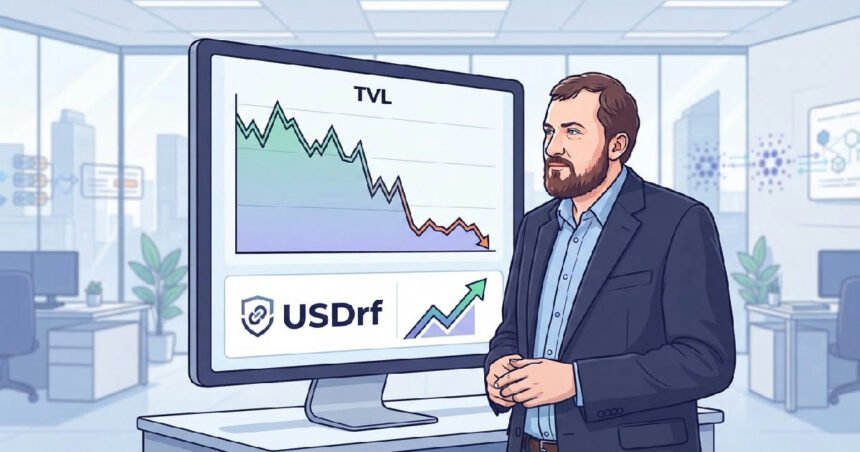
Cardano’s decentralized finance (DeFi) ecosystem is facing a critical test as a new project backed by founder Charles Hoskinson aims to reverse a steep decline in activity. On October 1, the RealFi platform launched its credit-backed dollar token, USDrf, on the Cardano mainnet, introducing a system designed to bridge blockchain capital with real-world lending opportunities.
The launch arrives as the total value locked (TVL) in Cardano DeFi has plummeted by more than 50%, falling from a high of approximately $150 million in May 2026 to just $67 million. This contraction stands in stark contrast to the network’s growing stablecoin supply, which is approaching a record $70 million, creating a pool of idle capital searching for a destination.
A diverging path for Cardano DeFi metrics
The decline in Cardano’s DeFi TVL paints a challenging picture for the network, especially when compared to rivals like Ethereum and Solana, which maintain DeFi markets valued in the billions. The drop represents a significant reversal from earlier peaks, including a reported TVL near $600 million back in March 2024, highlighting the struggle to retain capital within its native applications.
This downturn has made Cardano’s strategy to attract more sophisticated financial activity more urgent. The ecosystem has seen other signs of stalled DeFi growth across the industry, but its own metrics are particularly concerning. For instance, weekly decentralized exchange (DEX) volume fell dramatically from over $100 million in late August to just $3.37 million by mid-September 2026.
Yet, while DeFi engagement has withered, the network’s stablecoin market cap tells a different story. The supply of dollar-pegged tokens on Cardano is nearing an all-time high of almost $70 million. This creates a paradox: a growing base of stable liquidity with a shrinking number of on-chain applications to deploy it in. RealFi is stepping in to fill that exact void.
RealFi’s pitch to revive on-chain credit
RealFi introduces a direct conduit between this stablecoin liquidity and a portfolio of off-chain credit assets. The project, which Cardano founder Charles Hoskinson confirmed he invested “several million dollars” in, aims to fulfill the long-held “bank the unbanked” vision by generating yield from real-world lending, primarily in emerging markets.
The platform launched two primary tokens: USDrf, a dollar-pegged token, and sUSDrf, its yield-bearing counterpart. Eligible users can acquire USDrf and stake it to receive sUSDrf, which provides variable returns from an underlying portfolio. According to RealFi documentation, this portfolio can include direct loans, private credit funds, public credit instruments, and even investment-grade ETFs and government treasuries.
This model marks a significant departure from typical DeFi protocols that generate yield primarily from token incentives and trading fees. Instead, RealFi’s returns are tied to the performance of actual loans serviced in countries like Kenya and Uganda, where the team was building its platform before the mainnet launch.
The separation of retail and institutional access
A crucial aspect of RealFi’s design is the distinction between how retail users and institutional partners interact with the system. While both can hold USDrf, their paths for converting the token back to dollars are fundamentally different, a structure built around the platform’s complex Cardano smart contract capabilities.
Eligible retail users can purchase USDrf on supported decentralized exchanges but cannot redeem it directly with the issuer, RealFi Reserve. Their exit strategy depends entirely on finding a buyer on the open market, making their liquidity subject to DEX conditions and the prevailing market price of USDrf.
Verified institutional entities, however, receive a direct line to the issuer. After completing a verification process and whitelisting their addresses, they can mint USDrf directly and request redemption for $1 per token, less fees. Even this access is not without limits; redemptions are subject to queues and daily or monthly caps, and can be suspended entirely during periods of market stress or security incidents.
Understanding the risk structure
For users seeking yield, the sUSDrf token introduces another layer of risk. Stakers face a seven-day “cooldown” period when they wish to unstake, and the conversion rate back to USDrf is not guaranteed to be one-for-one. This is because sUSDrf occupies a junior position in the protocol’s loss-absorption hierarchy.
In the event of defaults within the credit portfolio, the protocol’s first-loss reserves are designed to take the initial hit. If those reserves are depleted, sUSDrf holders are next in line to absorb losses before the senior USDrf token is impacted. RealFi’s documentation is explicit, describing sUSDrf as a “junior loss-absorbing instrument whose yield can fall to zero and whose principal can be impaired.”
This structure protects the core USDrf token but places stakers in a higher-risk, higher-reward position. USDrf itself is not an insured bank deposit, and for retail holders, its value is ultimately determined by market liquidity on a DEX, not a guaranteed redemption from the issuer.
The looming balance sheet test
While the concept is compelling, RealFi’s immediate challenge is one of transparency and execution. At launch, public information on the size of its protective buffers, such as first-loss capital and liquid reserves, was not available. The public reserve attestation page names an auditor, HT Digital, but did not display a dated reserve quantity as of October 1.
This makes it difficult for outside observers to assess how much credit deterioration the portfolio could withstand before holders of sUSDrf or even USDrf are affected. The project’s success now hinges on its ability to underwrite and manage its loan portfolio effectively while providing sufficient liquidity for retail users who want to exit their positions.
The platform also carries significant geographical restrictions. It is currently unavailable to users in the United States, the European Union, the United Kingdom, and Hong Kong, among other jurisdictions, limiting its initial addressable market.
A new chapter for cardano’s real-world ambitions
The launch of RealFi represents a pivotal moment for Cardano’s broader strategy. For years, Hoskinson has spoken about using blockchain to provide financial services in developing nations, a vision that recent Cardano blockchain trials with corporate giants like Petrobras have started to explore. RealFi is the first major production-level attempt to turn that vision into a functioning credit market on Cardano.
Hoskinson has already outlined plans to connect the product with other ecosystems, including Bitcoin DeFi and Cardano’s own privacy-focused platform, Midnight. Such integrations could allow users to borrow against Bitcoin-linked assets and deploy the capital into RealFi, using privacy-preserving credentials to meet identity requirements outside of traditional banking.
For now, those integrations remain on the horizon. The immediate test for RealFi will be more fundamental: can it attract meaningful capital and manage its credit risks effectively?
The performance of its loan book, the depth of liquidity on DEXs, and the demand from institutional partners will determine whether this ambitious project can reverse Cardano’s DeFi slide and create a durable, real-world utility for its growing stablecoin base.