

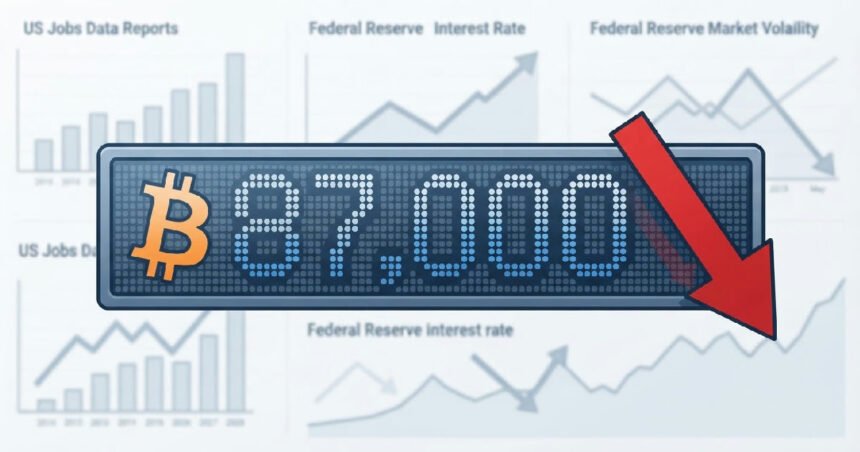
Bitcoin’s price briefly soared to $87,000 on October 2, 2026, reacting to weaker-than-expected US jobs data, but the rally proved unsustainable. The cryptocurrency swiftly retreated, failing to maintain its gains despite macroeconomic signals typically favorable to risk assets.
Immediately after the 8:30 a.m. ET release of the September 2026 jobs report, Bitcoin surged from above $86,000 to a peak of $87,250. However, this momentum quickly dissolved, with the digital asset falling back to $84,643.39.
US jobs data disappoints, bitcoin’s 87000 surge
The US labor market showed significant signs of cooling in September 2026, with key figures falling well short of economists’ forecasts. This slowdown has immediate implications for financial markets, including cryptocurrencies.
Nonfarm payrolls added only 29,000 jobs, a stark contrast to expectations ranging from 84,000 to 93,000. This figure represented roughly one-third of the anticipated job creation.
Weak Payrolls and Rising Joblessness
The unemployment rate edged up to 4.2%, surpassing the 4.1% forecast and the previous month’s 4.1% figure. More precise data indicated the rate climbed from 4.141% to 4.175%.
Wage growth also lagged, with month-over-month earnings increasing by just 0.1% against an expected 0.3%. Year-over-year earnings rose 3%, falling short of the 3.2% projection.
Furthermore, revisions painted a bleaker picture for prior months. August payrolls were revised down from 162,000 to 133,000, and July’s initial gain of 21,000 was reclassified as a loss of 10,000 jobs.
These combined revisions for July and August accounted for 60,000 fewer jobs than previously reported. This downward trend in job creation suggests a significant shift in the labor market.
Bitcoin’s Brief Ascent and Rapid Retreat
Bitcoin, often seen as a risk asset, typically benefits from a softening labor market as it can reduce the likelihood of aggressive interest rate hikes. This was evident in its initial reaction to the jobs report.
The cryptocurrency was trading above $86,000 before the report and peaked at $87,250 by 8:32 a.m. ET. But the enthusiasm waned quickly, leading to a retreat that saw Bitcoin down 0.7% over 24 hours.
Prior to the report, Bitcoin had enjoyed a 2% gain over the previous 24 hours and more than a 2% weekly gain. It had also rallied almost 15% from its September 15 low.
Crypto trader Doctor Profit reportedly posted on X that he was building a “massive short” position near $86,200. His orders were placed between $86,500 and $87,000, anticipating a downturn.
QCP Markets noted the brief surge pushed Bitcoin to $86,913, marking its highest print since September 23. This short-lived spike highlights the market’s sensitivity to economic indicators.
The failed rally underscores the complex dynamics influencing Bitcoin price volatility. Even seemingly positive macroeconomic news doesn’t always translate into sustained gains.
Fed Rate Hike Odds Plummet
The dismal jobs data dramatically shifted expectations for the Federal Reserve’s monetary policy. A weaker labor market makes it harder for the Fed to justify further interest rate increases.
Odds of a 25 basis point rate hike in October plunged to 16% on Polymarket, a sharp reversal from 65% at the start of the week. Futures data also showed a decline, putting October hike odds at 20%.
While an October hike now seems unlikely, the Federal Reserve is still widely expected to announce another rate increase in December. This outlook tempers some of the market’s immediate relief.
Broader Market Reactions
The jobs report had a profound impact across global financial markets. US stocks saw broad gains, while Treasury yields eased, reflecting reduced tightening expectations.
The Dow Jones Industrial Average gained 0.49%, the S&P 500 rose 0.74%, and the Nasdaq Composite increased by 1.19%. Tech giants like SpaceX and Tesla saw significant jumps, rising 7.35% and 4.65% respectively.
Conversely, Accenture fell 6.27% and SanDisk dropped 3.79%. This mixed performance shows investor selectivity even amidst a general market upturn.
The soft jobs data pointed towards a Treasury rally, easing pressure on long-dated yields. The 30-year Treasury yield reached 5.62%, and the 10-year yield briefly hit 5.29%.
Gold, often a safe haven, posted its worst month of the year, falling 8.5%. This decline aligns with real-rate signals, indicating a broader market adjustment to evolving economic forecasts.
Despite the broader market response, Bitcoin’s inability to hold its gains points to its unique market sensitivities. Understanding Bitcoin macro correlation becomes increasingly vital for investors.
Economic Outlook and Inflation Concerns
Many economists and politicians characterize the current US economic situation as an “affordability crisis.” Prices remain high, affecting everyday consumers.
Federal Reserve new chair Kevin Warsh has explicitly stated that prices are too high. He emphasizes the central bank’s focus on implementing policies to make life more affordable for Americans.
The September employment figures reflect a mixed economic landscape. Healthcare, construction, and manufacturing sectors added jobs, gaining 17,000, 11,000, and 9,000 respectively.
However, financial activities contracted by 7,000 jobs, and government payrolls shed 17,000 positions, primarily in local government education. These sectoral shifts illustrate underlying economic adjustments.
The Federal Reserve’s next steps will be critical in navigating this environment. The market will closely watch for further indicators that could finally spark a sustained rally for assets like Bitcoin, or signal continued volatility.