

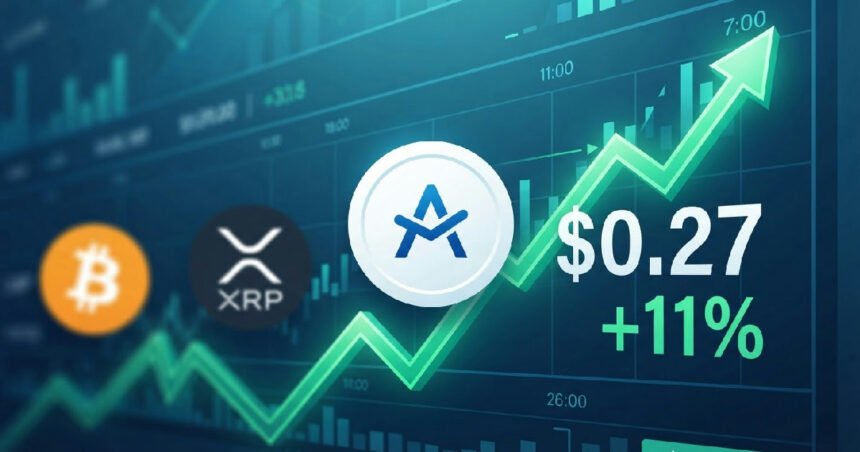
Cardano’s native token, ADA, saw a substantial rally on Monday, October 5, 2026, surging by 11% to reach a price of $0.27. This significant climb positioned ADA as a strong performer, outpacing both Bitcoin (BTC) and XRP (XRP) in market momentum for the day. The achievement marks ADA’s highest valuation since May 2026, signaling a potential shift in investor sentiment.
The cryptocurrency market often sees dominant players like Bitcoin dictate trends, but Cardano’s recent performance suggests independent strength. Its move above key rivals underscores growing interest in its ecosystem and underlying technological advancements. This upward trajectory contrasts with broader market dynamics, where other major cryptocurrencies have shown more modest gains.
Cardano ADA surge outpaces rivals
Over the last three months, Cardano has demonstrated impressive growth, with ADA appreciating by over 50%. In comparison, Bitcoin saw a 37% increase, and XRP registered a 33% gain during the same period. This sustained performance highlights a notable shift in how investors are evaluating digital assets, looking beyond just established market leaders.
Market Performance Comparison (Last Three Months)
This comparative data clearly illustrates Cardano’s superior performance in the recent market cycle, reflecting a notable shift in investor focus towards assets with strong underlying development and growing utility.
The recent rally builds upon an already robust recovery for ADA, which has climbed 74% from its July 2026 low of $0.1554. This consistent upward trend suggests that underlying developments within the Cardano network are gaining traction and translating into tangible market value. Investors appear to be responding positively to its ongoing evolution.
Key Catalysts Behind ADA’s Sharp Rally
Several factors have contributed to Cardano’s impressive price surge, indicating a maturing ecosystem and increasing utility. These drivers range from innovative financial products to a burgeoning decentralized finance sector, attracting new users and capital.
This upward movement reflects a growing confidence among investors who are increasingly recognizing Cardano’s commitment to tangible, real-world applications. The integration of advanced financial products, such as those that bridge traditional finance with blockchain, highlights a strategic move towards broader utility and adoption beyond speculative trading.
Moreover, the rapid expansion of the decentralized finance (DeFi) sector within Cardano has played a pivotal role in its recent gains. As more capital flows into these protocols, it not only boosts the network’s total value locked but also demonstrates the practical utility and robustness of its underlying infrastructure, attracting both institutional and retail participants.
RealFi’s Mainnet Debut Fuels Growth
A significant catalyst has been the recent launch of RealFi on Cardano’s mainnet. This initiative introduced USDrf and staked sUSDrf, offering attractive annual yields of up to 9% by routing stablecoins into institutional credit and emerging market loans. Such real-world applications provide tangible value and a compelling reason for new capital to flow into the Cardano ecosystem.
The appeal of stablecoin yields, especially in the context of traditional finance, can draw a wider range of investors seeking predictable returns. RealFi effectively bridges the gap between decentralized finance and traditional credit markets. It offers a secure and transparent avenue for asset deployment within Cardano’s infrastructure, further solidifying its utility.
Surging DeFi Activity and Investor Confidence
Cardano’s decentralized finance (DeFi) ecosystem has also shown remarkable growth, directly impacting ADA’s value. The Total Value Locked (TVL) on Cardano rose by 8.72% within 24 hours, reaching an impressive $70.78 million. This metric reflects the total capital locked within the network’s DeFi protocols, signaling increased user engagement and trust in its applications.
Furthermore, daily decentralized exchange (DeX) volume hit $4.36 million, supported by 15,985 active addresses. These figures demonstrate robust on-chain activity, indicating that users are actively trading and utilizing services within the Cardano network. The growing Cardano DeFi sector is crucial for sustained growth and adoption, as it expands the platform’s functional capabilities.
Retail sentiment surrounding ADA has also shifted dramatically, moving from ‘bearish’ to ‘bullish’ on platforms like Stocktwits. Chatter volume concurrently rose from ‘low’ to ‘high’, reflecting heightened public interest and positive market psychology. This change in public perception often precedes or accompanies significant price movements, creating a self-reinforcing cycle of demand.
Architectural Philosophy Driving Cardano’s Development
Cardano differentiates itself through a unique developmental approach, prioritizing academic rigor and a methodical, peer-reviewed process. This philosophy underpins its technical foundations, aiming for a more secure and sustainable blockchain ecosystem compared to many competitors.
This commitment to scientific methodology and formal verification means that every major protocol upgrade undergoes extensive research and peer review before implementation. Such a meticulous approach, while potentially slower in execution, significantly enhances the network’s long-term stability, security, and resilience against vulnerabilities often seen in less rigorously developed systems.
The emphasis on peer-reviewed academic research provides a strong foundation for trust and reliability, which is crucial for attracting large-scale enterprise adoption and institutional investment. This systematic, evidence-based development path contrasts with more agile, less formal approaches, positioning Cardano as a beacon of engineering discipline in the often fast-paced and experimental blockchain space.
Academic Rigor and Proof-of-Stake Innovation
Launched in 2017 by Charles Hoskinson, a co-founder of Ethereum, Cardano was designed as a third-generation cryptocurrency platform. Hoskinson, also CEO of Input Output Global (IOG), formerly IOHK, envisioned a blockchain built on scientific philosophy. This approach emphasizes formal verification and extensive peer review for its core protocols.
At the heart of Cardano is Ouroboros, its Proof-of-Stake (PoS) consensus mechanism. Ouroboros was the first PoS protocol to be mathematically proven secure and peer-reviewed, setting a high bar for blockchain security and efficiency. Unlike Bitcoin’s energy-intensive Proof-of-Work system, Ouroboros divides time into epochs and slots, selecting stake pools to create new blocks based on staked ADA, making it significantly more environmentally friendly.
Structured Evolution Through Development Eras
Cardano’s development adheres to a well-defined roadmap, organized into distinct eras. These phases ensure systematic progress and the gradual rollout of new features and capabilities. Each era builds upon the last, contributing to the network’s overall maturity and functionality.
The roadmap began with Byron, establishing the foundational technology and the ADA cryptocurrency itself. Shelley then introduced decentralization of block production and staking capabilities between June and July 2020. The subsequent Goguen era brought crucial smart contract functionality, enabling decentralized applications (dApps) and expanding the network’s utility. Addressing smart contract misconceptions has been vital for developers and users alike as the ecosystem matured.
Basho focused on scalability improvements, including input endorsers, pipelining, and the pivotal Hydra Layer 2 solution. The final phase, Voltaire, is dedicated to decentralized governance, empowering ADA holders with direct control over network development and treasury management. This multi-stage approach aims for a robust, scalable, and truly decentralized platform.
Advancing Scalability and Decentralized Governance
Cardano continues to push the boundaries of blockchain technology with ongoing advancements in scalability and decentralized governance. These efforts are critical for the network to handle increasing transaction volumes and to empower its community in decision-making processes.
For any blockchain aspiring to global adoption, the ability to process a massive number of transactions efficiently is paramount. Cardano’s dedicated focus on achieving high throughput through solutions like Hydra is essential to prevent network congestion and maintain low transaction fees, ensuring a seamless experience for a growing user base and complex decentralized applications.
Equally vital is the transition towards genuine decentralized governance, which empowers the community to shape the network’s future direction. By putting decision-making power in the hands of ADA holders, Cardano aims to create a truly democratic and self-sustaining ecosystem, fostering greater community engagement and ensuring the platform remains adaptable and aligned with its users’ evolving needs.
Hydra’s Role in Enhancing Transaction Throughput
Hydra, Cardano’s Layer 2 scaling solution, is not a sidechain but an off-chain framework designed to significantly boost transaction speed and efficiency. It operates by processing transactions within “Hydra Heads” among fixed groups of participants, effectively reducing the load on the main chain. This innovative approach aims for a theoretical maximum throughput of an astounding 1 million transactions per second (TPS).
Recent updates have further refined Hydra. In August 2026, Cardano’s development report highlighted Hydra 2.3.0, which brought faster snapshot processing and native HD wallet key support. By September 2026, Hydra 2.4.1 was launched, focusing on security enhancements by fixing a bug that could allow invalid transactions to be included in snapshots. These continuous improvements are vital for preparing Cardano for mass adoption.
Voltaire Era Shapes Future Governance
The Voltaire era represents Cardano’s final development phase, centered on achieving full decentralized governance. This phase is guided by Cardano Improvement Proposal (CIP)-1694, which outlines comprehensive mechanisms for on-chain voting, treasury management, and constitutional amendments. The goal is to transition control of the network entirely to its community of ADA holders.
The Chang hard fork, implemented in September 2024, officially marked Cardano’s entry into the Voltaire era. This significant upgrade introduced initial governance features, including DRep registration and the launch of the GovTool. Further updates are planned for treasury withdrawals and more extensive constitutional changes.
A permanent Constitution was notably approved by 95% of delegates at the Constitutional Convention held in Buenos Aires and Nairobi between December 4-6, 2024, underscoring the community’s commitment to shared governance.
Analyst Projections for Cardano’s Trajectory
With its recent performance and ongoing technical advancements, Cardano has captured the attention of market analysts, who are offering various price predictions for its future. The consensus generally points towards continued growth, albeit with some caveats.
Analysts are projecting that ADA could reach between $2 and $3.25 in 2026, with some bullish targets extending up to $4.50. These optimistic forecasts often cite potential boosts from the anticipated approval of exchange-traded funds (ETFs) and the successful implementation of further Hydra upgrades. The expansion of the DEX volume on Cardano is another positive signal analysts watch closely.
An AI model, Claude, specifically anticipated ADA to conclude 2026 at $0.31, representing a 26% increase from its October 3, 2026 price of $0.25. The model suggested that the RealFi launch alone would contribute an additional $0.02 to this target, highlighting the perceived impact of new utility.
While some analysts maintain a cautious outlook, anticipating a potential decline in 2026, a strong recovery by December is considered possible.
This potential recovery would be heavily influenced by factors such as further network upgrades, the continued development of its DeFi ecosystem, and evolving cryptocurrency regulation. As Cardano continues to build out its infrastructure and expand its real-world applications, its trajectory will remain a key focus for investors and the broader crypto community.
Frequently Asked Questions (FAQ)
- What is ADA?
- ADA is the native cryptocurrency of the Cardano blockchain platform. It is used for transactions, staking, and participating in the network’s governance.
- What is the significance of RealFi’s launch on Cardano?
- RealFi’s mainnet debut, offering products like USDrf and sUSDrf with competitive yields, represents a significant step in bridging decentralized finance with traditional credit markets. It provides real-world utility and attracts new capital by offering tangible value.
- How does Cardano ensure scalability?
- Cardano addresses scalability through various mechanisms, notably its Layer 2 scaling solution, Hydra. Hydra aims to significantly increase transaction throughput by processing transactions off-chain within “Hydra Heads,” complementing the main chain’s capacity.
- What is Cardano’s approach to decentralized governance?
- Cardano is transitioning towards full decentralized governance in its Voltaire era, guided by CIP-1694. This empowers ADA holders with direct control over network development, treasury management, and constitutional amendments through on-chain voting, aiming for a truly democratic ecosystem.
- Why is Cardano’s development considered unique?
- Cardano distinguishes itself through an academic, peer-reviewed approach to development, prioritizing formal verification and rigorous research for its protocols. This methodical philosophy aims to build a highly secure, stable, and sustainable blockchain, contrasting with more rapid, less formal development models.