

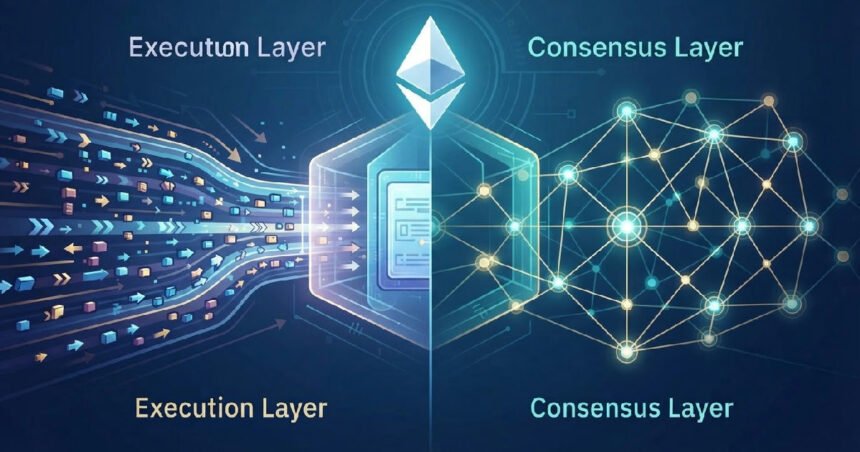
Ethereum’s infrastructure currently operates on a sophisticated two-part system known as Ethereum’s dual architecture, comprising the Execution Layer (EL) and the Consensus Layer (CL). This fundamental split provides a robust framework that drives the network’s current operations and future advancements.
This design allows each component to handle specialized functions independently, significantly improving the network’s modularity and setting the stage for future enhancements. It ensures Ethereum maintains both robust security and operational stability.
Understanding Ethereum’s Dual Architecture Today
The core concept of Ethereum’s dual architecture separates transaction processing from network consensus, a fundamental re-engineering of its operational core. This architectural shift was established by “The Merge” on September 15, 2022, which transitioned Ethereum from Proof-of-Work to Proof-of-Stake.
Prior to this, the Execution Layer was known as the “Eth1” chain or Ethereum Mainnet, handling all user-facing activities. The Consensus Layer originated as the Beacon Chain or “Eth2,” responsible for establishing the Proof-of-Stake (PoS) framework and managing its validators. This strategic separation ensures that Ethereum can evolve while maintaining robust security and operational stability, directly influencing how Ethereum stakers navigate the network’s protocols.
The Execution Layer: Processing Transactions
The Execution Layer (EL) is where all the action happens for decentralized applications and smart contracts. It processes transactions, executes code within the Ethereum Virtual Machine (EVM), and manages the entire network’s state. This layer is essentially the computational engine of Ethereum.
Software implementations, known as execution clients, include popular choices like Geth (Go Ethereum), Erigon, Nethermind, and Hyperledger Besu. These clients continuously listen for new transactions broadcast across the network and maintain the crucial database of all Ethereum data.
The Consensus Layer: Securing the Network
Meanwhile, the Consensus Layer (CL) is the network’s security backbone, enforcing its Proof-of-Stake consensus mechanism. It orchestrates validator participation, manages block proposals, handles attestations, and ensures transaction finalization. This layer guarantees that the network agrees on the correct order and validity of all operations.
Consensus clients, such as Prysm, Lighthouse, Teku, and Nimbus, implement the PoS algorithm and manage the Beacon Chain. They decide which blocks are canonical and when they achieve finality, a critical aspect of network integrity.
How Ethereum’s Layers Interact
A full Ethereum node operates by running two distinct client software instances: an execution client and a consensus client. These layers don’t work in isolation; they communicate continuously to ensure seamless network operation.
The interaction between these two critical components happens via the Engine API, a set of JSON-RPC calls. This interface allows the execution client and the consensus client to coordinate and exchange essential data, forming a unified and functional blockchain.
Synchronized Operations via Engine API
When a validator’s turn comes to propose a new block, the consensus client requests a transaction payload from its paired execution client. The execution client then processes these transactions, validating state changes, and sends the processed data back.
Subsequently, the consensus client adds this validated block to its blockchain, attests to its validity, and broadcasts the attestation across the consensus peer-to-peer network. Consensus is ultimately achieved when at least 66% of the nodes agree on the global state of the network.
Time within PoS Ethereum is precisely structured into 12-second “slots” and 32-slot “epochs.” A randomly selected validator proposes a block in each slot, and finality, meaning transactions cannot be reversed, typically occurs after about two epochs, or roughly 13 minutes.
Key Benefits of Ethereum’s Modular Design
The fundamental split into execution and consensus layers, enabled by “The Merge,” provides several significant advantages for Ethereum. This modularity addresses critical needs for modern blockchain infrastructure, fostering long-term growth and stability.
This design principle enhances overall system robustness and flexibility, allowing distinct development paths for each layer. It simplifies maintenance and upgrades, preventing interdependencies from hindering progress across the network.
Enhanced Security and Sustainability
The Proof-of-Stake mechanism, managed by the consensus layer, significantly bolsters network security through crypto-economic incentives. Validators stake 32 ETH as collateral, which can be “slashed” or destroyed if they engage in malicious behavior or fail in their duties, strongly encouraging honest participation.
Furthermore, the transition to Proof-of-Stake drastically reduced Ethereum’s energy consumption by approximately 99.95%, making it a far more environmentally friendly blockchain. The overall modular design and the transition to Proof-of-Stake have enabled significant strides in network efficiency, including ongoing efforts to improve blockchain data streamlining.
Pathway to Scalability and Decentralization
This modular design is also crucial for future scalability upgrades, particularly sharding, which will allow the execution layer to split into multiple parallel processing units. This capability is vital for handling increased transaction volumes.
Layer 2 solutions, such as rollups, leverage this modularity by handling transaction execution off-chain while relying on Ethereum’s mainnet for secure settlement. While initial concerns about centralization existed, the PoS system aims to lower validator entry barriers, potentially fostering greater decentralization over time.
This modularity supports not just Ethereum’s evolution, but also reflects a wider push across the industry for optimised blockchain operations and faster transaction finality.
The Road Ahead for Ethereum
Ethereum’s dual architecture ensures a clear separation of concerns, enabling each layer to evolve independently without disrupting the other. This independent upgradeability means that changes to consensus rules, like fork-choice algorithms or reward schedules, can be implemented within the consensus layer without affecting the execution layer’s core functions.
This forward-thinking design provides Ethereum with a flexible and resilient foundation, ready to integrate future innovations and adapt to evolving demands. It underscores a commitment to sustained development and long-term viability in the rapidly changing blockchain landscape.