

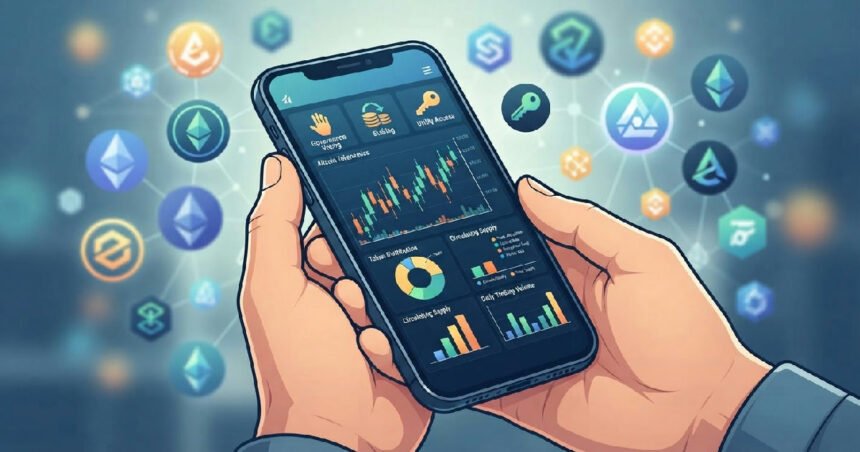
Altcoin tokenomics establishes the core economic framework for any cryptocurrency token beyond Bitcoin, defining its creation, distribution, and ultimate utility. This intricate design is critical for fostering and sustaining the token’s value within its specific blockchain ecosystem.
It integrates supply and demand principles, incentive structures, and governance mechanisms. This ensures the project’s long-term viability and aligns the interests of all participants. Understanding these models is essential for anyone engaging with the broader crypto market.
Understanding Altcoin Tokenomics Fundamentals
Tokenomics, a portmanteau seamlessly combining “token” and “economics,” represents the comprehensive study and strategic design behind a cryptocurrency’s economic model. This blueprint outlines how a digital token’s supply and demand will function within its ecosystem. It meticulously dictates the token’s issuance, its initial and ongoing distribution, and the specific utilities it offers users.
Moreover, tokenomics carefully considers the incentives crucial for driving desired holder behavior and engagement. This detailed framework aims to establish a self-sustaining economy for the digital asset, fostering long-term participation. Its primary objective is to maximise a token’s intrinsic value and overall utility.
This maximization is achieved by carefully shaping its supply and demand dynamics, setting appropriate transaction fees, and precisely assigning voting rights to its community. Such structured design underpins the token’s market presence and functionality.
An altcoin simply refers to any cryptocurrency that isn’t Bitcoin, encompassing a vast and diverse segment of the digital asset market. These digital assets frequently introduce novel functionalities and unique economic designs that distinguish them from their predecessor.
A utility token, a specific type of altcoin, is explicitly designed to provide access to particular functions or services within a blockchain ecosystem. Its value stems directly from what users can accomplish with it, such as paying fees or unlocking premium features within a platform.
Scarcity within tokenomics signifies a token’s deliberately limited availability, which, when combined with demand, significantly influences its perceived worth. This engineered scarcity is a core pillar of its economic model, central to value preservation.
Value, in this context, defines the perceived worth of an altcoin. It’s a complex interplay of its inherent utility, its engineered scarcity, market demand, and the overall health and adoption of its underlying technological ecosystem.
Crafting Value through Economic Models
Altcoin economic models are strategically designed to create and sustain value for token holders over time. They achieve this primarily through a combination of carefully engineered utility and meticulously controlled scarcity. These are further reinforced by various mechanical processes within the token’s operational framework.
Genuine utility is fundamental for an altcoin’s long-term value, providing a compelling reason for users to acquire and hold the token beyond mere speculation. Without practical use cases, demand can falter, and even deflationary mechanisms alone cannot reliably sustain a token’s worth.
Driving Demand with Utility
Tokens can grant users specific access to functionalities within a decentralised application (dApp) or platform. For instance, holding a particular token might be a prerequisite to use a decentralised storage service or to unlock premium content features.
Many altcoins serve as the designated currency for transaction fees, often known as “gas fees,” on their native blockchains. They also facilitate payments for services offered within their broader ecosystem, making them integral to day-to-day operations.
Staking is another key utility where holders actively lock up their tokens for a specified period. This action supports critical network operations, helps validate transactions, or provides essential liquidity to decentralised exchanges and protocols.
In return for their participation, stakers earn rewards, typically in the form of additional tokens. This mechanism directly incentivises both holding and active network participation, contributing significantly to overall network security and decentralisation.
Governance tokens empower holders with crucial voting rights, allowing them to actively participate in the decision-making processes of a Decentralised Autonomous Organisation (DAO) or protocol. The weight of an individual’s vote is typically proportional to the number of tokens held.
This powerful mechanism empowers the community to collectively influence vital aspects such as protocol upgrades, treasury allocation strategies, and other key operational parameters. It fosters a profound sense of ownership and commitment among the project’s user base, ensuring alignment.
It’s important to note the distinction: every governance token is inherently a utility token because it provides a function, but not every utility token includes governance features, as voting power is its distinguishing factor.
Finally, tokens can be strategically employed to incentivise desired behaviors within an ecosystem. These incentives are crucial for driving engagement and participation among both users and developers alike, fueling the project’s growth.
Engineering Scarcity for Worth
Scarcity is often meticulously engineered through sophisticated mechanisms that precisely manage a token’s total and circulating supply. This carefully controlled availability is a cornerstone of its economic model, directly influencing its perceived value.
The interplay of limited supply and consistent demand directly influences a token’s value. Projects often disclose their supply schedules to promote transparency regarding this critical aspect, giving holders insight into future availability.
The Role of Incentives and Governance
Beyond staking and direct access to services, tokens serve as powerful incentives designed to encourage desired behaviors within an ecosystem. These rewards are instrumental in driving engagement and participation among users and developers alike.
Tokens are used to incentivize desired behaviors within the ecosystem, fostering a self-sustaining cycle of value creation and community growth. This includes encouraging user engagement and broader participation, leading to a more robust platform.
Effective governance mechanisms, often directly tied to token holdings, ensure that a project evolves in line with its community’s interests and collective vision. This democratic approach helps maintain the project’s long-term relevance and adaptability in a rapidly changing environment.
The dual role of incentives and governance is crucial for fostering a robust and actively engaged community. This continuous and active participation directly translates into sustained demand and enhanced utility for the token, strengthening its position.
Sustaining Value and Strategic Considerations
While speculation undeniably exists in the volatile crypto market, genuine utility and robust tokenomics are what truly differentiate sustainable projects from fleeting ventures. Without these foundational elements, long-term value is challenging to maintain, often leading to instability.
A thorough understanding of a token’s comprehensive economic model is crucial for accurately assessing its viability and future potential. This understanding includes carefully considering its inherent utility, its engineered scarcity, and how it aligns with the overall ecosystem it supports.
A vibrant ecosystem, driven by active development and consistent community adoption, is undeniably vital for an altcoin’s enduring success. Strong tokenomics needs this supportive environment to thrive and expand its reach and influence effectively.
Ultimately, sustainable growth for any project relies heavily on its intrinsic value and a well-designed, robust economic model. A token’s fundamental design must ensure its long-term viability and provide genuine utility to succeed in the competitive digital asset space.
The Evolving Landscape of Altcoin Design
The dynamic field of altcoin tokenomics is constantly evolving, with new models continuously emerging to address challenges such as scalability, efficiency, and broader adoption. Designers are continually refining these frameworks to create more resilient and economically sound ecosystems for the future.
As the altcoin landscape matures and innovative approaches gain traction, the focus remains sharply on robust and viable token designs. Future developments will likely lead to more refined and effective economic frameworks, adapting to new technological and market demands.
Analysts across the industry are closely watching for innovative approaches to tokenomics, constantly seeking out novel solutions. They often highlight projects with compelling economic structures as key indicators of potential success and market leadership, guiding investment interest.