

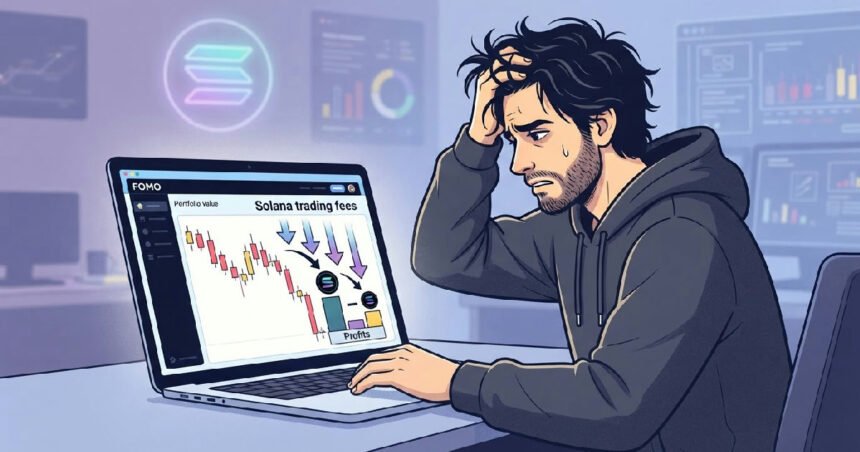
High transaction costs on decentralized applications are negating profits for the vast majority of retail traders on the Solana network, a new analysis reveals. A massive study by blockchain data firm Bitquery found that after accounting for app-level fees, a staggering 90% of users on the social trading platform FOMO failed to turn a profit.
The historical study, which tracked 829,539 wallets from January to October 2026, provides a stark look at the financial realities of high-frequency social trading. While Solana is known for its low base network fees, the extra charges levied by applications can quickly erode or eliminate narrow gains, a finding that challenges the perception of easy profits in DeFi.
Bitquery study shows how Solana trading fees impact profitability
The Bitquery report offers a before-and-after snapshot of user success. Before subtracting the app’s fees, about 15% of the nearly 830,000 wallets studied were in profitable territory. However, once the platform’s USDC-denominated charges were factored in, that figure plummeted to just 10%.
Even more telling is the impact on traders who were initially successful. The data showed that app fees pushed 32% of these pre-fee winning wallets into a net loss. It’s a clear illustration of how transaction costs can be the deciding factor between a small gain and a negative outcome, particularly for those operating with thin margins.
While poor trading decisions were the main source of user losses, accounting for the bulk of an estimated $395 million aggregate shortfall, the fees were not insignificant. The wallets in the cohort paid approximately $40 million in fees to the FOMO app alone, highlighting a significant and consistent drain on user capital.
How app fee structures impact small traders
The core of the issue lies in how trading applications structure their fees, which often hurts smaller participants the most. Unlike the minimal base fees of the Solana network itself, dApps like FOMO implement their own pricing models that can be substantial relative to the trade size.
According to FOMO’s published schedule, fees can vary based on the routing mechanism. Some routes carry a minimum fee of 0.95 USDC. For a trader making a small 10 USDC bet, this minimum represents a 9.5% charge before the trade even has a chance to become profitable. This creates a high barrier to success that many users may not fully appreciate.
This dynamic is crucial for understanding the real costs of using the Solana ecosystem. While the underlying technology is efficient, the application layer adds its own economic reality. The overall experience of managing a Solana wallet involves navigating these costs, which extend far beyond the blockchain’s own transaction charges.
Earlier analysis found similar high-cost patterns
The Bitquery findings are not an isolated incident. An earlier analysis published by blockchain intelligence firm Arkham Intelligence on May 22, 2024, pointed to the same phenomenon. Though smaller in scope, Arkham’s study of 11,000 wallets using the FOMO dApp painted a similar picture of prohibitive costs.
That report found the wallets had collectively paid over $1.5 million in transaction fees. This worked out to an average of $136 per wallet, a figure Arkham noted was “a lot for a Solana user.” The firm concluded that for a wallet to be profitable, its gains from betting on crypto price movements had to overcome this significant fee hurdle.
Taken together, the two reports from Arkham and Bitquery suggest a persistent and widespread issue. The problem of high app-level fees eating into trader profits has not diminished over time; if anything, the larger scale of the Bitquery study shows the impact has only become more pronounced as more users have entered the ecosystem.
The challenging reality of social trading
Platforms like FOMO are part of a growing trend of social trading, where users can see the activity of other traders and attempt to follow their strategies. The FOMO app, operated by FOMO Labs, allows users to follow accounts but does not automatically copy their trades, forcing each user to execute their own orders and incur the associated fees.
This model’s profitability is now in question. The data suggests that even if a user is following a genuinely successful trader, the fees on their own buy and sell orders can wipe out any advantage gained from the signal. This undermines the core value proposition of social trading, revealing that access to information does not guarantee success when structural costs are high.
The very name of the app, FOMO (Fear Of Missing Out), speaks to the psychological drivers at play. This pressure can encourage frequent, small-scale trading, which is the exact behavior most penalized by fee structures with high minimums. Ultimately, the prevailing investor sentiment and desire to chase trends can lead traders directly into high-cost scenarios that make profitability incredibly difficult.
Outlook for Solana dApps and their users
The revelations from these studies present a challenge for the Solana ecosystem. While developers praise its speed and low network costs, the end-user experience on many dApps is defined by a different set of fees. If retail users consistently lose money, not just from market volatility but from the cost of participation, it could hamper long-term adoption.
The path forward likely involves greater transparency from applications and more education for users. Displaying an