

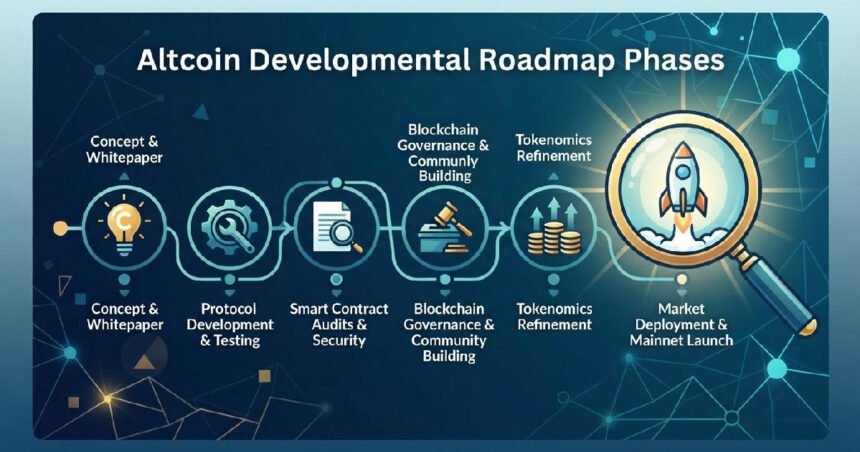
Navigating the developmental roadmap of an emerging altcoin project offers a clear understanding of its journey from initial concept to full market deployment. This strategic document outlines a project’s vision, technical plans, and growth strategy, serving as a blueprint for all stakeholders.
It details the various stages, technologies involved, and the project’s evolution over time. For anyone tracking the volatile cryptocurrency market, grasping these phases is fundamental to assessing potential.
Altcoin developmental roadmap phases explained
An altcoin developmental roadmap is essentially a strategic blueprint, outlining the planned trajectory and major milestones of a cryptocurrency project. It serves as a comprehensive guide for the development team, potential investors, and the broader user community.
This document details specific tasks, the underlying technologies, and the intended progression of the project. A well-constructed roadmap establishes clear objectives, defines expected timelines, and provides a coherent plan of action for the altcoin’s evolution.
Core definitions in crypto development
An altcoin refers to any cryptocurrency other than Bitcoin. This term is a contraction of “alternative coin” and covers a vast range of digital currencies designed to offer improvements or different functionalities. Some definitions also exclude Ethereum due to its significant market capitalization and established ecosystem.
A whitepaper provides a detailed summary of a blockchain or crypto project. It explains the project’s purpose, technological mechanisms, the problems it aims to solve, its tokenomics, and use cases, often incorporating the roadmap. Whitepapers are vital for investors seeking to understand a project’s viability and transparency.
Testnets are separate, parallel versions of a blockchain used by developers for building, testing, and debugging applications without risking real funds. Tokens on a testnet hold no market value. Conversely, a mainnet signifies a fully developed and independently operating blockchain running its own live network with real transactions and economic value.
Key phases in an altcoin’s lifecycle
The lifecycle of an altcoin project generally moves through several distinct phases, from initial concept to market deployment. These stages are typically detailed within its developmental roadmap, offering structure to its progression.
The first stage involves the project’s ideation and whitepaper creation. Here, teams identify specific problems not adequately addressed by existing solutions and formulate a unique value proposition for their altcoin. Emerging altcoins often aim to solve real-world problems.
This phase also includes crucial market research to identify gaps and opportunities, followed by the assembly of a capable team with relevant expertise. The creation of a detailed whitepaper solidifies the project’s vision, technology, tokenomics, and initial roadmap.
Development and prototyping
Building the core technology and ensuring its functionality and security mark the next critical phase. This includes defining the blockchain architecture, such as consensus mechanisms like Proof of Work or Proof of Stake, alongside data storage and transaction processing protocols.
Developers then focus on core protocol development, coding fundamental functionalities like transaction validation and coin creation. Smart contracts are also developed and implemented to automate processes and enable trustless transactions. Before a full launch, projects deploy a testnet.
This test version allows developers to experiment, test features, and rectify bugs without financial risk. Rigorous security audits of smart contracts and the core protocol are conducted by independent third parties to identify and mitigate vulnerabilities, a crucial step for reliability.
Funding and community building efforts
Securing capital and cultivating a supportive community are paramount for an altcoin project’s success. This phase begins with refining the tokenomics, which involves finalizing the token distribution model, vesting schedules, and incentive mechanisms to ensure sustainability and fair allocation.
Funding rounds follow, starting with seed or private sales to early investors, venture capitalists, or strategic partners. Public sales, such as Initial Coin Offerings (ICOs), Initial Exchange Offerings (IEOs), or Initial DEX Offerings (IDOs), are then conducted to raise capital more broadly and distribute tokens to the public. The choice of funding method often depends on the desired level of decentralization and platform involvement.
Simultaneously, extensive community engagement and marketing efforts are undertaken to build a strong base of supporters. This involves leveraging social media, forums, airdrops, and content marketing to generate awareness and drive adoption. Technology and adoption continue shaping market trends.
Strategic partnerships with other projects, businesses, or influencers are also formed to expand the altcoin’s reach and utility. These collaborations are essential for integrating the project into the wider blockchain ecosystem and fostering its long-term growth.
Mainnet launch and ecosystem development
The mainnet launch represents a significant transition for any altcoin project, moving from a testing environment to a live, operational network. This deployment allows for real transactions and establishes economic value, demonstrating the project’s maturity and readiness for public use.
Following the mainnet launch, if tokens were initially issued on another blockchain, a token swap or migration typically occurs. This process enables holders to exchange their temporary tokens for native tokens on the new mainnet, solidifying their ownership within the project’s own ecosystem.
Accessibility for trading is then ensured through exchange listings, where the altcoin becomes available on various cryptocurrency exchanges. This provides necessary liquidity and allows a broader audience to acquire and trade the asset, influencing its market presence.
Developers are actively encouraged to build decentralized applications (dApps) on the platform, supported by Software Development Kits (SDKs) and dedicated developer assistance. This fosters ecosystem growth by expanding the network of users, developers, and partners, strengthening the altcoin’s utility. Factors like market pressure can also influence development.
Finally, governance implementation involves establishing and activating the project’s model for decision-making. This could be on-chain, off-chain, or a hybrid approach, allowing community participation in the project’s future direction and ensuring its decentralization progresses over time.
Beyond launch: growth and maturity
After the mainnet launch, an altcoin project enters an ongoing phase focused on long-term sustainability, scaling, and further decentralization. This stage is characterized by continuous development and upgrades, where new features, security enhancements, and protocol improvements are implemented.
These updates are often based on iterations of the roadmap and valuable community feedback. Scaling solutions are actively developed and integrated to enhance transaction throughput and efficiency, utilizing methods like Layer 2 solutions to manage network demands effectively.
A key objective during this phase is the gradual reduction of central control, increasing community involvement in governance and network operations. This push towards greater decentralization strengthens the project’s core tenets and resilience.
Driving real-world use cases and expanding the altcoin’s utility within its ecosystem and beyond are continuous efforts. This user adoption and utility expansion are critical for sustained growth. Ultimately, fostering community-led initiatives helps create a self-sustaining ecosystem driven by collective proposals and ongoing development.