

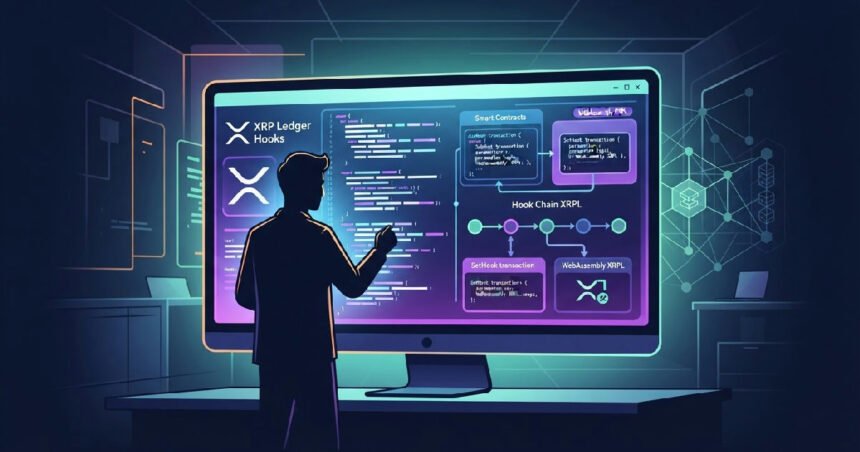
XRP Ledger Hooks are a significant development for the XRP Ledger (XRPL), introducing advanced, custom transaction logic directly onto the blockchain. These Hooks function as small, efficient WebAssembly modules, effectively bringing smart contract-like capabilities to the XRPL’s native protocol, expanding its utility for complex financial operations.
This integration allows developers to define custom, programmable rules that execute both before and after transactions. It marks a fundamental shift, moving beyond basic transaction processing to enable sophisticated automation and bespoke financial instruments directly on a layer-1 blockchain.
Introducing XRP Ledger Hooks
At its core, an XRP Ledger Hook represents a piece of code attached to an XRPL account. This code dictates specific actions or conditions that must be met for transactions interacting with that account. Think of them as on-ledger gatekeepers or automated assistants, ensuring compliance or triggering subsequent events based on predefined criteria.
The concept fundamentally changes how value can be managed and transferred within the XRPL ecosystem. Unlike some other blockchain smart contract platforms, XRPL Hooks are deeply embedded within the ledger’s core architecture. This native integration is designed to ensure high performance and efficiency.
These Hooks enable functionalities that were previously impossible or required off-ledger solutions. They extend the XRPL’s capabilities without compromising its speed or cost-effectiveness. This makes the ledger more versatile for a wider range of financial applications.
How XRPL Hooks operate
Understanding the mechanical operation of XRP Ledger Hooks reveals their architectural elegance and power. They are designed as a Layer 1 feature, indicating a deep integration into the fundamental protocol of the XRPL. This foundational approach ensures maximal efficiency and inherent security for their execution.
This deep integration means that Hooks benefit directly from the XRPL’s established performance characteristics, including its rapid transaction finality and low operational costs. By embedding custom logic at the protocol level, the overhead typically associated with executing smart contracts on separate layers is significantly reduced, leading to a more streamlined and responsive environment for complex operations.
Furthermore, positioning Hooks as a core ledger component enhances their security profile. They leverage the XRPL’s battle-tested consensus mechanism and decentralized nature, mitigating risks often found in off-chain or less integrated solutions. This architectural decision underpins the reliability and trustworthiness of Hook-enabled transactions.
Architecture and integration
Hooks are essentially WebAssembly (WASM) modules installed onto specific XRPL accounts. This choice of WASM is critical, as it provides a secure and high-performance environment for running code. The XRPL’s core server software, known as rippled, has been modified with the Hooks Amendment to support this functionality.
Within the rippled environment, a WebAssembly runtime, Wasmer.io, is embedded. This runtime is responsible for executing the Hook code compiled from languages like C or AssemblyScript. This three-part stack — rippled, the Hook Runtime, and the Hooks themselves — forms a robust and efficient execution environment for advanced transaction logic.
This structure ensures that Hooks can process complex logic with minimal overhead. The native integration also means they benefit from the XRPL’s inherent security and decentralization. It’s a design choice that prioritizes both functionality and network stability.
Deployment and lifecycle
Developers begin by writing their desired Hook logic in a WebAssembly-compatible language. This could be C, AssemblyScript, or even specialized languages like HookScript. The flexibility in language choice lowers the barrier to entry for many programmers, fostering broader adoption.
Once the logic is written, it is compiled into a .wasm file. This compiled file is then deployed onto an XRPL account using a specific transaction type: the SetHook transaction. This transaction effectively binds the custom logic to the chosen account, making it active on the ledger.
Hooks aren’t static; they can be updated or deleted from an account at any time. Subsequent SetHook transactions allow for modification, providing flexibility and enabling iterative development. This lifecycle management is crucial for adapting to evolving needs or fixing potential issues.
A single XRPL account can host a sequence of up to 10 Hooks, forming a “Hook Chain.” When a transaction interacts with an account, these Hooks execute sequentially from slot 0 to slot 9. This chaining mechanism allows for highly modular and layered logic, increasing complexity and utility.
Execution process
When a transaction attempts to interact with an XRPL account that has Hooks installed, the Hooks spring into action. They execute based on the predefined rules and their position within the Hook Chain. This execution can occur either before the main transaction is processed or after it completes.
The execution environment is designed to be deterministic and secure. Each Hook’s execution is sandboxed, preventing malicious code from affecting the broader ledger. This isolated environment protects the integrity of the XRPL while still allowing for powerful custom actions.
Hook Parameters play a vital role in customizing Hook behavior without altering the underlying code. These key-value pairs are set during the initial SetHook transaction. They allow developers to configure a Hook’s specific actions, such as spending limits or beneficiary addresses, without requiring a recompile and re-upload of the WASM file.
This parameterization adds another layer of versatility and efficiency. It means a single, well-designed Hook can serve multiple purposes, configured differently for various accounts or use cases. This reduces the need for numerous unique Hook deployments, streamlining the development process.
Unlocking advanced transaction logic
The introduction of XRP Ledger Hooks significantly expands the possibilities for how assets and value are managed on the XRPL. This advanced transaction logic enables a new generation of decentralized applications and financial instruments, propelling the XRPL closer to becoming a comprehensive platform for digital assets and smart contracts.
By allowing programmable rules to be directly enforced at the ledger level, Hooks empower developers to build solutions that are not only innovative but also inherently trustless and transparent. This capability extends beyond simple payments, supporting intricate financial workflows, automated agreements, and dynamic asset management, all without relying on intermediaries.
This shift opens doors to sophisticated use cases previously unfeasible or overly complex on the XRPL. From custom escrow conditions to automated compliance checks and novel token functionalities, the ledger’s utility is broadened, fostering an environment where complex financial engineering can thrive securely and efficiently within a decentralized framework.
Programmable rules and automation
With Hooks, developers can implement sophisticated rules directly on the ledger. These rules can dictate everything from transaction blocking or allowing to modifying internal account states. It facilitates a level of automation previously unattainable on the XRPL’s native layer.
For example, a Hook could enforce spending limits on an account, automatically block transactions to blacklisted addresses, or even emit new transactions based on specific triggers. This foundational capability supports a wide array of automated financial mechanisms. This includes concepts such as escrow services or subscription models.
The ability to program these rules at the protocol level ensures greater trust and transparency. All logic is on-chain and auditable, aligning with the principles of decentralized finance. It removes reliance on centralized intermediaries for complex transaction processes.
Real-world use cases
The practical applications of XRP Ledger Hooks are extensive and diverse. Carbon offset programs could utilize Hooks to automatically burn or transfer tokens when certain environmental criteria are met. This would create a verifiable and automated system for ecological initiatives.
Savings plans could be hardcoded onto the ledger, automatically transferring a portion of incoming funds into a separate, locked account. XRP price predictions often overlook these underlying technological advancements. This ensures disciplined savings without requiring manual intervention.
Similarly, royalty distribution systems for digital content could be automated. Creators would receive their share instantly upon each sale or usage, without needing to trust a third party. This opens new revenue streams for artists and content producers in a transparent manner.
Market implications and future outlook
The rollout of XRP Ledger Hooks positions the XRPL as a more formidable competitor in the smart contract platform space. While the XRP Ledger has always been known for its speed and efficiency in payments, Hooks add a crucial layer of programmable functionality. This allows it to support more intricate decentralized applications.
This development could attract a new wave of developers and projects to the XRPL ecosystem. The ability to deploy custom logic directly on a high-performance ledger offers a compelling proposition. It expands the types of use cases that can be built and scaled on the platform.
Increased adoption and innovation on the XRPL could, in turn, influence the demand and utility of XRP. The native digital asset of the ledger plays a key role in transaction costs and ecosystem participation. A more robust and versatile XRPL benefits the entire network. Its XRP price stability and efficient transaction processing are further enhanced by these capabilities.
Concluding summary
XRP Ledger Hooks represent a pivotal advancement, transforming the XRPL into a more dynamic and versatile blockchain platform. By embedding smart contract-like capabilities directly into the layer-1 protocol, they enable unprecedented levels of custom transaction logic and automation. This opens doors for innovative financial products and decentralized applications.
The deep integration of WebAssembly modules and the flexible deployment mechanisms underscore the XRPL’s commitment to performance and developer utility. As the ecosystem continues to mature, Hooks are set to play a central role in driving new use cases and fostering greater adoption across the digital economy. XRP gains capital in this evolving landscape, highlighting investor confidence in the platform’s future.
What is a Hook on the XRP Ledger?
A Hook is a small, efficient WebAssembly (WASM) module deployed on an XRPL account, enabling custom transaction logic. It allows developers to define rules that execute before or after transactions, adding smart contract-like capabilities to the ledger.
How do XRPL Hooks differ from smart contracts on other blockchains?
Unlike some other platforms, XRPL Hooks are deeply integrated into the ledger’s core architecture as a Layer 1 feature. This native integration prioritizes high performance, efficiency, and security, leveraging the XRPL’s inherent speed and low transaction costs.
What languages can be used to write XRPL Hooks?
Developers can write Hook logic in WebAssembly-compatible languages such as C, AssemblyScript, or HookScript. This flexibility aims to lower the barrier to entry for a wide range of programmers.
Can Hooks be updated or removed?
Yes, Hooks are not static. They can be updated or deleted from an XRPL account at any time using subsequent SetHook transactions, providing flexibility for iterative development and adaptation to evolving requirements.
What are some real-world applications of XRPL Hooks?
Hooks enable various applications like automated carbon offset programs, disciplined savings plans, and transparent royalty distribution systems for digital content, all executed directly on the ledger without intermediaries.