

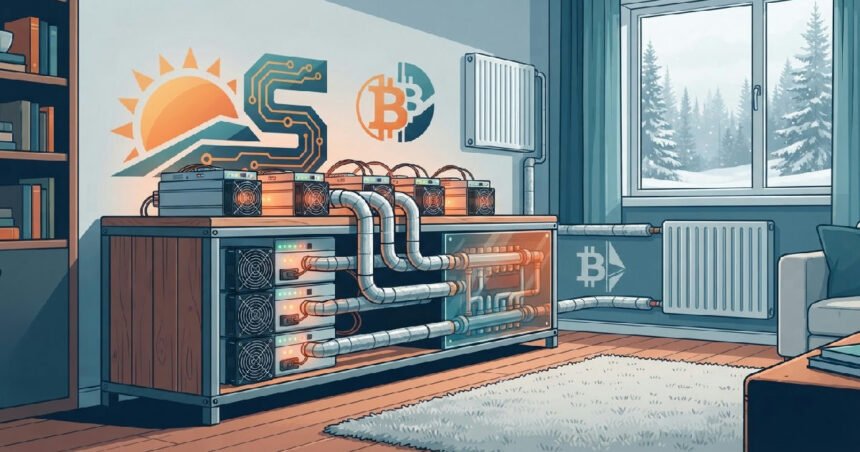
In a significant move towards sustainable energy solutions, several Finnish companies are leveraging the heat generated by Bitcoin miners to warm homes and district heating systems across the country.
This innovative approach, spearheaded by firms like SunBit, aims to offset electricity costs through Bitcoin earnings, effectively providing “free heat” for properties, though its long-term viability remains tied to the volatile price of Bitcoin. The initiative continues to gain traction, particularly with individual homeowners in Finland’s cold climate.
Integrating Bitcoin Mining for Home Heating
Finland’s harsh winters and existing district heating infrastructure create an ideal environment for repurposing the substantial waste heat from Application-Specific Integrated Circuit (ASIC) miners. Companies like SunBit, Marathon Digital (MARA), Hashlabs Mining, Terahash Energy, and MinersLoop are actively deploying systems to integrate this byproduct into heating networks. This strategy not only addresses heating demands but also offers environmental and economic benefits.
SunBit, a Finnish firm, offers a proprietary solution known as the Bitcoin Boiler. It’s designed to capture the heat output from individual Bitcoin mining machines. These systems circulate water, heated up to 60°C by the miners, through a building’s radiators and floor pipes, much like traditional oil or gas boilers.
Founder and CEO Elmeri Suomi reported this week that SunBit has installed 30 such systems, mostly in Finland, since their first production batch in 2025. One notable example is a 180-square-meter house in Nokia, Finland. It has entirely disconnected from its district heating network, relying solely on a Bitcoin miner for warmth.
Diverse applications for Bitcoin heat
Beyond individual homes, the concept extends to commercial and industrial applications. In the Netherlands, SunBit’s first export project in Lekkum in 2025 saw a miner replace gas heating at a commercial property. Finnish locations like Kotka and Tampere also host these systems.
An old manor house in Tampere, Finland, uses mining heat to maintain a 1,500-liter water tank at 50°C to 60°C, replacing wood heating. The versatility of these systems is also evident in a 3,000-square-meter industrial hall in Vimpeli. It runs a Bitcoin miner alongside an air-to-water heat pump, soaking up surplus power from a 30-kilowatt solar array.
The Economics of “Free Heat” from Bitcoin Miners
The central premise behind these systems is straightforward: if the Bitcoin generated by the miner covers the electricity consumed, the homeowner essentially receives heat without an ongoing net energy bill. However, the initial investment is significant. SunBit’s Bitcoin Boiler systems cost roughly $20,000 or more to install.
The financial advantage largely depends on prevailing Bitcoin prices, electricity costs, and the overall computational power competing for mining rewards. According to Elmeri Suomi, the heating functionality itself remains constant, regardless of market fluctuations. He stated, “The heating itself works regardless of the market, and only the payback time moves.”
Calculating profitability and payback
SunBit’s financial calculator illustrates this dynamic, assuming a 495-terahash Bitmain Antminer S21 XP Hydro running nonstop. This machine consumes approximately 46,400 kilowatt-hours annually. At an electricity cost of about 11 cents per kilowatt-hour, the annual power bill totals around $5,200.
With Bitcoin trading at roughly $82,000 and network computing power at 1,040 exahashes per second, the miner could generate about one-twelfth of a Bitcoin per year. After SunBit’s 10% service fee, this translates to about $6,100 in Bitcoin value for the owner. The fee covers 24/7 monitoring and optimization for Finland’s spot power market.
If an owner opts out of the service, they retain the full one-twelfth of a Bitcoin, estimated at $6,800 annually. This scenario potentially yields a surplus of approximately $900 over the modeled electricity cost, before accounting for the system’s initial purchase price. SunBit calculates the owner’s break-even point to be just under $70,000 for Bitcoin.
For comparison, a house burning 2,300 liters of heating oil annually, at about $2.19 per liter, faces a bill of approximately $5,000. Replacing this with a Bitcoin miner could eliminate the fuel bill and, under current assumptions, generate about $920 in mining income after electricity costs. This leads to a payback period of around three and a half years before maintenance or financing.
Competitive Landscape: Heat Pumps and District Heating
While Bitcoin mining offers a novel heating solution, it faces competition from established alternatives. These include highly efficient heat pumps and traditional district heating systems. Heat pumps, for instance, are highly efficient, producing 2.5 to 3 kilowatt-hours of heat for every kilowatt-hour of electricity consumed.
In contrast, a Bitcoin miner converts each kilowatt-hour of electricity into exactly one kilowatt-hour of heat. This efficiency difference means that for a house requiring 25,000 kilowatt-hours of heat annually, an air-to-water heat pump would incur running costs of about $1,100. District heating for the same consumption would be around $3,170.
Miner advantages in cold climates
If a miner were run only long enough to provide 25,000 kilowatt-hours of heat, it would generate approximately $490 more than its electricity costs. Elmeri Suomi highlights a distinct advantage for miners during Finland’s severe winters. He explained that a miner’s heat output does not fluctuate with external temperatures.
Unlike air-source heat pumps, which see their efficiency drop significantly in extreme cold, a Bitcoin miner maintains 100% conversion of electricity to heat, up to 60°C, throughout the year, even at –25°C. This consistent performance can be crucial in regions with prolonged deep freezes.
However, the running cost of a Bitcoin miner is inherently linked to two external factors: Bitcoin’s market price and the overall computing power on the network.
Suomi admits that this dependency creates a unique financial variable that heat pumps do not share. The estimated payback period for these systems can therefore range from three to six years for installed costs between $20,400 and $31,400.
Navigating Bitcoin’s Halving and Market Volatility
A significant factor influencing the long-term profitability of these Bitcoin-heated homes is the upcoming 2028 Bitcoin halving event. Scheduled for spring 2028, this event will reduce the reward for mining a new block from 3.125 to 1.5625 Bitcoin, effectively cutting miner revenue in half. This could occur before homeowners fully recoup their initial investment, introducing considerable financial uncertainty.
The miner profitability stands to be significantly impacted. SunBit’s current financial models do not incorporate the effects of this halving, as the company avoids making future price or difficulty predictions. “I personally don’t want to give price predictions and difficulty predictions,” Suomi confirmed.
He noted that SunBit instead educates every customer on the halving’s historical impact on profitability. This transparent approach ensures customers are aware of the inherent risks. If SunBit’s current input assumptions remain constant after the halving, mining income per kilowatt-hour would plummet from approximately 13 cents to about 7 cents. This figure falls below the 11-cent power price.
This means the heat would then cost the owner roughly 4 cents per kilowatt-hour, close to what an air-to-water heat pump costs to run at SunBit’s assumed efficiency. For households installing a system this winter, they would experience approximately 18 months of current profit margins before the halving takes effect.
After the 2028 halving, a miner-heated house in Finland would reportedly need Bitcoin to trade above roughly $131,000 to maintain the equivalent of “free heat.” This represents a substantial 60% increase above Friday’s price. The reliance on a “number go up” narrative becomes a very literal heating plan for these pioneering Finnish homes.
Broader Implications for Finland’s Energy Future
The integration of Bitcoin mining with heating systems in Finland extends beyond individual home solutions. It presents broader environmental and energy security advantages for the nation. By repurposing waste heat from Bitcoin mining, Finland can reduce its dependence on traditional heating sources like peat, coal, biomass, and oil.
This shift leads to a significant reduction in carbon emissions. Each megawatt of recycled heat from Bitcoin mining can reportedly prevent 455 fewer metric tons of CO₂ emissions annually, potentially reaching 720 metric tons if carbon-free energy is utilized. Companies like Marathon Digital (MARA) and Hashlabs Mining are implementing large-scale projects.
These projects feed waste heat into existing district heating networks. MARA’s systems are already warming homes for approximately 80,000 residents in Finland, including a pilot project that supplied heat to 11,000 homes in Satakunta. This initiative later expanded to cover an additional 67,000 residents.
Hashlabs Mining’s first Finnish site has provided heat to 15,000 residents since August 2024. Analysts now estimate that mining heat warms homes for around 140,000 Finns, constituting roughly 2.5% of the country’s population. This widespread adoption underscores the potential of Bitcoin mining to contribute to national energy goals.
Jaran Mellerud, Co-founder of Hashlabs Mining, emphasized this, stating, “With the help of industrial consumers like Bitcoin miners, Finland can increasingly use its massive nuclear power plant to produce heat.” He also noted that Bitcoin mining offers the “best provider of reliable, high-temperature water for district heating.”
The economic benefits also play a crucial role. This initiative offers a cost-effective heating solution that can lower expenses for residents and create new revenue streams for mining companies. Moreover, by utilizing local heat sources, Finland can enhance its energy security, reducing its reliance on imported fuels, particularly amidst geopolitical uncertainties.
The overall Bitcoin market, with its periodic volatility, constantly influences the viability calculations for these energy projects.
Alen Makhmetov, also a Hashlabs Co-founder, mentioned that some district heating plants faced bankruptcy after Russia invaded Ukraine, highlighting the need for innovative and cheaper solutions like Bitcoin mining. This blend of technological innovation and environmental consciousness positions Finland as a global leader in sustainable Bitcoin mining practices. The model demonstrates how digital assets can play an unexpected but tangible role in traditional infrastructure.